
Bible stories for kids
The Story of Zacchaeus for Kids
Zacchaeus was a rich chief tax collector in Jericho who was too short to see Jesus over the crowd, so he climbed a sycomore tree, and Jesus called him down (Luke 19:1-10). Here is the story of Zacchaeus for kids and children, to read aloud, hear narrated or see as a picture storybook, with the King James words beside every scene.
The storybook opens full screen, one page at a time. The whole story is also below, with the Bible text beside it.
Where it is in the Bible
- Bible passages
- Luke 19:1-10. Only the book of Luke has this story.
- Who is in it
- Jesus, Zacchaeus the chief tax collector, and the crowd in Jericho
- Where it happens
- Jericho, a city near the Jordan river, on the road up to Jerusalem
- When
- On Jesus' last journey to Jerusalem, a little before he rode into the city (Luke 19:11, Luke 19:28)
- Key verse
- “For the Son of man is come to seek and to save that which was lost.” (Luke 19:10, KJV)
The story
This story is true. It is in the Bible, in the book of Luke.
Have you ever been too small to see over a crowd? In this story, a man is too little to see Jesus, so he climbs up a tree. Then Jesus looks up, and calls to him. Listen for what Jesus says: Zacchaeus, make haste, and come down.
Scene 1 of 5
A rich man in Jericho
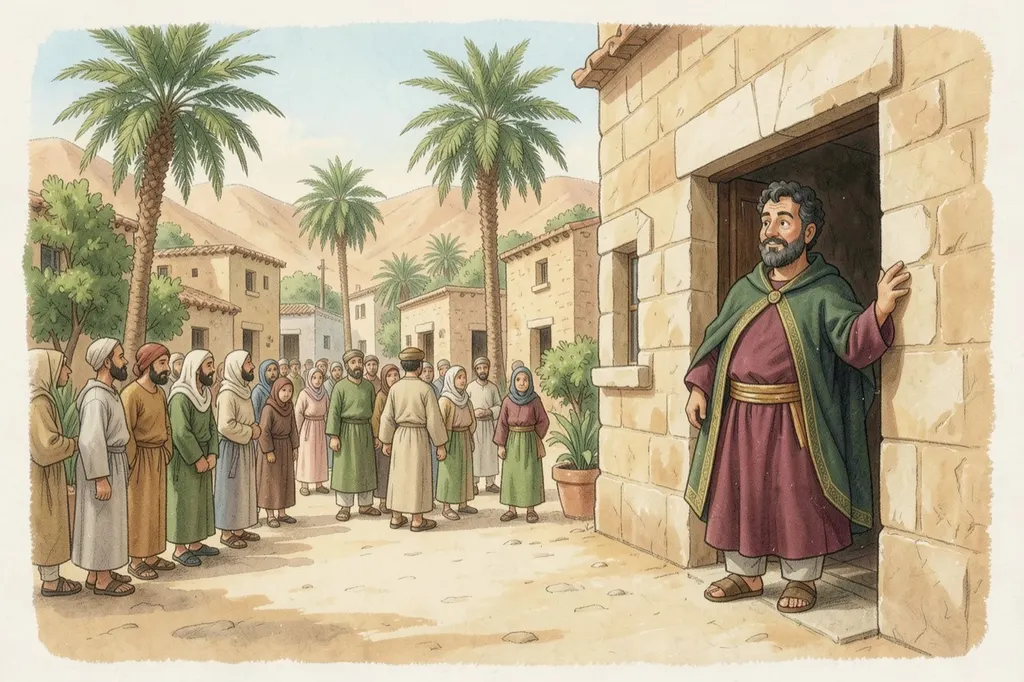
Jesus was on his way to Jerusalem, the great city where God's temple stood. A big crowd of people went along with him.
On the way, Jesus came to a city called Jericho, and he was passing through it.
And in Jericho, the Bible says:
“there was a man named Zacchaeus, which was the chief among the publicans, and he was rich.”
A publican was a tax collector. Taxes are money that people had to pay to their rulers. In those days, the land was ruled by the Romans, and the publicans collected the money for them.
Chief means the one in charge. So Zacchaeus was in charge of the other tax collectors.
Many people did not like the publicans. Some publicans took more money than they were meant to, and kept the extra for themselves. The Bible doesn't tell us how Zacchaeus became so rich.
But now Jesus had come to his city.
Scene 2 of 5
Up a sycomore tree
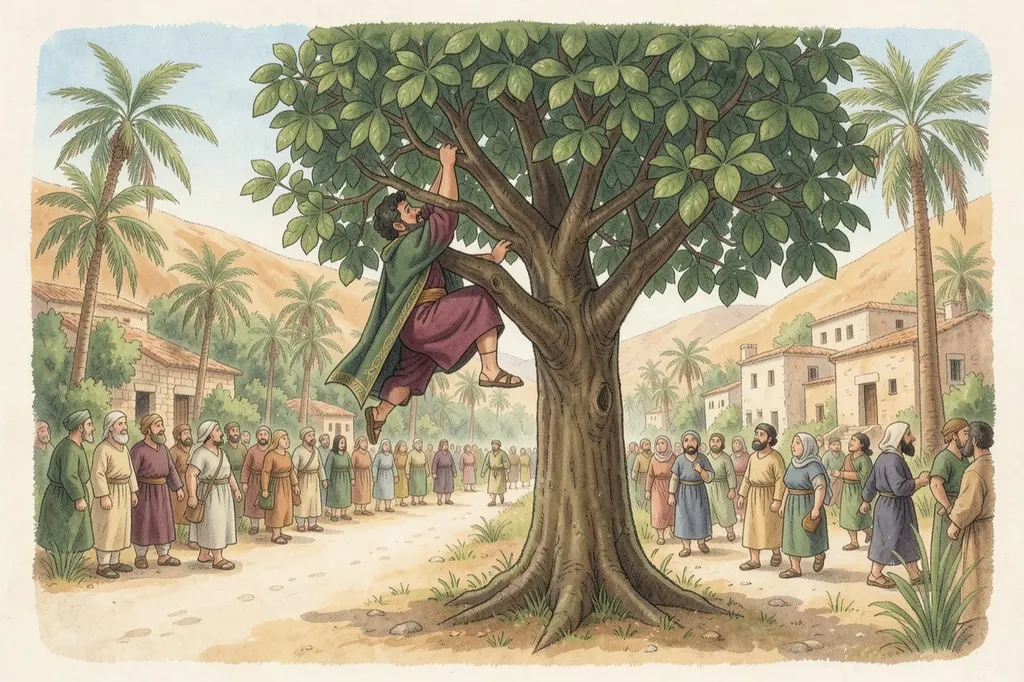
Zacchaeus wanted to see Jesus. He wanted to see who this Jesus was. But there was a problem:
“he sought to see Jesus who he was; and could not for the press, because he was little of stature.”
The press means the crowd, all pressed together. And little of stature means short.
However hard Zacchaeus tried, he could not see over all those people.
So Zacchaeus ran. He ran on ahead, in front of the crowd.
Beside the road was a sycomore tree. A sycomore is a kind of fig tree, with a wide trunk and strong, spreading branches.
And Zacchaeus, the rich chief of the tax collectors, climbed right up into it.
Jesus was going to pass that way. So Zacchaeus sat up in the tree, among the leaves, and waited.
Scene 3 of 5
Make haste, and come down
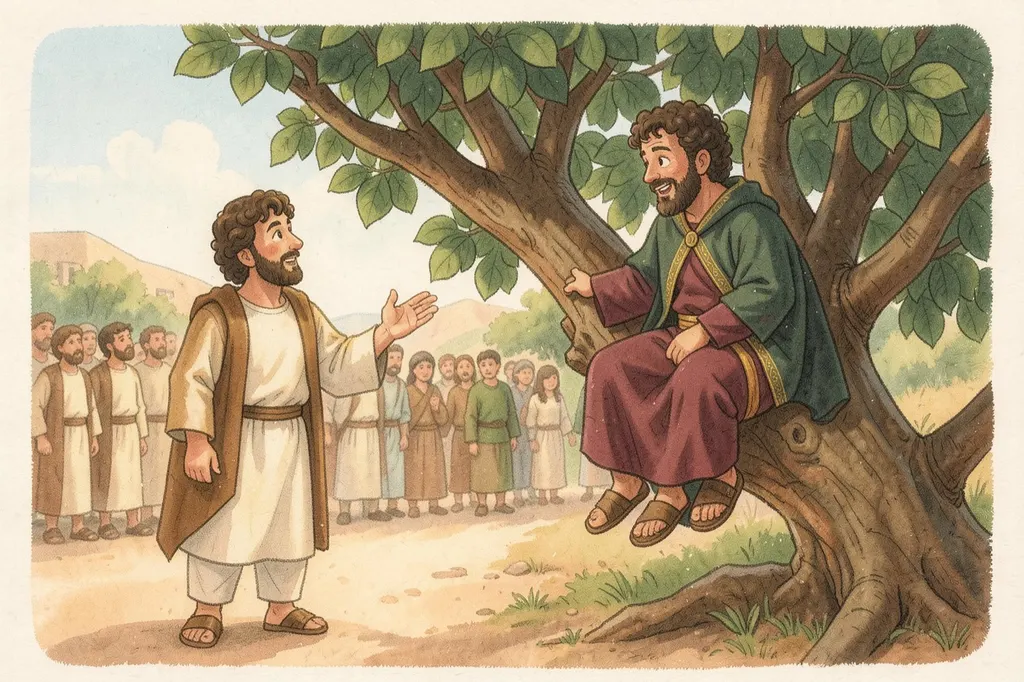
Along came the crowd. And along came Jesus.
Jesus came to the place where the tree was. He looked up. And he saw Zacchaeus, up in the branches.
What do you think Jesus said? Jesus called him by his name:
“Zacchaeus, make haste, and come down; for to day I must abide at thy house.”
Make haste means hurry. And abide means stay.
Jesus knew his name. And Jesus said he must stay at Zacchaeus' house, that very day.
So Zacchaeus hurried. Down, down, down he came, out of the tree.
And Zacchaeus "received him joyfully." That means he welcomed Jesus, and he was very glad.
Scene 4 of 5
Half of my goods
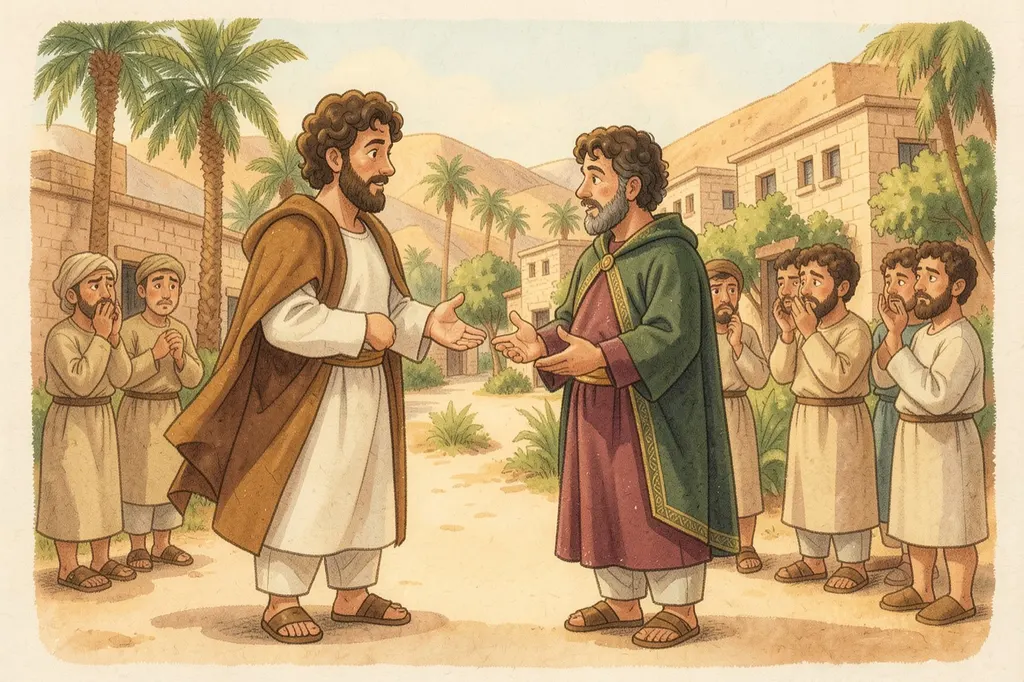
But not everyone was glad. When the people saw it, they did not like it at all:
“they all murmured, saying, That he was gone to be guest with a man that is a sinner.”
To murmur is to grumble, in low, cross voices. A sinner is someone who does wrong things. The people did not think Jesus should be the guest of a man like Zacchaeus.
Then Zacchaeus stood, and spoke to Jesus:
“Behold, Lord, the half of my goods I give to the poor; and if I have taken any thing from any man by false accusation, I restore him fourfold.”
Goods are the things a person owns. Half of everything Zacchaeus had, he would give to people who were poor.
False accusation means saying something untrue about someone, to take what is theirs. And fourfold means four times as much.
If Zacchaeus had taken one coin from anyone in an unfair way, he would give that person four coins back.
Scene 5 of 5
To seek and to save
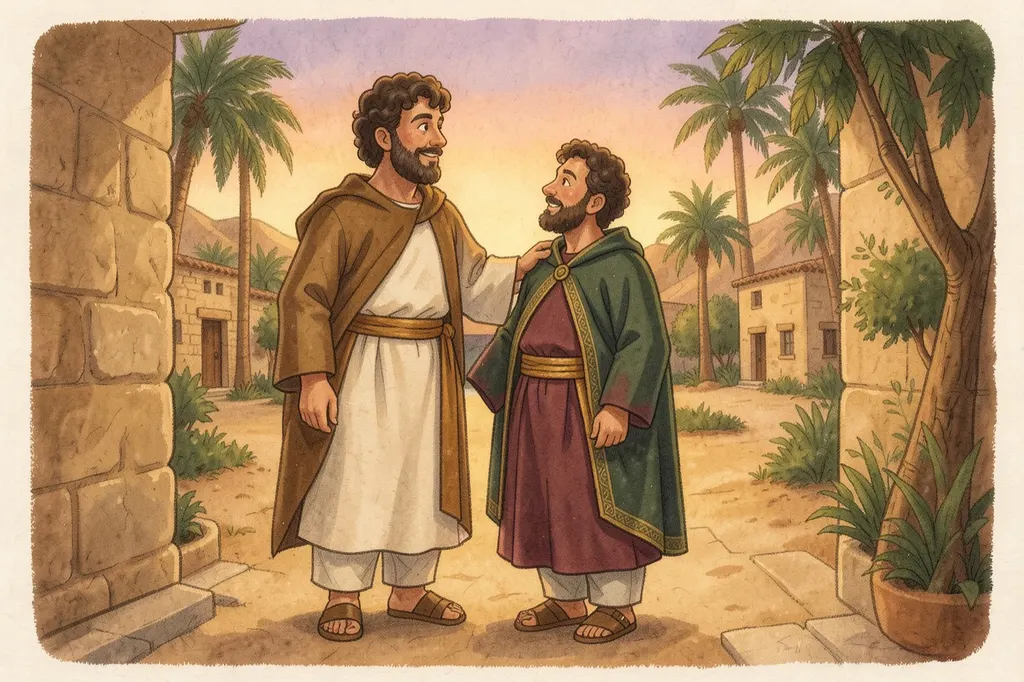
Then Jesus spoke to Zacchaeus:
“This day is salvation come to this house, forsomuch as he also is a son of Abraham.”
Salvation means being saved by God.
Abraham was the father of God's people, long, long ago. So a son of Abraham means Zacchaeus belonged to God's people too.
Then Jesus said:
“For the Son of man is come to seek and to save that which was lost.”
The Son of man is a name Jesus used for himself. To seek means to look for.
And lost means far away from God, the way a lost sheep is far away from its shepherd.
Do you remember what Jesus said to the man in the tree? Zacchaeus, make haste, and come down.
Can you say it too? Zacchaeus, make haste, and come down.
Zacchaeus was too little to see over the crowd. So he climbed up a tree.
And Jesus looked up, and called him by his name.
For the Son of man is come to seek and to save that which was lost.
How to explain the story of Zacchaeus to a child
Start with the tree. Zacchaeus wanted to see Jesus so much that he climbed one (Luke 19:4), but Jesus was the one who stopped, called him by name and came to his house. Luke doesn't say anyone told Zacchaeus to give or repay; he offered. Jesus explained what had happened himself: "the Son of man is come to seek and to save that which was lost" (Luke 19:10).
What this story shows about God
For grown-ups. The story itself never states a lesson, so here it is, with the verses behind it.
Jesus came to seek and to save the lost
Zacchaeus climbed a tree to see Jesus, but Jesus said why he had come: to look for people who are far from God, and to save them.
Luke 19:10Jesus calls his own by name
Jesus looked up into the tree and called Zacchaeus by his name. Jesus said a good shepherd calls his own sheep by name.
Luke 19:5; John 10:3God welcomes the people others turn away from
The crowd called Zacchaeus a sinner. Jesus went to his house, and said that salvation had come to it, and that Zacchaeus was a son of Abraham.
Luke 19:7-9Questions to ask after
Pick the ones that fit your child. There are no wrong answers.
Ages 3 to 5
- Why did Zacchaeus climb up the tree?
- What did Jesus say to Zacchaeus?
- How did Zacchaeus feel when Jesus said he would come to his house?
Ages 6 to 9
- Jesus called Zacchaeus by his name. How do you think that felt?
- Why do you think the people grumbled when Jesus went to Zacchaeus' house?
- Zacchaeus said he would give half of what he had to the poor. What could you share with someone who needs it?
Ages 10 to 12
- Zacchaeus went looking for Jesus, but Jesus said he came to seek the lost. Who was really looking for whom in this story?
- The crowd called Zacchaeus a sinner, and Jesus called him a son of Abraham. Why do you think Jesus saw him so differently?
- In the story, nobody tells Zacchaeus to give anything away or pay anyone back. Why do you think he offered to?
If your child asks
Honest answers to the hard questions, with the verses behind them.
Did Zacchaeus cheat people?
Luke doesn't list anything Zacchaeus did wrong. In Luke 19:8 he says, "if I have taken any thing from any man by false accusation, I restore him fourfold", and many readers take that as owning up to cheating. His words are in the present tense, so some readers think giving and repaying were already his habit; most take them as a promise made that day. Tax collectors were known for taking more than they should: John the Baptist told them, "Exact no more than that which is appointed you" (Luke 3:12-13). Either way, Zacchaeus promised to pay back four times over.
Luke 19:8; Luke 3:12-13
Why did the people grumble when Jesus went to Zacchaeus' house?
In Luke 19:7 they called Zacchaeus "a man that is a sinner". Tax collectors worked for the Roman rulers and were often disliked, and the crowd did not think Jesus should be his guest. The same thing happened in Luke 15:1-2, when people murmured that Jesus "receiveth sinners, and eateth with them". Jesus' answer here is Luke 19:10: he came to seek and to save the lost.
Luke 19:7; Luke 15:1-2
How did Jesus know Zacchaeus' name?
Luke 19:5 doesn't say. Jesus looked up and called him by name, and the Bible doesn't tell us whether someone had told him or he simply knew. In John 1:47-48, Jesus knew Nathanael before they met, and said he had seen him under a fig tree. With a child, you can say: we don't know how, but Jesus knew exactly who Zacchaeus was.
Luke 19:5; John 1:47-48
Was Zacchaeus really a wee little man, like the song says?
Luke 19:3 says he "was little of stature", so he was short, and the crowd blocked his view. The Bible doesn't say how short he was; "a wee little man" comes from a Sunday school song. The song calls the tree a sycamore, but Luke 19:4 says "a sycomore tree", a kind of fig tree with wide, low branches, which is easy to climb.
Luke 19:3-4
Why did Zacchaeus promise to pay people back four times as much?
Luke 19:8 doesn't give a reason. For a wrong done to someone, God's law asked for it to be paid back with a fifth part added (Numbers 5:6-7). Paying back four times over was what the law asked of someone who stole a sheep (Exodus 22:1). In Luke, nobody asks Zacchaeus to do this. He offered it himself.
Luke 19:8; Exodus 22:1; Numbers 5:6-7
What we added and left out
Every quoted line in this story is the King James Bible, word for word.
What we added
- Plain explanations of old words, in the next breath: publican, chief, the press, little of stature, sycomore, make haste, abide, received him joyfully, murmured, sinner, goods, false accusation, fourfold, salvation, son of Abraham, Son of man, seek, lost.
- That Jesus was on his way to Jerusalem, where God's temple stood (Luke 19:45), with a crowd. Luke 19:1 says only that he "entered and passed through Jericho"; Luke 18:31, Luke 18:36 and Luke 19:11 say where he was going and that a multitude was with him.
- That publicans collected taxes for the Romans, that many people disliked them, and that some took more than they should. Luke 19 doesn't say this. Luke 2:1 and Luke 20:22-25 tell of the taxes paid to Caesar, and John the Baptist told publicans, "Exact no more than that which is appointed you" (Luke 3:12-13).
- That a sycomore is a kind of fig tree, with a wide trunk and spreading branches. Luke 19:4 says only "a sycomore tree".
- Small things the Bible leaves for us to picture: that the tree was beside the road, that Zacchaeus sat among the leaves and waited, and that he came "down, down, down". Luke 19:4 says he climbed it "for he was to pass that way", and Luke 19:6 that he "made haste, and came down".
- We say the people did not think Jesus should be Zacchaeus' guest. Luke 19:7 says "they all murmured, saying, That he was gone to be guest with a man that is a sinner".
- That a son of Abraham means one of God's people, and that lost means far from God, like the lost sheep Jesus told of in Luke 15:4-6. Luke 19:9-10 doesn't explain either phrase.
- The narrator's questions to your child, and the "listen for it" frame. The words to listen for, Zacchaeus, make haste, and come down, are from Luke 19:5.
What we left out
- What comes just before: Jesus giving sight to a blind man on the road near Jericho (Luke 18:35-43). And just after: the parable of the pounds (Luke 19:11-27) and Jesus riding into Jerusalem (Luke 19:28-40), which is the Palm Sunday story.
- Nothing in Luke 19:1-10 is left out. Every verse is told, and the five scenes follow Luke's order.
Not in the Bible, so not in our story
The Bible doesn't call Zacchaeus "a wee little man", as the song does: Luke 19:3 says only that he was "little of stature", and doesn't say how short. It doesn't say what Jesus and Zacchaeus ate or that there was a feast, whether Zacchaeus made his promise at his house or in the street, or how Jesus knew his name. And the tree in Luke 19:4 is a sycomore, a kind of fig tree, not the sycamore trees of Britain or America.
Words from the story
Old Bible words your child might ask about.
- Publican
- A tax collector. Publicans collected money for the Roman rulers.
- Chief
- The one in charge.
- Sought
- Tried, or looked for.
- The press
- A crowd of people, all pressed together.
- Little of stature
- Short.
- Sycomore
- A kind of fig tree, with a wide trunk and strong, spreading branches.
- Make haste
- Hurry.
- Abide
- Stay.
- Joyfully
- Very gladly.
- Murmured
- Grumbled, in low, cross voices.
- Sinner
- Someone who does wrong things.
- Goods
- The things a person owns.
- False accusation
- Saying something untrue about someone, to take what is theirs.
- Fourfold
- Four times as much.
- Salvation
- Being saved by God.
- Forsomuch as
- Because.
- Son of Abraham
- One of God's people, the family of Abraham.
- Son of man
- A name Jesus used for himself.
- Lost
- Far away from God, like a sheep far away from its shepherd.
Sources and how we made this story
References
- Luke 19:1-2: King James Version and Berean Standard Bible
- Luke 19:3-4: King James Version and Berean Standard Bible
- Luke 19:5-6: King James Version and Berean Standard Bible
- Luke 19:7-8: King James Version and Berean Standard Bible
- Luke 19:9-10: King James Version and Berean Standard Bible
- King James Version (1769 Oxford text), public domain. Berean Standard Bible, public domain since 2023 (berean.bible).
- Background: Zacchaeus on Wikipedia.
How we made this story
- The retelling. Written by Tinykiwi with AI assistance, following how we tell these stories, then checked line by line against the Bible text. Every quoted line is the King James Version, word for word. What we explained, added and left out is listed above.
- The pictures and narration. The illustrations are AI-generated and chosen by hand. The narration is an AI voice recorded ahead of time, and every recording is checked word for word against the text.
- These stories are part of Tinykiwi, an audio Bible App for Kids we are building. For apps you can use today, see our guide to the best Bible story apps for kids.
More Bible stories for kids
Coming soon: Samson, Pentecost, Gideon, The Baptism of Jesus.
Tinykiwi. Coming soon.
The audio Bible app for kids.
Tinykiwi is an audio Bible app for kids that turns Bible learning into family time at bedtime, in the car, or before church.