
Bible stories for kids
The Story of Joseph for Kids
The story of Joseph is in Genesis 37 to 50: Jacob's favourite son and his coat of many colours, the brothers who sold him, and how God made him a ruler in Egypt who saved his whole family from famine. Here is the Joseph story for kids and children, in order, to read aloud, hear narrated or see as a picture storybook, with the King James words beside every scene.
The storybook opens full screen, one page at a time. The whole story is also below, with the Bible text beside it.
Where it is in the Bible
- Bible passages
- Genesis 37 to 50. This page tells Genesis 37 and 39 to 46, and ends with Genesis 50:20.
- Who is in it
- Joseph, his father Jacob (also called Israel), his brothers Reuben, Judah and Benjamin, Potiphar, and Pharaoh the king of Egypt
- Where it happens
- The land of Canaan, then Egypt: Potiphar's house, the prison and Pharaoh's palace, and at last the land of Goshen
- When
- Joseph was seventeen when the story begins (Genesis 37:2) and thirty when he stood before Pharaoh (Genesis 41:46). He told his brothers who he was in the second year of the famine (Genesis 45:6)
- Key verse
- “But as for you, ye thought evil against me; but God meant it unto good, to bring to pass, as it is this day, to save much people alive.” (Genesis 50:20, KJV)
The story
This story is true. It is in the Bible, in the book of Genesis.
Have you ever had a day when everything went wrong? In this story, a lot goes wrong for Joseph. But one thing stays true. Listen for it.
Scene 1 of 6
The coat of many colours
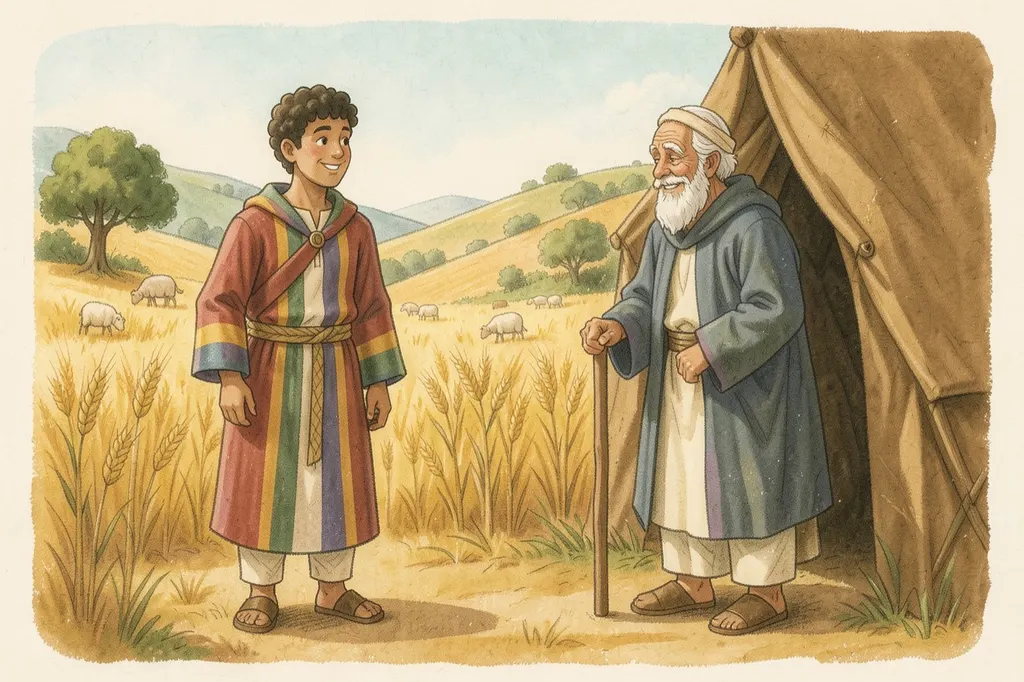
Long ago, in the land of Canaan, lived a man named Jacob. Jacob had another name, too: Israel. He had twelve sons.
“Now Israel loved Joseph more than all his children, because he was the son of his old age: and he made him a coat of many colours.”
His brothers saw that their father loved Joseph most, and they hated him.
Then Joseph told his brothers a dream: their bundles of grain bent down low to his bundle. In another dream, the sun, the moon and eleven stars bent down low to him. His brothers hated him even more.
One day, Jacob sent Joseph to see how his brothers were. When they saw him coming, they planned to kill him. But Reuben, the oldest, said, "Let us not kill him."
So they pulled off Joseph's coat, and put him into an empty pit. Then some traders came by, going to Egypt. And the brothers sold Joseph to them for twenty pieces of silver.
The brothers dipped Joseph's coat in a goat's blood, and took it home. Jacob thought a wild animal had killed his son. And he would not be comforted.
Scene 2 of 6
The Lord was with Joseph
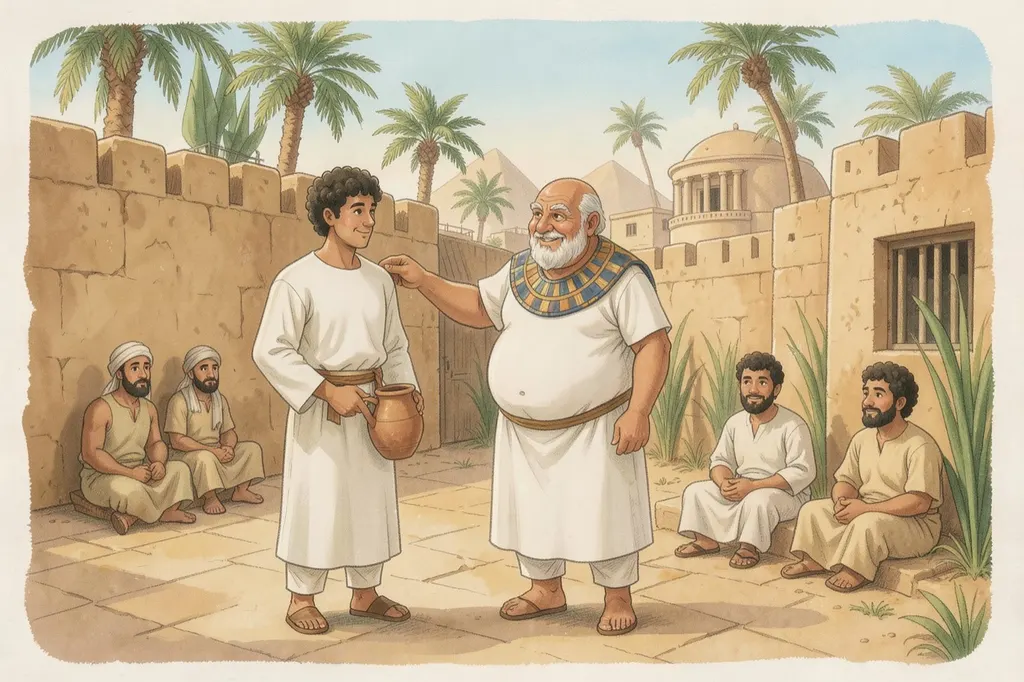
In Egypt, Joseph was sold to a man called Potiphar, the captain of Pharaoh's guard. Pharaoh was the king of Egypt.
“And the LORD was with Joseph, and he was a prosperous man”
Prosperous means everything he did went well. So Potiphar put Joseph in charge of his whole house.
But Potiphar's wife told a lie about Joseph. Potiphar was very angry, and he put Joseph in prison. Joseph had done nothing wrong.
“But the LORD was with Joseph, and shewed him mercy”
Mercy means kindness. The keeper of the prison put Joseph in charge of all the prisoners.
Two of the prisoners were Pharaoh's butler, who served the king his drinks, and Pharaoh's baker. Each of them had a dream, and God helped Joseph tell what the dreams meant. It all happened just as Joseph said. The butler went back to serve Pharaoh. But he forgot all about Joseph.
Scene 3 of 6
Pharaoh's dreams
Two whole years went by. Then Pharaoh had two strange dreams.
In one dream, seven fat cows came up out of the river, and seven thin cows came and ate them up.
In the other, seven thin heads of grain swallowed up seven good ones.
None of Pharaoh's wise men knew what they meant. Then the butler remembered Joseph.
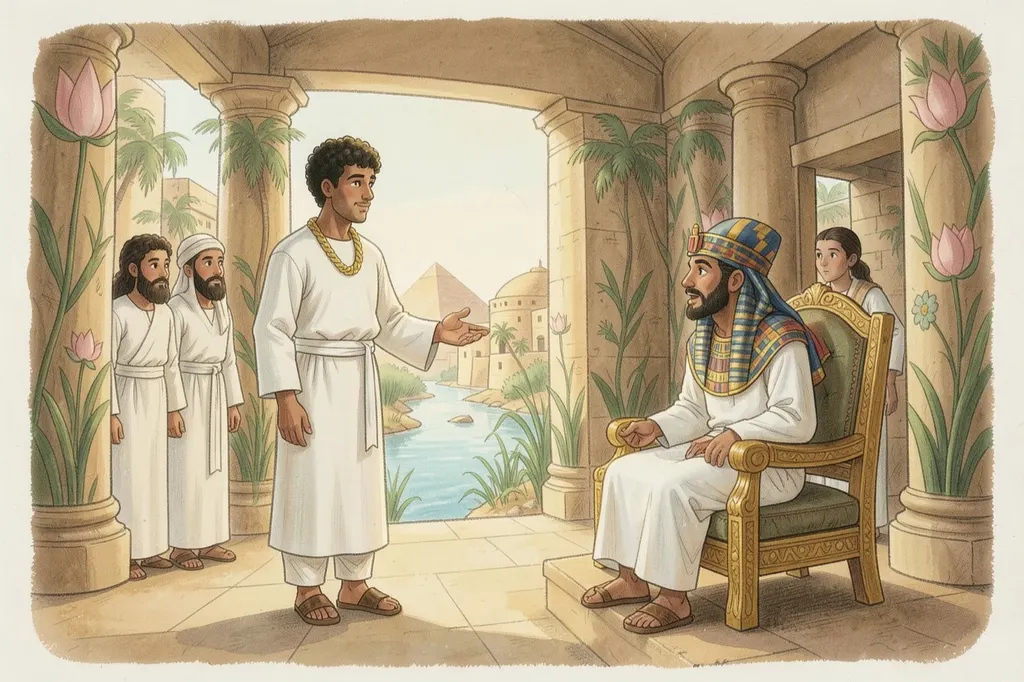
So they brought Joseph quickly out of prison, to tell Pharaoh what the dreams meant. And Joseph said:
“It is not in me: God shall give Pharaoh an answer of peace.”
God was showing Pharaoh what he was about to do, Joseph said. Seven years of plenty were coming. Then seven years of famine. A famine is a time when food will not grow, and people go hungry.
So Pharaoh made Joseph ruler over all the land of Egypt. He put his own ring on Joseph's hand.
For seven years, Joseph stored up grain, as much as the sand of the sea. Then the famine came, in every land. But in Egypt, there was bread.
Scene 4 of 6
The brothers come to Egypt
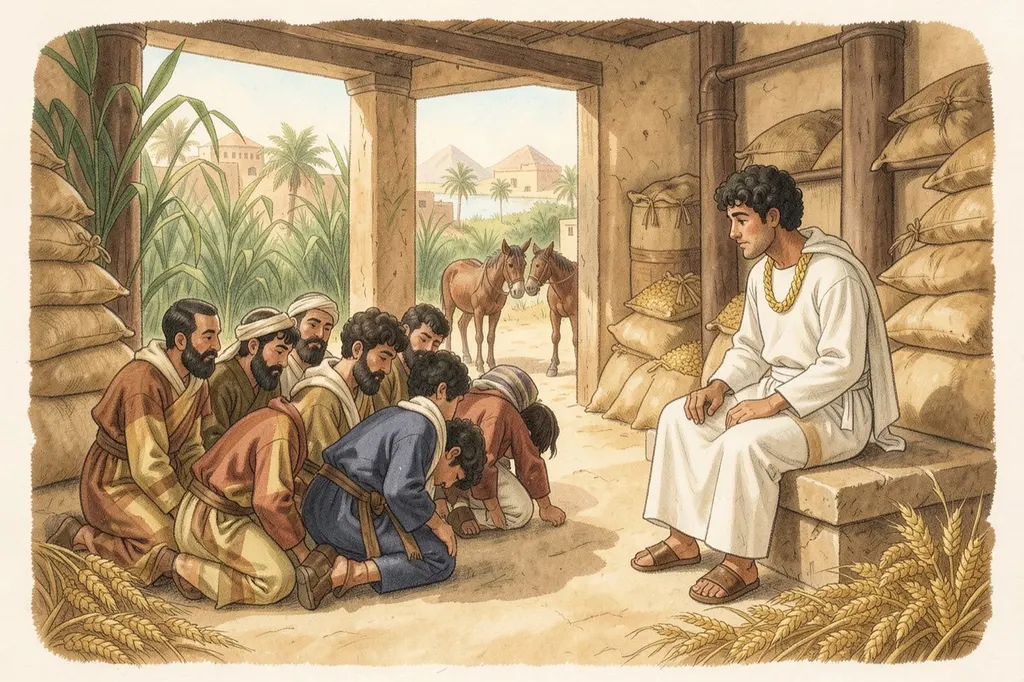
Far away in Canaan, Jacob's family was hungry too. So Jacob sent ten of his sons to Egypt, to buy grain. But he kept Benjamin, the youngest, at home.
In Egypt, the brothers came to the governor, the man in charge of all the grain. And they bent down low before him, with their faces to the ground.
The governor was Joseph. He was a grown man now, and he spoke to them in the language of Egypt.
“And Joseph knew his brethren, but they knew not him.”
Brethren means brothers. Joseph remembered his dreams. He spoke roughly to his brothers, and said they were spies. To test them, he said one brother must stay, and the others must bring back their youngest brother.
The brothers said to one another that this trouble had come because of what they did to Joseph, long ago. They did not know Joseph understood every word.
Joseph turned away from them, and he wept.
Scene 5 of 6
I am Joseph your brother
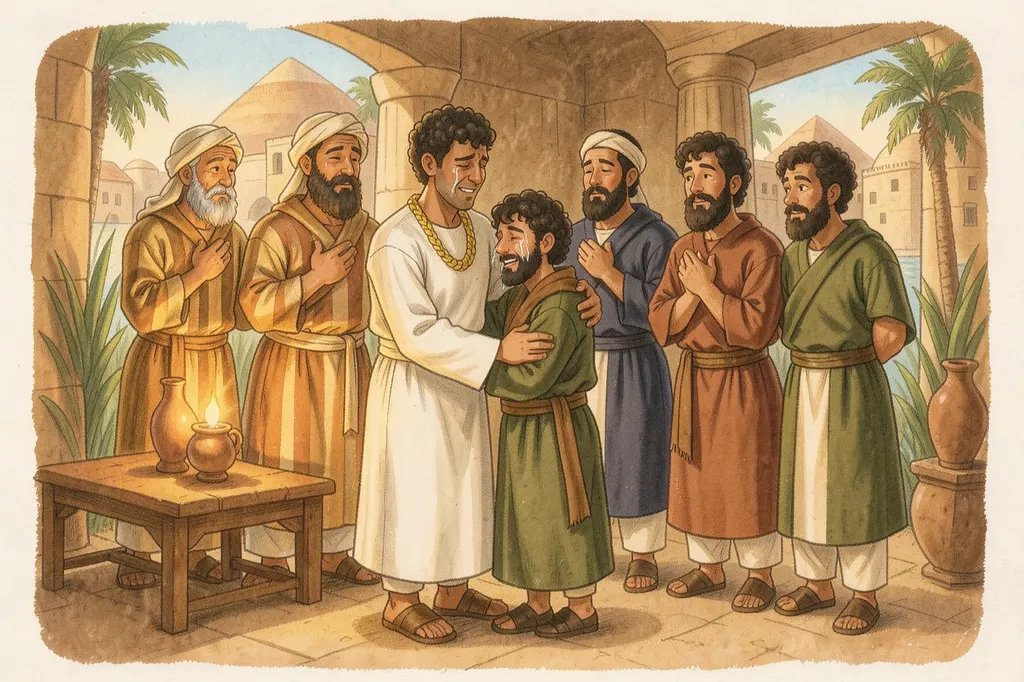
The brothers came back, and this time they brought Benjamin. Joseph had his silver cup hidden in Benjamin's sack, and said Benjamin must stay as his servant. But Judah begged to stay instead, in Benjamin's place.
Then Joseph could not hold it in any longer. He sent everyone else out of the room, and he wept so loudly that the Egyptians heard.
He told his brothers who he was, but they were too frightened to answer. So Joseph asked them to come near, and said:
“I am Joseph your brother, whom ye sold into Egypt.”
Joseph told them not to be upset, or angry with themselves. God had sent him to Egypt ahead of them, to save their lives.
Joseph hugged Benjamin, and they both wept. He kissed all his brothers. And after that, his brothers talked with him.
Then Joseph sent wagons to bring their father. At first, their father could not believe the news. Then he said, "It is enough; Joseph my son is yet alive".
Scene 6 of 6
God meant it unto good
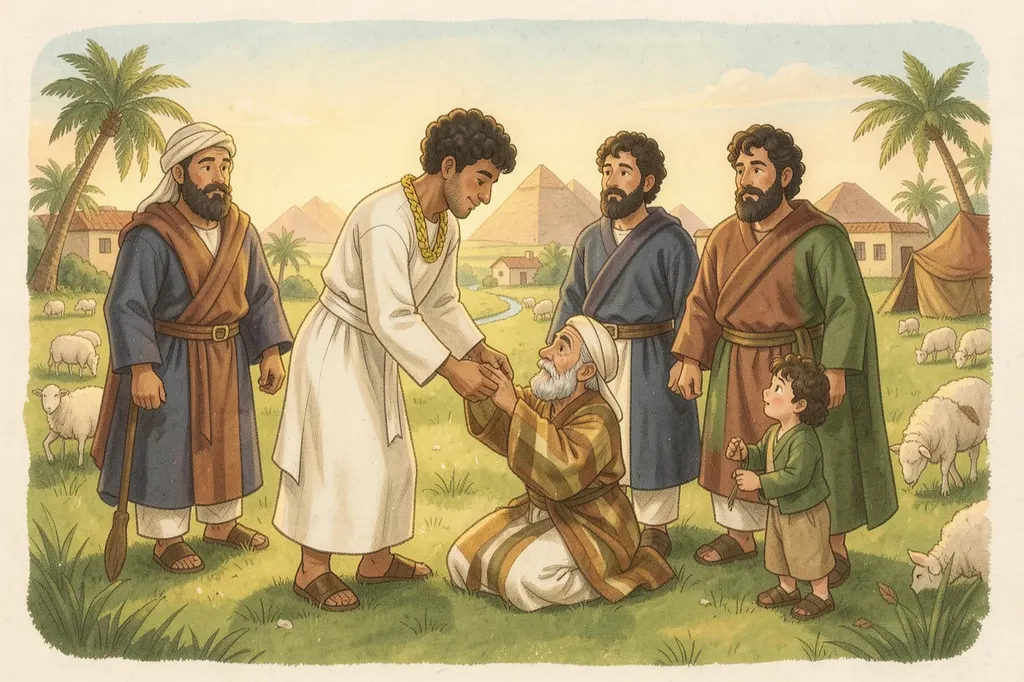
So Jacob came down to Egypt with all his family. Joseph rode out in his chariot to meet his father, and hugged him, and wept for a long time.
Many years later, Jacob died, very old. Then the brothers were afraid that Joseph would pay them back for the wrong they had done.
They sent Joseph a message, asking him to forgive them. And Joseph wept. Then they came and bent down low before him, and said they would be his servants.
But Joseph told them not to be afraid. And he said:
“But as for you, ye thought evil against me; but God meant it unto good, to bring to pass, as it is this day, to save much people alive.”
Joseph meant that his brothers had wanted to hurt him, but God meant it for good, to save many lives.
Joseph promised to look after his brothers, and their little ones. And he spoke kindly to them.
Do you remember what stayed true, the whole way through? The Lord was with Joseph.
Can you say it too? The Lord was with Joseph.
In Potiphar's house, and in the prison, and in Pharaoh's palace, the Lord was with Joseph.
His brothers thought evil against him. But God meant it unto good.
How to explain the story of Joseph to a child
Keep God at the centre, not Joseph's coat or his cleverness. In Potiphar's house and in prison, Genesis says "the LORD was with Joseph" (Genesis 39:2, 21), and Joseph told Pharaoh, "It is not in me" (Genesis 41:16). At the end Joseph explains it himself: his brothers meant to harm him, "but God meant it unto good" (Genesis 50:20).
What this story shows about God
For grown-ups. The story itself never states a lesson, so here it is, with the verses behind it.
God is with his people in hard places
Joseph was sold as a slave and then put in prison for something he did not do. Both times, Genesis says the Lord was with Joseph.
Genesis 39:2; Genesis 39:21God knows what is coming
Joseph told Pharaoh that the answer to his dreams was not in Joseph but in God, who was showing Pharaoh what he was about to do.
Genesis 41:16; Genesis 41:25God can turn evil to good
Joseph's brothers meant to harm him, but God used it to save many lives, his brothers' lives among them.
Genesis 45:5-7; Genesis 50:20Questions to ask after
Pick the ones that fit your child. There are no wrong answers.
Ages 3 to 5
- What did Jacob make for Joseph?
- Where did Joseph go when the traders took him away?
- What did Joseph do when he saw his youngest brother Benjamin again?
Ages 6 to 9
- Joseph was sold, and then put in prison for something he did not do. How do you think he felt?
- Joseph told Pharaoh, "It is not in me." Who did Joseph say would give the answer?
- Joseph's brothers had been very unkind to him. Why do you think he was kind to them in the end?
Ages 10 to 12
- Joseph's brothers meant to harm him, and God meant it for good. Can both be true about the same thing? How?
- Years before, Judah was the brother who said to sell Joseph (Genesis 37:26-27). Later he offered to stay as a servant in Benjamin's place. What had changed in him?
- Joseph waited years in prison before anything got better. What do you think helped him keep going?
If your child asks
Honest answers to the hard questions, with the verses behind them.
Why did Joseph's brothers hate him so much?
Genesis 37 gives three reasons. Their father Jacob loved Joseph more than all his sons and gave him the coat of many colours (Genesis 37:3-4). Joseph told them dreams in which they bent down to him, and "they hated him yet the more" (Genesis 37:8). And Genesis 37:11 says "his brethren envied him". Envy is wanting what someone else has, so much that it turns into anger at them.
Genesis 37:3-11
What lie did Potiphar's wife tell about Joseph?
For grown-ups: Genesis 39:7-20 tells that Potiphar's wife kept asking Joseph to sleep with her, and he refused, saying "how then can I do this great wickedness, and sin against God?" (Genesis 39:9). She then told her husband that Joseph had attacked her, and Joseph was put in prison. Our Joseph story says only that she told a lie about him. With a young child you could say: she said Joseph did something wrong that he did not do.
Genesis 39:7-20
What happened to the baker in the Joseph story?
For grown-ups: in Genesis 40:16-22, Joseph told Pharaoh's baker that his dream meant Pharaoh would put him to death in three days, and it happened as Joseph said, while the butler was given back his job. Our Joseph story leaves the baker's ending out. With a young child you could say: Joseph told both men the truth about their dreams, even the hard part.
Genesis 40:16-22
Why didn't Joseph tell his brothers who he was straight away?
Genesis doesn't give Joseph's reason. It says he knew his brothers, remembered his dreams, and tested them (Genesis 42:8-9, 15). It also shows the test working: the brothers admitted they had done wrong to Joseph (Genesis 42:21), and Judah offered to stay as a slave in Benjamin's place (Genesis 44:33). All through it, Joseph kept turning away to weep (Genesis 42:24 and 43:30).
Genesis 42:8-24; Genesis 44:33
Did Joseph forgive his brothers?
Genesis shows that he did, though Joseph never uses the word. When he told his brothers who he was, he said, "be not grieved, nor angry with yourselves, that ye sold me hither" (Genesis 45:5). Years later they asked him to forgive them (Genesis 50:17). He told them not to fear, promised to look after them and their children, "and he comforted them, and spake kindly unto them" (Genesis 50:21).
Genesis 45:5; Genesis 50:17-21
What we added and left out
Every quoted line in this story is the King James Bible, word for word.
What we added
- Plain explanations of old words, in the next breath: prosperous, mercy, famine, brethren. We call the butler the servant who brought the king his drinks.
- That God gave Jacob the name Israel is from Genesis 32:28 and 35:10; Genesis 37 uses both names.
- Our own words for some King James ones: "bundles of grain" for sheaves and "bent down low" for "made obeisance" (Genesis 37:7-9); "cows" for kine and "heads of grain" for ears of corn (Genesis 41:2-7).
- A few sentences from outside the scene passages, so the scenes join up: the butler and the baker in prison (Genesis 40); the brothers' second journey with Benjamin, the silver cup and Judah's offer (Genesis 43 and 44); Jacob's journey to Egypt and Joseph meeting him (Genesis 46:1-7 and 46:28-30); and Jacob's death (Genesis 49:33).
- We say Joseph had done nothing wrong. Genesis 39:8-12 shows him refusing Potiphar's wife and running away from her.
- We say Joseph spoke to his brothers in the language of Egypt. The Bible says "he spake unto them by an interpreter" (Genesis 42:23).
- The line near the end, that the Lord was with Joseph in Potiphar's house, the prison and Pharaoh's palace: Genesis 39:2 and 39:21 say it of the house and the prison, and for the palace we follow Pharaoh's own words, "a man in whom the Spirit of God is" (Genesis 41:38), and Acts 7:9-10: "But God was with him".
- That God helped Joseph tell what the prisoners' dreams meant rests on Joseph's own words to them, "Do not interpretations belong to God?" (Genesis 40:8).
- The sentence after Genesis 50:20 that explains it ("Joseph meant: ..."), and the "listen for it" frame and questions from the narrator to your child.
What we left out
- The names of the traders, Ishmeelites and Midianites, and that it was Judah who said to sell Joseph rather than kill him (Genesis 37:25-28).
- Joseph bringing his father a bad report of his brothers (Genesis 37:2), Jacob scolding Joseph about the second dream (Genesis 37:10), and the man who found Joseph wandering in the fields near Shechem (Genesis 37:15-17).
- Reuben's plan to rescue Joseph and his grief at the empty pit (Genesis 37:22 and 37:29-30), and Jacob's sackcloth and his words about going down to the grave (Genesis 37:34-35), shortened to one sentence.
- Genesis 38, the story of Judah and Tamar.
- What Potiphar's wife asked of Joseph and what she said he did (Genesis 39:7-19). See "If your child asks" above.
- The details of the butler's and baker's dreams, the baker's death, and Joseph asking the butler to remember him (Genesis 40:9-22 and 40:14-15).
- Joseph's plan to store a fifth of the harvest (Genesis 41:33-36), his Egyptian name, his wife Asenath and his sons Manasseh and Ephraim (Genesis 41:45 and 41:50-52), and the gold chain and chariot Pharaoh gave him (Genesis 41:42-43).
- The brothers' three days in prison, Simeon bound and kept in Egypt (Genesis 42:24), the money put back in their sacks, and Jacob's refusal to send Benjamin (Genesis 42:17 and 42:25-38), and the meal Joseph gave his brothers (Genesis 43:16-34).
- Pharaoh's gifts, Benjamin's three hundred pieces of silver, and Joseph telling his brothers not to quarrel on the way home (Genesis 45:16-24).
- That the brothers' message said their father had told them to ask for forgiveness before he died (Genesis 50:16-17), and Joseph asking, "am I in the place of God?" (Genesis 50:19).
- Jacob meeting Pharaoh, the famine years in Egypt, Jacob's blessings on his sons, and Joseph's own death (Genesis 47 to 50).
Not in the Bible, so not in our story
The Bible doesn't say what colours Joseph's coat was. The King James calls it "a coat of many colours" (Genesis 37:3), but the Hebrew words are not certain, and some translations call it an ornate robe or a long robe with sleeves. Genesis doesn't say the pit was a well, or how long Joseph was in it. It doesn't say how long Joseph was in prison either: only that Pharaoh's dreams came "at the end of two full years" after the butler went free (Genesis 41:1).
Words from the story
Old Bible words your child might ask about.
- Coat of many colours
- The special coat Jacob made for Joseph. The Hebrew words may also mean a long robe with sleeves, or a richly decorated robe.
- Brethren
- An old word for brothers.
- Pit
- A deep hole in the ground. Joseph's was empty, with no water in it.
- Pharaoh
- The title of the king of Egypt.
- Prosperous
- Doing well, so that everything you do turns out well.
- Shewed
- An old spelling of showed.
- Mercy
- Kindness that someone does not have to show you.
- Butler
- Here, the servant who brought the king his drinks. The King James also calls him the chief butler.
- Kine
- An old word for cows.
- Famine
- A long time when food will not grow and people go hungry.
- Governor
- A ruler put in charge of a land by the king.
Sources and how we made this story
References
- Genesis 37:1-36: King James Version and Berean Standard Bible
- Genesis 39:1-23: King James Version and Berean Standard Bible
- Genesis 41:1-57: King James Version and Berean Standard Bible
- Genesis 42:1-24: King James Version and Berean Standard Bible
- Genesis 45:1-28: King James Version and Berean Standard Bible
- Genesis 50:15-21: King James Version and Berean Standard Bible
- King James Version (1769 Oxford text), public domain. Berean Standard Bible, public domain since 2023 (berean.bible).
- Background: Joseph (Genesis) on Wikipedia.
How we made this story
- The retelling. Written by Tinykiwi with AI assistance, following how we tell these stories, then checked line by line against the Bible text. Every quoted line is the King James Version, word for word. What we explained, added and left out is listed above.
- The pictures and narration. The illustrations are AI-generated and chosen by hand. The narration is an AI voice recorded ahead of time, and every recording is checked word for word against the text.
- These stories are part of Tinykiwi, an audio Bible App for Kids we are building. For apps you can use today, see our guide to the best Bible story apps for kids.
More Bible stories for kids
Coming soon: Samson, Pentecost, Gideon, The Baptism of Jesus.
Tinykiwi. Coming soon.
The audio Bible app for kids.
Tinykiwi is an audio Bible app for kids that turns Bible learning into family time at bedtime, in the car, or before church.