
Bible stories for kids
The Story of Abraham for Kids
The story of Abraham starts in Genesis 12: God calls Abram to leave home, tells him to count the stars, gives him a new name, and in Genesis 21 keeps his promise when old Abraham and Sarah have baby Isaac. Here is the Abraham story for kids and children: an Abraham Bible story to read aloud, hear narrated or see as a storybook, with King James words beside every scene.
The storybook opens full screen, one page at a time. The whole story is also below, with the Bible text beside it.
Where it is in the Bible
- Bible passages
- Genesis 12 to 21. God testing Abraham with Isaac follows in Genesis 22, and Abraham's story runs on to Genesis 25.
- Who is in it
- Abraham (first called Abram), his wife Sarah (first called Sarai), and their son Isaac
- Where it happens
- Haran, then the land of Canaan, and the plains of Mamre
- When
- Abram was 75 when he left Haran (Genesis 12:4), and Abraham was 100 when Isaac was born (Genesis 21:5)
- Key verse
- “Is any thing too hard for the LORD? At the time appointed I will return unto thee, according to the time of life, and Sarah shall have a son.” (Genesis 18:14, KJV)
The story
This story is true. It is in the Bible, in the book of Genesis.
Have you ever waited a long, long time for something you were promised? In this story, an old man and an old woman wait for years and years. And God asks a question. Listen for it.
Scene 1 of 5
Go to a land I will show you
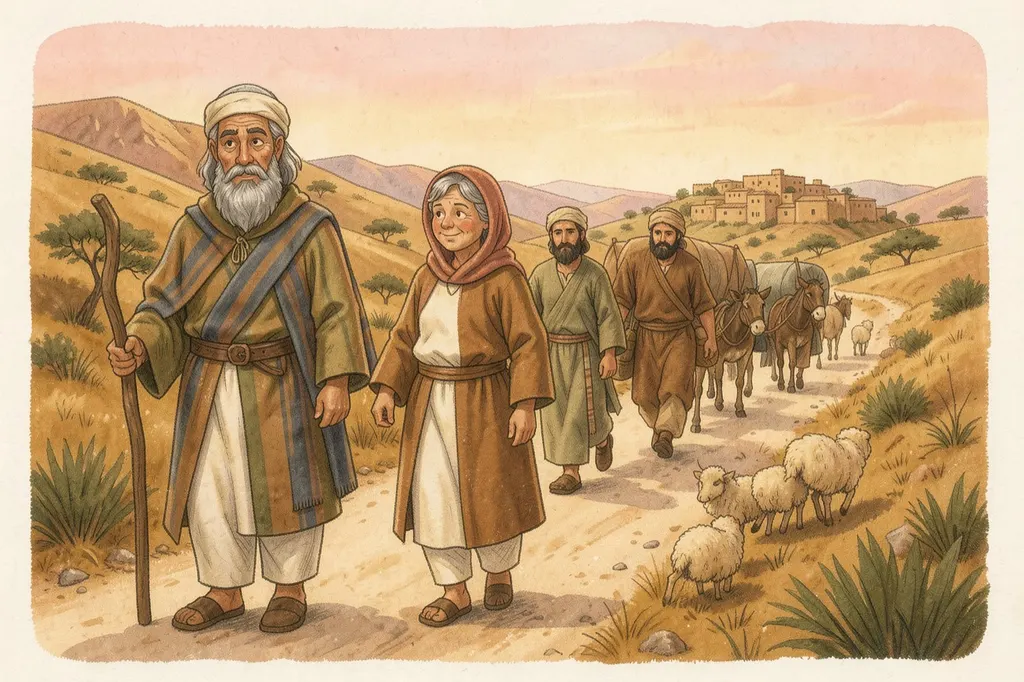
Long ago, in a town called Haran, there was a man named Abram. His wife was called Sarai. They had no children.
One day, the Lord spoke to Abram. God told him to leave his country, his family and his father's house, and go to a new land. God did not tell him its name. God would show it to him.
God made Abram a promise too. He would bless Abram, and make him a great nation. A nation is a whole people, many thousands of them.
“So Abram departed, as the LORD had spoken unto him”
Departed means he left. Abram was seventy-five years old. He took Sarai, and his nephew Lot, and everything they owned, and they set off. They walked a long, long way, to the land of Canaan.
There, the Lord appeared to Abram. God said he would give this land to Abram's children, and their children after them. So Abram built an altar, a pile of stones for worshipping God. Then he picked up his tent, and kept on going.
Scene 2 of 5
Count the stars
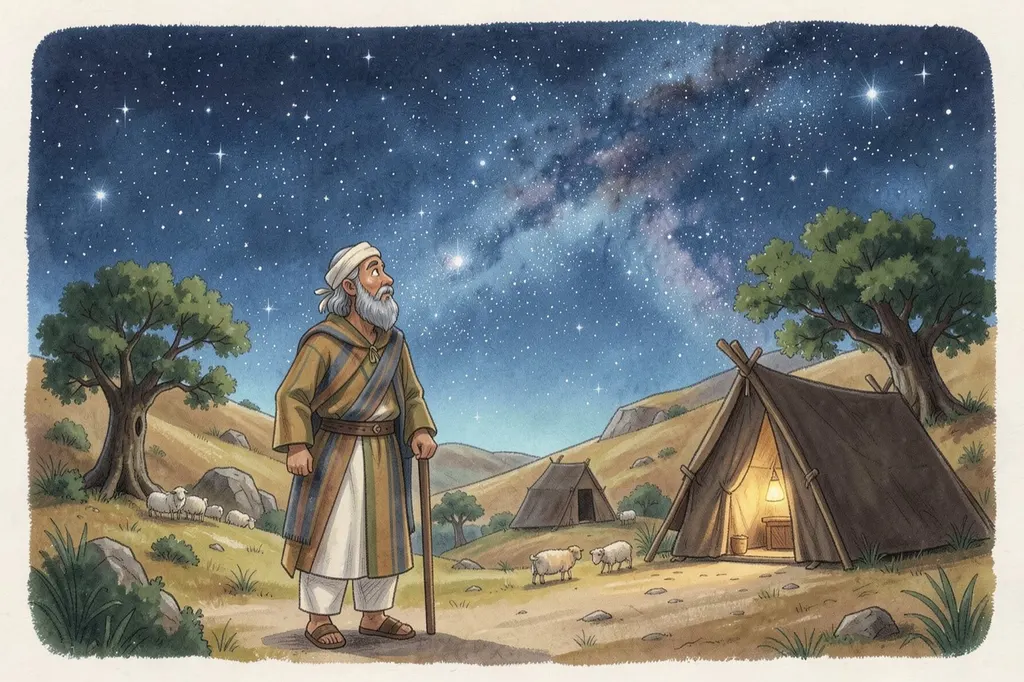
Time went by. Abram and Sarai lived in tents in the land of Canaan. But they still had no child.
Then the Lord spoke to Abram in a vision. A vision is something God lets a person see. God told Abram not to be afraid. God himself was his shield.
Abram asked what God could give him, when he still had no child of his own. God said Abram would have a son, his very own. Then God brought Abram outside, under the sky, and said:
“Look now toward heaven, and tell the stars, if thou be able to number them”
Tell means count. Can you count the stars? Nobody can. There are far too many.
And God said, "So shall thy seed be." Seed means children, and grandchildren, and their children, on and on. As many as the stars.
“And he believed in the LORD”
Scene 3 of 5
A new name
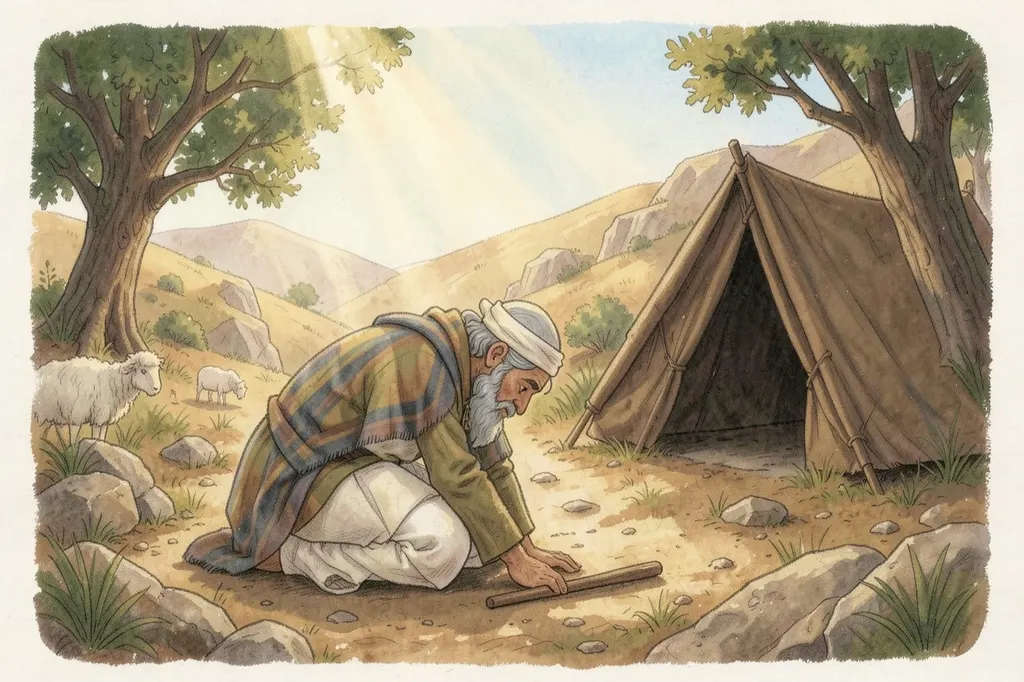
More years went by. Abram was ninety-nine years old now, and Sarai was very old too. And still Sarai had no baby.
Then the Lord appeared to Abram, and said, "I am the Almighty God." Abram fell on his face, down low on the ground.
God made a covenant with Abram. A covenant is a big, solemn promise, and God said this one would last forever. And God gave Abram a new name. From now on he would be Abraham:
“for a father of many nations have I made thee.”
God said kings would come from Abraham's family. And God would be their God, forever.
God gave Sarai a new name too. Now she would be Sarah. And God said that Sarah would have a son.
Abraham fell on his face again, and he laughed. He wondered in his heart how a man a hundred years old could have a child.
Scene 4 of 5
Three visitors
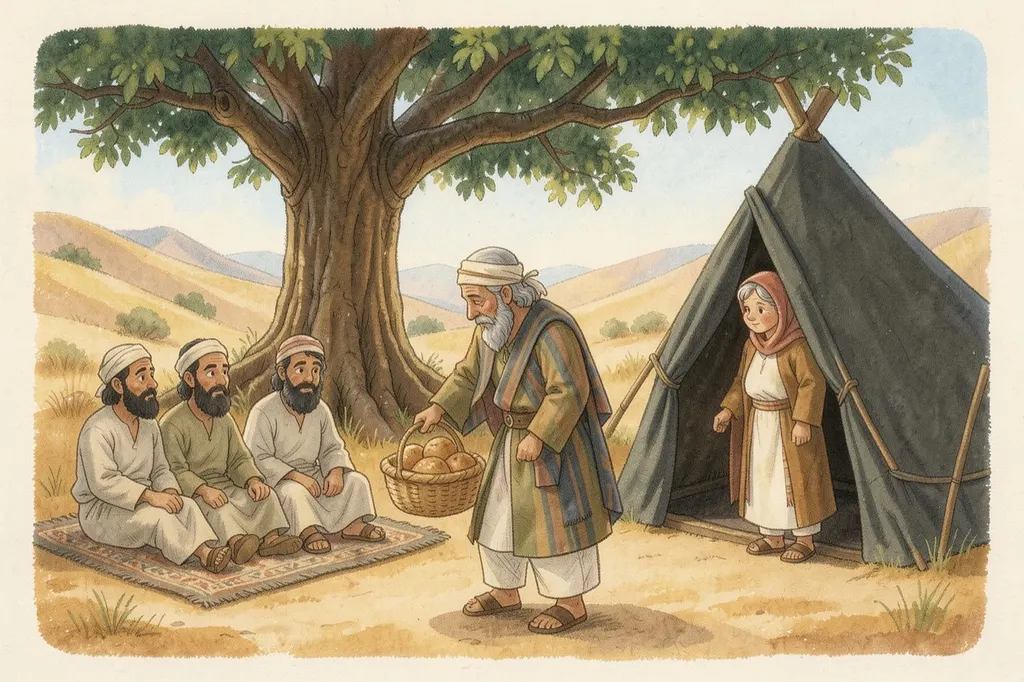
One hot day, the Lord appeared to Abraham, in the plains of Mamre. Abraham was sitting at the door of his tent. He looked up, and there were three men standing near him.
Abraham ran to meet them, and bent low to the ground. He asked them to stay, wash their feet, and rest under the tree. He asked Sarah to bake cakes of bread, quickly, and he chose a good young calf to cook. Then he set the food before them, with butter and milk, and they ate.
The visitors asked where Sarah was. "Behold, in the tent," said Abraham.
Then the Lord said that about this time next year, Sarah would have a son.
Sarah was listening at the tent door. She was very old, far too old to have a baby. So Sarah laughed to herself.
The Lord asked Abraham why Sarah had laughed. And then he asked:
“Is any thing too hard for the LORD?”
Sarah was afraid. She said, "I laughed not." But the Lord said, "Nay; but thou didst laugh."
Scene 5 of 5
A baby called Isaac
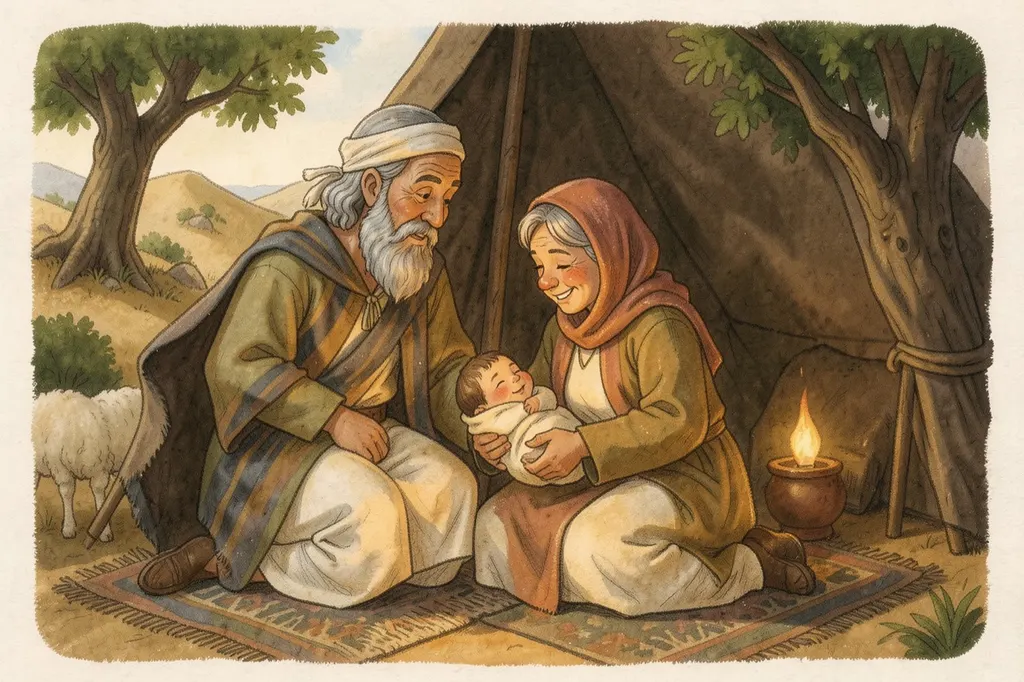
And the Lord did for Sarah just what he had said.
At the very time God had promised, Sarah had a baby boy. Abraham was one hundred years old. And Abraham called his son Isaac.
Sarah had laughed in the tent, when she heard God's promise. Now she laughed again. And Sarah said:
“God hath made me to laugh, so that all that hear will laugh with me.”
Sarah said that no one would ever have told Abraham she would feed a baby of her own. But here he was, in her arms. Her very own son, Isaac.
Abraham and Sarah had waited and waited, for twenty-five years. Is any thing too hard for the Lord?
Do you remember the question God asked? Is any thing too hard for the Lord?
Can you say it too? Is any thing too hard for the Lord?
Abraham and Sarah waited for years and years. They both laughed. And God did just what he had said.
Up in the sky, the stars are still shining, far too many to count.
So shall thy seed be.
How to explain the story of Abraham to a child
Start with the stars. God took Abram outside and told him to count them, and promised a family that big, when Abram and Sarai had no child at all (Genesis 15:5). In all they waited twenty-five years, and both of them laughed at the idea. The story is about God, who asked, "Is any thing too hard for the LORD?" (Genesis 18:14), and then kept his word.
What this story shows about God
For grown-ups. The story itself never states a lesson, so here it is, with the verses behind it.
God calls people to follow him
God told Abram to leave everything he knew, without telling him where he was going, and Abram went.
Genesis 12:1-4God keeps his promises
God promised Abram a family when he was 75, and when Abraham was 100, at the very time God had said, Isaac was born.
Genesis 21:1-2nothing is too hard for God
Abraham and Sarah were far too old to have a baby, and both of them laughed. God asked, "Is any thing too hard for the LORD?"
Genesis 18:14Questions to ask after
Pick the ones that fit your child. There are no wrong answers.
Ages 3 to 5
- What did God tell Abram to count?
- What did Abraham give the three visitors to eat?
- What was the name of Abraham and Sarah's baby?
Ages 6 to 9
- God told Abram to leave home, but did not tell him where he was going. How do you think that felt?
- Why do you think Sarah laughed when she heard she would have a baby?
- Have you ever had to wait a long time for something? What helped you wait?
Ages 10 to 12
- Genesis 15:6 says Abram believed the Lord before anything had happened. Why do you think that mattered so much?
- Abraham and Sarah both laughed at God's promise, and God kept it anyway. What does that tell you about God?
- God gave Abram and Sarai new names. Why do you think a new name was part of the promise?
If your child asks
Honest answers to the hard questions, with the verses behind them.
Why did Abraham and Sarah have to wait so long for a baby?
In the story of Abraham, God first promised Abram a great nation when he was 75 (Genesis 12:2-4), and Isaac was born when Abraham was 100 (Genesis 21:5). The Bible doesn't give a reason for the wait. It does say that by then Sarah was far past the age of having a baby (Genesis 18:11), so when Isaac came, it was plainly God's doing: "Is any thing too hard for the LORD?" (Genesis 18:14).
Genesis 12:4; Genesis 18:11; Genesis 21:5
Was Sarah in trouble for laughing at God?
The Bible doesn't say she was punished. In Genesis 18:12-15, Sarah laughed to herself because she was so old, and then, afraid, she said she hadn't. God simply told her the truth, "Nay; but thou didst laugh", and kept his promise anyway. A year later Sarah laughed again, for joy: "God hath made me to laugh" (Genesis 21:6). Abraham had laughed at the same promise too (Genesis 17:17).
Genesis 18:12-15; Genesis 21:6
Who were the three visitors who came to Abraham?
Genesis 18:2 calls them "three men", and the chapter begins, "the LORD appeared unto him" (Genesis 18:1). One of them speaks as the Lord, and Genesis 19:1 calls the other two angels. Christians have long wondered about this, and many see God himself visiting Abraham. Hebrews 13:2 may have this visit in mind when it says some "have entertained angels unawares".
Genesis 18:1-2; Genesis 19:1; Hebrews 13:2
Did Abraham have another son besides Isaac?
Yes. In Genesis 16, before Isaac was born, Sarai gave her servant Hagar to Abram, and Hagar had a son, Ishmael, when Abram was 86 (Genesis 16:16). Our Abraham story leaves this out to keep to the promise of Isaac. God cared for Hagar and Ishmael too, and promised to make Ishmael a nation (Genesis 16:10-11; Genesis 21:13).
Genesis 16:1-16; Genesis 21:13
Did Abraham ever tell a lie?
Yes, twice. In Egypt (Genesis 12:10-20) and later in Gerar (Genesis 20:1-18), Abraham was afraid and said Sarah was his sister, so that no one would kill him to take her (Genesis 12:12). She was his half-sister, but he hid that she was his wife (Genesis 20:12). Both times God protected Sarah. With a child you could say: Abraham got scared and didn't tell the whole truth, and God still kept his promises.
Genesis 12:10-20; Genesis 20:1-18
What we added and left out
Every quoted line in this story is the King James Bible, word for word.
What we added
- Plain explanations of old words, in the next breath: nation, departed, altar, vision, tell (count), seed, covenant.
- A few sentences from outside the scene passages, so the scenes make sense: Abram living in Haran and Sarai having no children (Genesis 11:30-31); Sarai's new name, Sarah, and God's promise that she would have a son (Genesis 17:15-16); Abraham laughing at the promise (Genesis 17:17).
- We say God did not tell Abram the name of the land. The Bible says only "unto a land that I will shew thee" (Genesis 12:1); Hebrews 11:8 adds that he went out "not knowing whither he went".
- We say God brought Abram out under the sky. The Bible says "he brought him forth abroad" (Genesis 15:5).
- We say Sarah laughed again for joy. The Bible gives her words: "God hath made me to laugh, so that all that hear will laugh with me" (Genesis 21:6).
- The twenty-five years of waiting come from Abram's age when he left Haran, 75 (Genesis 12:4), and Abraham's age when Isaac was born, 100 (Genesis 21:5).
- We call an altar a pile of stones. Genesis 12 doesn't say what Abram's altars were made of; later the Bible speaks of altars of earth or of stones (Exodus 20:24-25).
What we left out
- Abram's trip to Egypt in a famine, when he said Sarai was his sister (Genesis 12:10-20), and the same thing again in Gerar (Genesis 20).
- Abram and Lot parting ways (Genesis 13), Abram rescuing Lot and meeting Melchizedek (Genesis 14), and the destruction of Sodom and Gomorrah (Genesis 18:16 to 19:38).
- God's covenant sacrifice and the smoking furnace and burning lamp (Genesis 15:7-21).
- Hagar and her son Ishmael (Genesis 16), and Hagar and Ishmael being sent away after Isaac was weaned (Genesis 21:8-21).
- Circumcision as the sign of the covenant (Genesis 17:9-14 and 21:4), and Abraham asking God to bless Ishmael, when God said Sarah's son would be called Isaac and Ishmael would become a great nation too (Genesis 17:18-21).
- The calf being prepared by a young man (Genesis 18:7), and Abraham's servant Eliezer of Damascus (Genesis 15:2).
- God testing Abraham by asking him to offer Isaac (Genesis 22). It is a separate story, and is not told here.
Not in the Bible, so not in our story
The Bible doesn't say the three visitors at Abraham's tent were three angels: Genesis 18:2 calls them "three men", one speaks as the Lord, and only two are called angels, in Genesis 19:1. Sarah "laughed within herself" (Genesis 18:12), to herself rather than out loud, and she was not the only one: Abraham laughed at the same promise first (Genesis 17:17). The song "Father Abraham had many sons" is a camp song, not a Bible verse.
Words from the story
Old Bible words your child might ask about.
- Nation
- A whole people, many thousands of them, who belong together.
- Departed
- Left, went away.
- Altar
- A pile of stones where people worshipped God.
- Vision
- Something God lets a person see, a bit like a dream.
- Tell
- An old word for count, as in "tell the stars".
- Seed
- In the Bible, a person's children, and their children after them.
- Covenant
- A solemn promise that binds two together. God called his covenant with Abraham everlasting (Genesis 17:7).
- Almighty
- Able to do anything.
Sources and how we made this story
References
- Genesis 12:1-9: King James Version and Berean Standard Bible
- Genesis 15:1-6: King James Version and Berean Standard Bible
- Genesis 17:1-8: King James Version and Berean Standard Bible
- Genesis 18:1-15: King James Version and Berean Standard Bible
- Genesis 21:1-7: King James Version and Berean Standard Bible
- King James Version (1769 Oxford text), public domain. Berean Standard Bible, public domain since 2023 (berean.bible).
- Background: Abraham on Wikipedia.
How we made this story
- The retelling. Written by Tinykiwi with AI assistance, following how we tell these stories, then checked line by line against the Bible text. Every quoted line is the King James Version, word for word. What we explained, added and left out is listed above.
- The pictures and narration. The illustrations are AI-generated and chosen by hand. The narration is an AI voice recorded ahead of time, and every recording is checked word for word against the text.
- These stories are part of Tinykiwi, an audio Bible App for Kids we are building. For apps you can use today, see our guide to the best Bible story apps for kids.
More Bible stories for kids
Coming soon: Samson, Pentecost, Gideon, The Baptism of Jesus.
Tinykiwi. Coming soon.
The audio Bible app for kids.
Tinykiwi is an audio Bible app for kids that turns Bible learning into family time at bedtime, in the car, or before church.