
Bible stories for kids
The Tower of Babel for Kids
The Tower of Babel is the true story in Genesis 11:1-9 of people who all spoke one language and built a city and a tower meant to reach heaven, until God mixed up their language and scattered them over the earth. Here it is for kids, to read aloud, hear narrated or see as a picture storybook, with the King James words beside every scene.
The storybook opens full screen, one page at a time. The whole story is also below, with the Bible text beside it.
Where it is in the Bible
- Bible passages
- Genesis 11:1-9, right after the families of Noah's sons are listed in Genesis 10
- Who is in it
- The people of the whole earth, the families of Noah's sons, and the Lord
- Where it happens
- A plain in the land of Shinar (Genesis 11:2), the land later called Babylonia (Daniel 1:2)
- When
- Some generations after the flood, as the families of Noah's sons grew (Genesis 10:1, 10:32)
- Key verse
- “Therefore is the name of it called Babel; because the LORD did there confound the language of all the earth: and from thence did the LORD scatter them abroad upon the face of all the earth.” (Genesis 11:9, KJV)
The story
This story is true. It is in the Bible, in the book of Genesis.
Have you ever stacked up blocks, higher and higher, to see how tall your tower could grow? In this story, a whole city of people build a tower. And again and again, they say the same words to each other: go to, let us. Listen for them.
Scene 1 of 5
Fill the earth
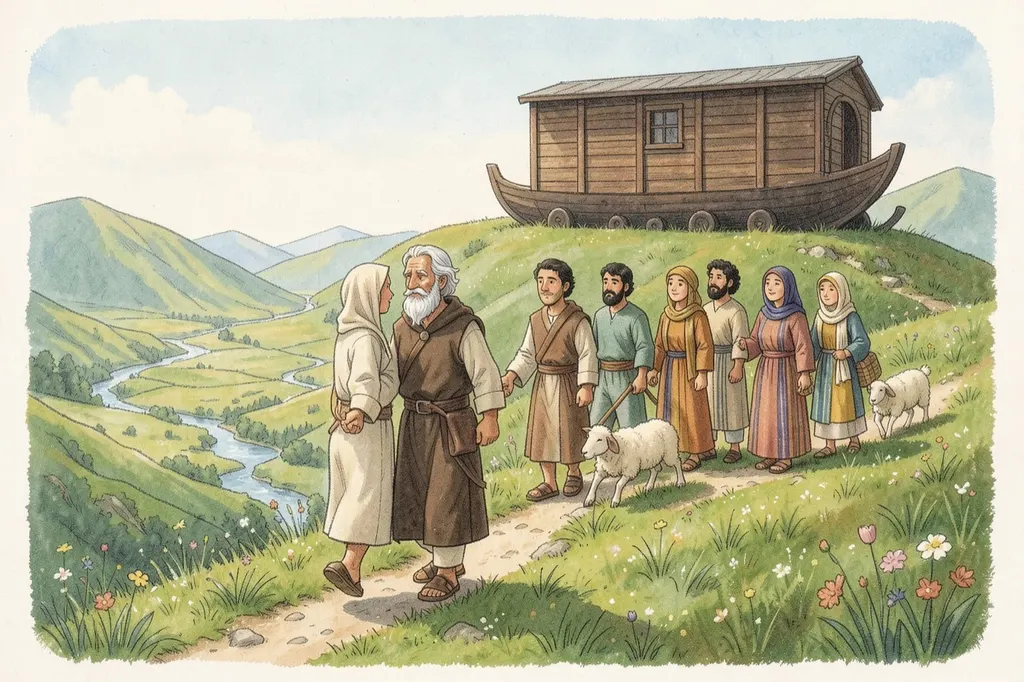
Long ago, after the great flood, Noah and his family came out of the ark.
There was Noah and his wife. There were their three sons, and the wives of the three sons. That was eight people, in all the wide world.
Then God blessed Noah and his sons, and said to them:
“Be fruitful, and multiply, and replenish the earth.”
Be fruitful and multiply means have children, and grandchildren, lots and lots of them. Replenish means fill up again. God told them to fill the whole earth with people again.
And the families grew. Noah's sons had children. Those children grew up, and had children of their own.
The families grew bigger, and bigger, and bigger.
Scene 2 of 5
One language
In those days, everyone in the world talked in the same way.
“And the whole earth was of one language, and of one speech.”
Everyone used the same words. Anyone could talk to anyone, and understand every word they said.
The people travelled from the east. And they found a plain in the land of Shinar. A plain is a wide, flat land, with no hills at all. And there they stayed.
Then the people said one to another:
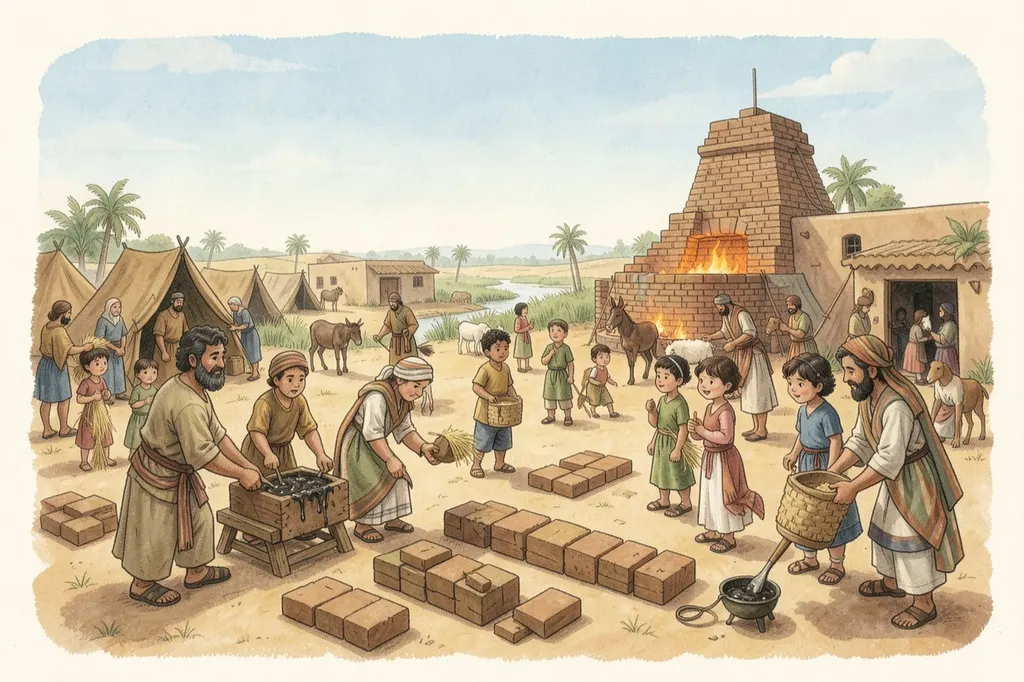
“Go to, let us make brick, and burn them throughly.”
Go to is an old way of saying, come on! Burn them throughly means bake them in the fire, until they are good and hard.
So the people used bricks, instead of stones. And to stick the bricks together, they used slime. Slime, here, means sticky black tar. It held the bricks together, the way cement does.
Scene 3 of 5
A tower to heaven
Then the people had a bigger plan. They said:
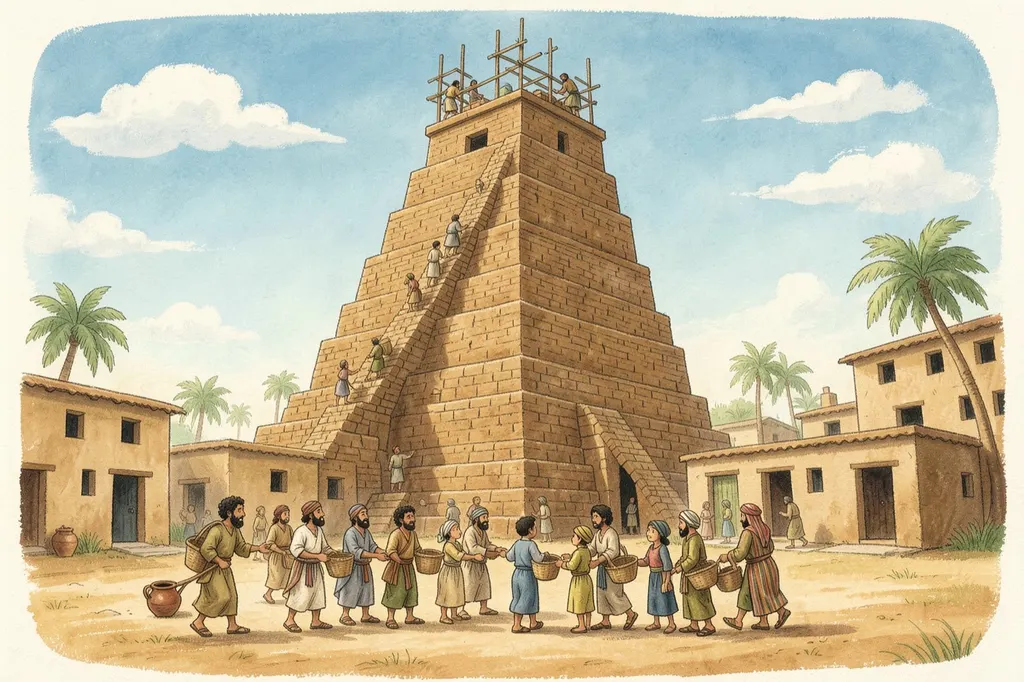
“Go to, let us build us a city and a tower, whose top may reach unto heaven; and let us make us a name, lest we be scattered abroad upon the face of the whole earth.”
A city is a big town, with many, many houses. And they would build a tower too. A tall, tall tower, with its top up in the sky.
Make us a name means make ourselves famous, so that everyone would know who we are.
Lest we be scattered means so that we will not be spread out, far apart, all over the earth. The people wanted to stay together, all in one place.
So they got to work. Brick on brick. Tar on brick, and brick on tar.
The city grew. And the tower went up, and up, and up.
Scene 4 of 5
The Lord came down
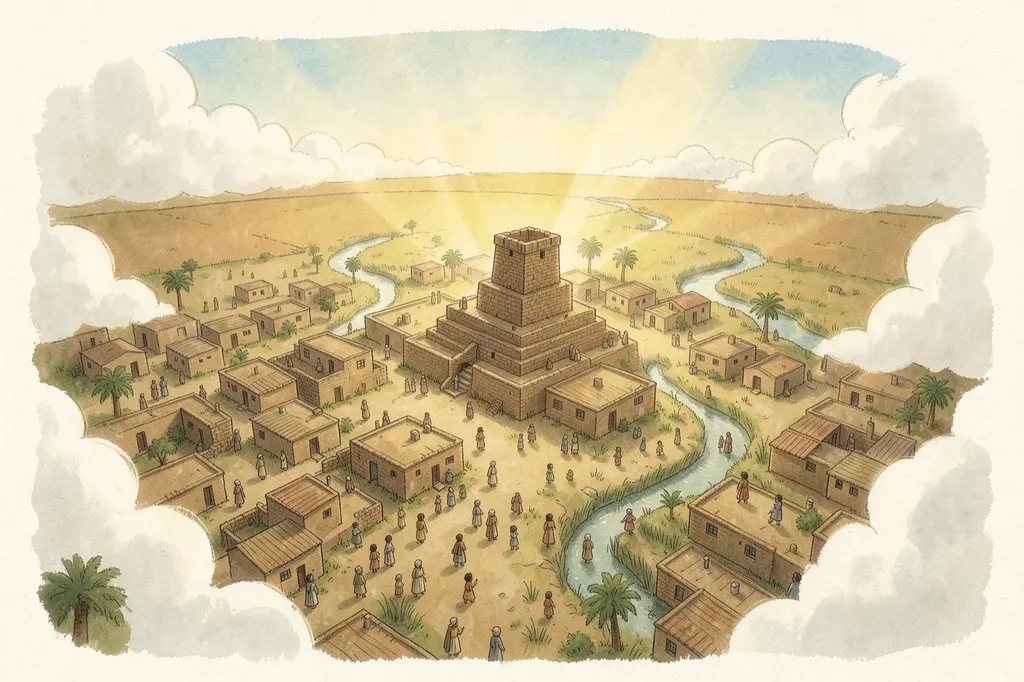
The people were busy building. And then the Bible says this:
“And the LORD came down to see the city and the tower, which the children of men builded.”
The children of men means the people. All of them, the grown-ups too.
Then the Lord said that the people were all one, with one language. This was only the beginning of what they would do, he said. Now nothing they planned would be too hard for them.
And then he said:
“Go to, let us go down, and there confound their language, that they may not understand one another’s speech.”
Did you hear that? Go to, let us. The people had said it, to build their tower up. Now the Lord said it too, to go down.
Confound means mix up. God would mix up their words, so that they could not understand each other any more.
Scene 5 of 5
Babel
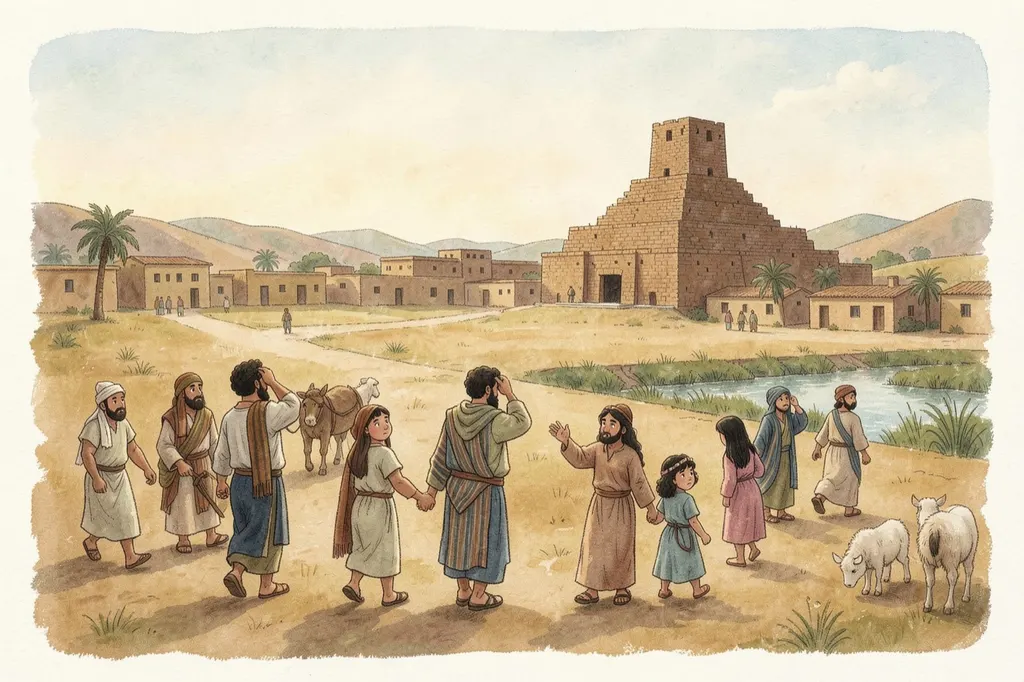
And that is just what happened. The Lord mixed up their language.
Now when one person spoke, the person beside them heard strange words they did not know. And when that person answered, the first one could not understand a word.
And the Lord scattered them from there, out over the face of all the earth. Scattered means spread out, far and wide, like seeds thrown across a field.
And the people left off building the city. Left off means stopped.
The families went their different ways, to new lands. And each family took its own new language with it.
And the city got its name.
“Therefore is the name of it called Babel; because the LORD did there confound the language of all the earth”
In the language of the Bible, the name Babel sounds like the word for mixed up.
Do you remember what the people said, again and again? Go to, let us.
Can you say it too? Go to, let us.
They built their city, and their tower.
And the Lord came down.
And from there, he scattered them abroad, upon the face of all the earth.
How to explain the Tower of Babel to a child
Tell it the way Genesis 11 does. The people wanted to make a name for themselves and stay in one place (Genesis 11:4), and God came down, mixed up their language and spread them over the earth (Genesis 11:8-9). Let the people's own words, "Go to, let us", be the line your child says along, and save what it means for the questions afterwards.
What this story shows about God
For grown-ups. The story itself never states a lesson, so here it is, with the verses behind it.
God sees what people do
The Lord came down to see the city and the tower. Nothing people build or plan is hidden from him.
Genesis 11:5; Psalm 33:13God's plan goes ahead
God told Noah's family to fill the earth. The people built so they would not be scattered, and in the end they went out over the face of all the earth.
Genesis 9:1; Genesis 11:8God is over every nation and language
Every family of the earth, with its own land and its own language, went out from Babel under God's hand.
Genesis 10:32; Genesis 11:9Questions to ask after
Pick the ones that fit your child. There are no wrong answers.
Ages 3 to 5
- What did the people make their tower out of?
- What did the people say, again and again?
- What happened when the Lord mixed up their words?
Ages 6 to 9
- The people wanted to make a name for themselves. What do you think that means?
- How would you feel if all your friends suddenly spoke words you could not understand?
- The people said "go to, let us" to build up. Then the Lord said it to come down. Why do you think the Bible tells it that way?
Ages 10 to 12
- God told Noah's family to fill the earth, but the people built so they would not be scattered. How are those two things connected?
- Is it wrong to want to be famous? When might it be good, and when might it not be?
- The people could do almost anything together. Why do you think God stopped this plan?
If your child asks
Honest answers to the hard questions, with the verses behind them.
Did God knock down the Tower of Babel?
No. In the Tower of Babel story, Genesis 11:8 says the Lord scattered the people "and they left off to build the city". The Bible never says the tower fell, or was blown down, or was struck by lightning. Those ideas come from later writings outside the Bible, such as the Book of Jubilees, and from many children's retellings.
Genesis 11:8
Was it wrong to build a tall tower?
Genesis doesn't say tall buildings are wrong. In the Tower of Babel story the people said why they built: to "make us a name", and so they would not be "scattered abroad upon the face of the whole earth" (Genesis 11:4). Yet God had told Noah's family to "replenish the earth" (Genesis 9:1). Many Christians see the problem as people wanting their own fame and their own way, instead of God's.
Genesis 11:4; Genesis 9:1
Is the Tower of Babel why there are so many languages?
That is what Genesis 11:9 says: Babel was where "the LORD did there confound the language of all the earth". Genesis 10 lists the families of Noah's sons, "every one after his tongue" (Genesis 10:5), and says "by these were the nations divided in the earth after the flood" (Genesis 10:32). The Bible doesn't say how many languages began at Babel, or how languages changed after that.
Genesis 11:9; Genesis 10:5; Genesis 10:32
Didn't God already know what the people were building?
Yes. Genesis 11:5 says "the LORD came down to see the city and the tower", which is the Bible's way of showing God paying close attention to what people do. Psalm 33:13 says "The LORD looketh from heaven; he beholdeth all the sons of men." Many readers also notice that the tower meant to reach heaven is one God had to come down to see.
Genesis 11:5; Psalm 33:13
Who is "us" when God says "let us go down"?
In the Tower of Babel story, God says "let us go down" (Genesis 11:7), just as he said "Let us make man in our image" in Genesis 1:26. The Bible doesn't explain the "us". Many Christians read it as a first hint of the Father, the Son and the Holy Spirit; others read it as God speaking with the angels of heaven.
Genesis 11:7; Genesis 1:26
What we added and left out
Every quoted line in this story is the King James Bible, word for word.
What we added
- Plain explanations of old words, in the next breath: be fruitful and multiply, replenish, go to, throughly, slime, make us a name, lest, the children of men, confound, left off, scattered. We call slime tar, as the Berean Standard Bible does (Genesis 11:3).
- Who came out of the ark is from Genesis 7:13 and 8:18: Noah, his wife, his three sons and their wives, eight people. That their families grew is from Genesis 10:1, "unto them were sons born after the flood", and the list of families in Genesis 10.
- We say the people travelled "from the east", as the King James has it (Genesis 11:2). The Berean Standard Bible reads "eastward"; the Hebrew can mean either.
- The building colour (brick on brick, the tower going up and up) is ours. Genesis 11:5 says only that the Lord came down to see the city and the tower "which the children of men builded".
- God's words in Genesis 11:6 are told as reported speech, in plain words.
- What it was like when the language was confounded (hearing strange words, no one understanding a word) is our explanation of "that they may not understand one another's speech" (Genesis 11:7).
- That each family took its own language is from Genesis 10:5, 10:20 and 10:31, which list the families "after their tongues". That Babel sounds like the Hebrew word for mixed up is the wordplay in Genesis 11:9: Babel and balal, to confound.
- The "listen for them" frame and the narrator's questions to your child, including "Did you hear that?" when the Lord says "Go to, let us" too.
What we left out
- God's new rules for Noah after the flood (Genesis 9:2-7), and the rainbow in the cloud (Genesis 9:8-17), which is told in the story of Noah's ark.
- The long list of Noah's descendants and their nations in Genesis 10, including Nimrod, whose kingdom began at Babel in the land of Shinar (Genesis 10:8-10).
- The family line from Shem down to Abram that follows the Tower of Babel (Genesis 11:10-32).
- Exactly when the tower was built. Genesis 10:25 says that in the days of Peleg "was the earth divided"; many readers link that to Babel, but the Bible doesn't say so.
Not in the Bible, so not in our story
Genesis never says the Tower of Babel fell, was blown down or was struck by lightning; Genesis 11:8 says only that the people "left off to build the city". It doesn't say how tall the tower was, what shape it was, or that Nimrod built it. And the name Babel isn't the English word babble: Genesis 11:9 ties it to the Hebrew word for confound, to mix up.
Words from the story
Old Bible words your child might ask about.
- Babel
- The name of the city where the Lord mixed up the people's language. It sounds like the Hebrew word for mixed up.
- Shinar
- The land where the tower was built, a wide flat land later called Babylonia.
- Plain
- A wide, flat land with no hills.
- Replenish
- To fill up again.
- Go to
- An old way of saying "come on!"
- Throughly
- An old spelling of thoroughly: all the way through.
- Slime
- Here, sticky black tar, used to hold bricks together.
- Morter
- An old spelling of mortar, the paste that holds bricks or stones together.
- Confound
- To mix up.
- Scattered
- Spread out, far and wide.
Sources and how we made this story
References
- Genesis 9:1: King James Version and Berean Standard Bible
- Genesis 11:1-3: King James Version and Berean Standard Bible
- Genesis 11:4: King James Version and Berean Standard Bible
- Genesis 11:5-7: King James Version and Berean Standard Bible
- Genesis 11:8-9: King James Version and Berean Standard Bible
- King James Version (1769 Oxford text), public domain. Berean Standard Bible, public domain since 2023 (berean.bible).
- Background: Tower of Babel on Wikipedia.
How we made this story
- The retelling. Written by Tinykiwi with AI assistance, following how we tell these stories, then checked line by line against the Bible text. Every quoted line is the King James Version, word for word. What we explained, added and left out is listed above.
- The pictures and narration. The illustrations are AI-generated and chosen by hand. The narration is an AI voice recorded ahead of time, and every recording is checked word for word against the text.
- These stories are part of Tinykiwi, an audio Bible App for Kids we are building. For apps you can use today, see our guide to the best Bible story apps for kids.
More Bible stories for kids
Coming soon: Samson, Pentecost, Gideon, The Baptism of Jesus.
Tinykiwi. Coming soon.
The audio Bible app for kids.
Tinykiwi is an audio Bible app for kids that turns Bible learning into family time at bedtime, in the car, or before church.