
Bible stories for kids
The Last Supper for Kids
The Last Supper is the Passover meal Jesus shared with his twelve apostles on the night before he died, told in Luke 22, John 13, Matthew 26 and Mark 14. Here is the last supper story for kids and children: the bread and the cup, Jesus washing his friends' feet, and his prayer on the Mount of Olives. Read it aloud, hear it narrated or open the picture storybook.
The storybook opens full screen, one page at a time. The whole story is also below, with the Bible text beside it.
Where it is in the Bible
- Bible passages
- Luke 22:7-46 and John 13:1-30. Matthew 26:17-46 and Mark 14:12-42 tell it too.
- Who is in it
- Jesus and his twelve apostles, among them Peter, John and Judas Iscariot
- Where it happens
- A large upper room in Jerusalem, then the Mount of Olives
- When
- At the feast of unleavened bread, on the day the Passover lamb was killed (Luke 22:7)
- Key verse
- “And he took bread, and gave thanks, and brake it, and gave unto them, saying, This is my body which is given for you: this do in remembrance of me.” (Luke 22:19, KJV)
The story
This story is true. It is in the Bible, in the books of Luke and John.
Have you ever wanted to remember a special day for ever? In this story, Jesus shares one last supper with his friends. And he asks them to do something, so they will always remember him. Listen for what he says.
Scene 1 of 5
A large upper room
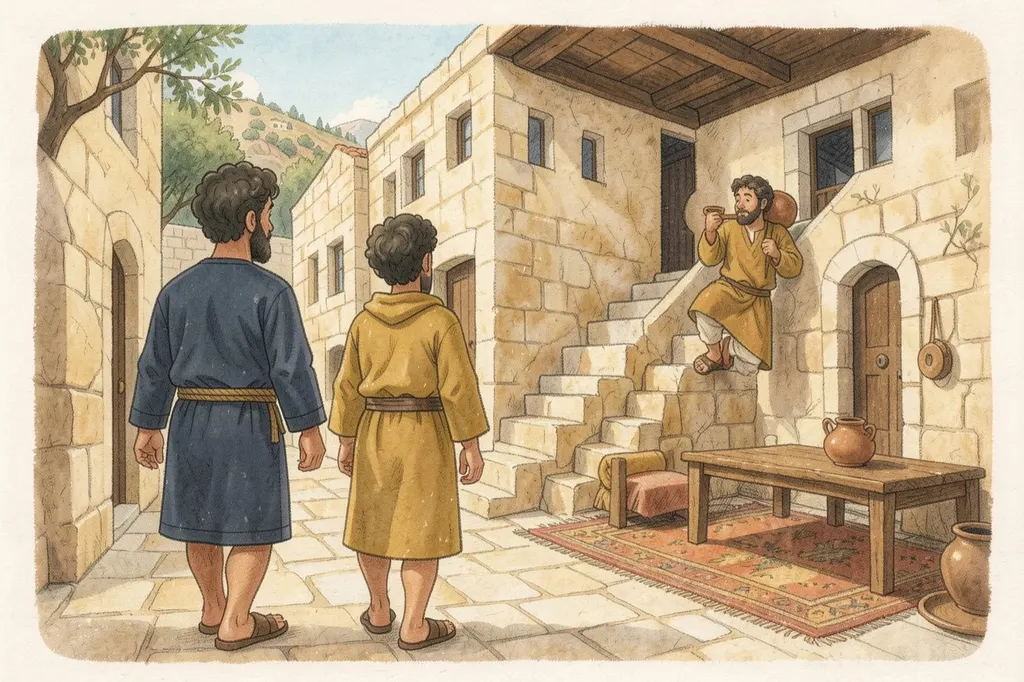
It was the time of the Passover, in the city of Jerusalem. Every year, God's people ate a special supper called the Passover. It helped them remember how God set them free from Egypt, long ago.
Jesus sent two of his friends, Peter and John, to get the Passover supper ready. They asked him where he wanted it.
Jesus told them to go into the city. There they would meet a man carrying a pitcher of water. A pitcher is a big jug. They should follow him into the house, and ask its owner for the guest room, where Jesus would eat the Passover with his friends.
The owner would show them a large upper room, furnished and ready. Furnished means set out with everything they needed.
So Peter and John went into the city. They found everything just as Jesus had said. And they made ready the Passover.
Scene 2 of 5
The bread and the cup
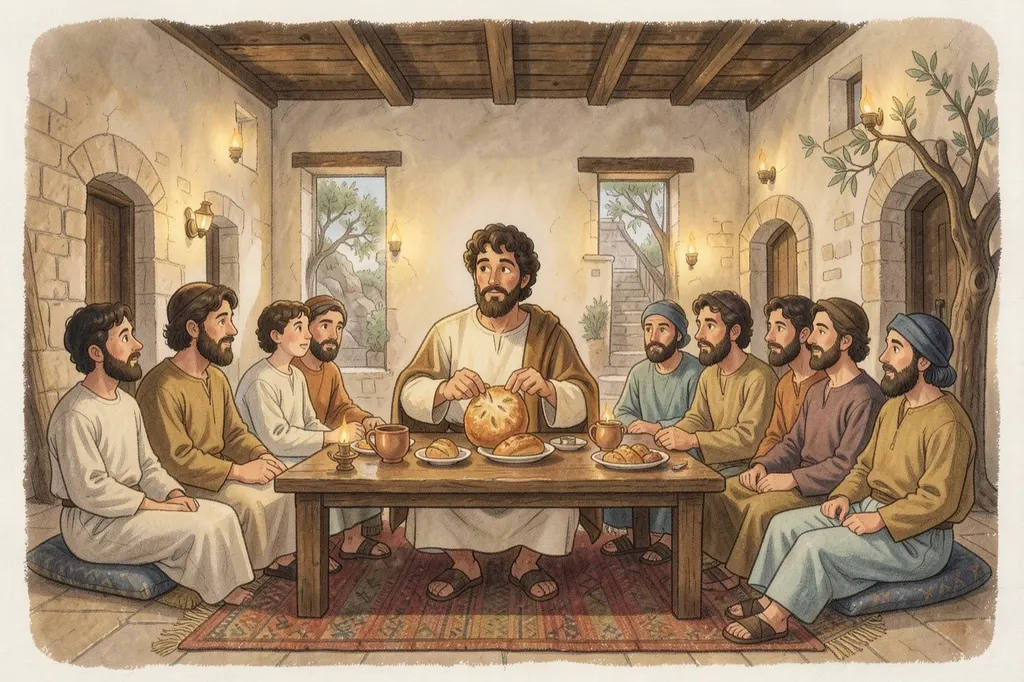
When the time came, Jesus sat down at the table with his twelve apostles. The apostles were the friends Jesus had chosen.
Jesus told them how much he had wanted to eat this Passover with them, before he suffered.
Then Jesus took some bread. He gave thanks to God, and broke the bread, and gave it to them. And he said:
“This is my body which is given for you: this do in remembrance of me.”
This do means do this. Remembrance means remembering. Jesus was asking his friends to do this, and remember him.
After supper, Jesus took the cup in the same way, and he said:
“This cup is the new testament in my blood, which is shed for you.”
A testament is a promise between God and his people. And this one was new.
Scene 3 of 5
A towel and a basin
The book of John tells us something else Jesus did at that supper.
Jesus knew his time had come to leave this world and go to his Father. And he loved his friends to the very end.
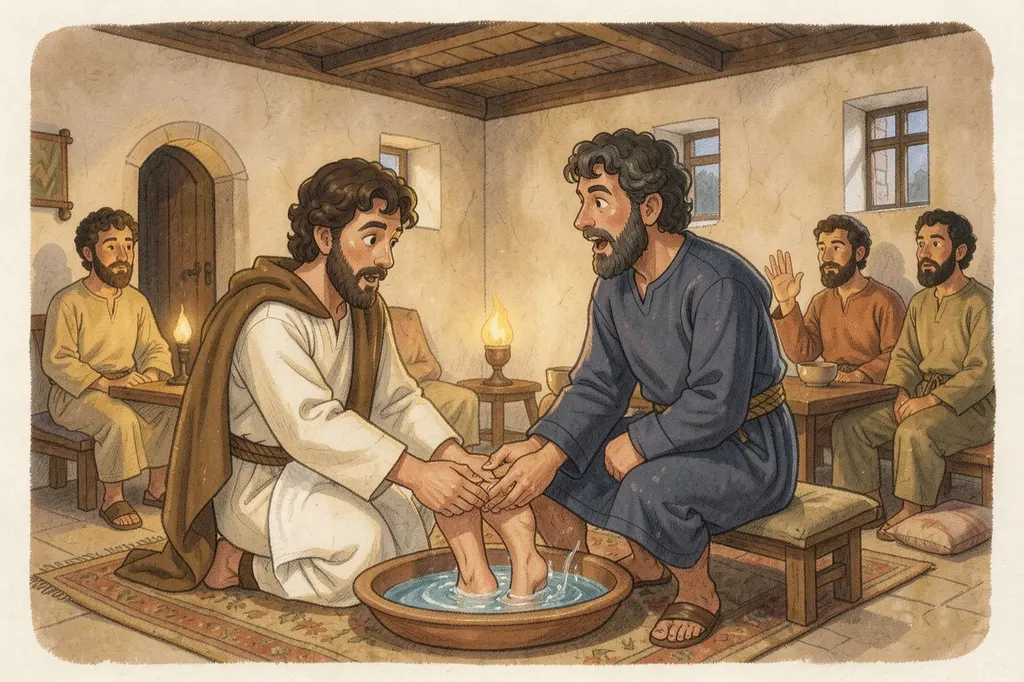
Jesus got up from the table and tied a towel around his waist. He poured water into a basin, a wide bowl. Then he began to wash his friends' feet. In those days, washing feet was a servant's job.
When Jesus came to Simon Peter, Peter asked if Jesus was really going to wash his feet. Jesus said Peter would understand later.
Peter said no. Jesus would never wash Peter's feet! Then Jesus said that if he did not wash Peter, Peter could have no part with him.
Can you guess what Peter said then?
“Lord, not my feet only, but also my hands and my head.”
Jesus said only his feet needed washing.
When he had washed all their feet, Jesus sat down again. He was their Lord and Master, he said, and he had washed their feet. So they ought to wash one another's feet, too.
Scene 4 of 5
And it was night
Then Jesus was troubled, deep inside. And he said:
“Verily, verily, I say unto you, that one of you shall betray me.”
Verily means truly. To betray is to turn against a friend.
The disciples looked at one another. Which one could he mean?
One disciple was leaning against Jesus at the table. The Bible calls him the disciple whom Jesus loved. Simon Peter made a sign to him, to ask Jesus who it was. So he asked.
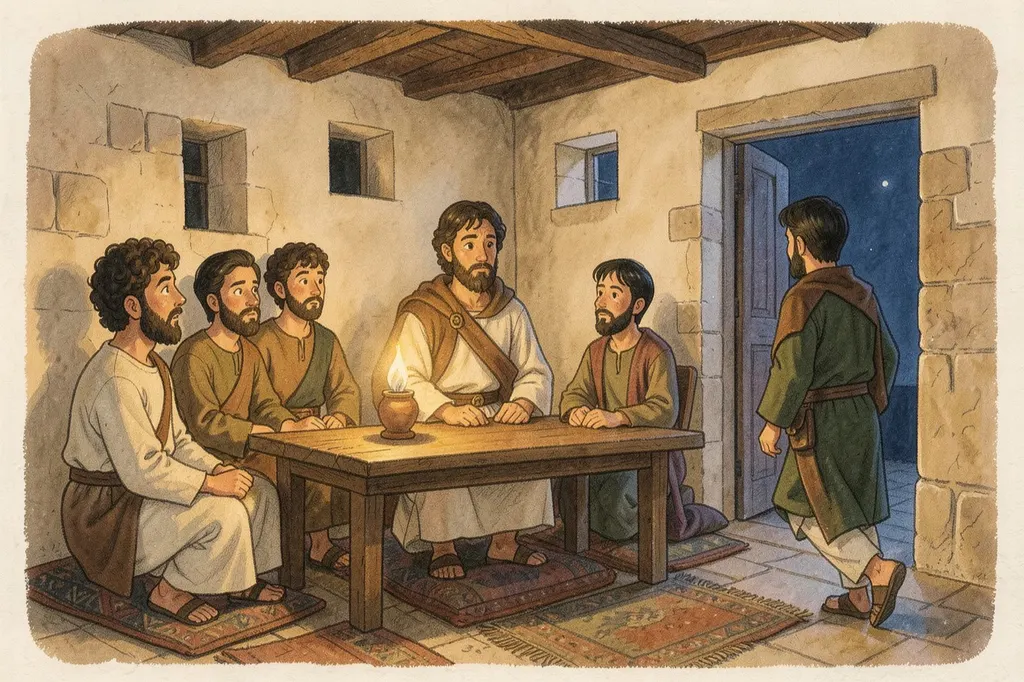
Jesus said it was the one he would give a sop to. A sop is a piece of bread, dipped in the dish. Then Jesus dipped the bread, and gave it to Judas Iscariot.
Jesus told Judas to do what he was going to do, quickly. Nobody at the table knew what Jesus meant. Judas looked after their money bag, so some of them thought he was going to buy things for the feast, or give something to the poor.
“He then having received the sop went immediately out: and it was night.”
Scene 5 of 5
Not my will
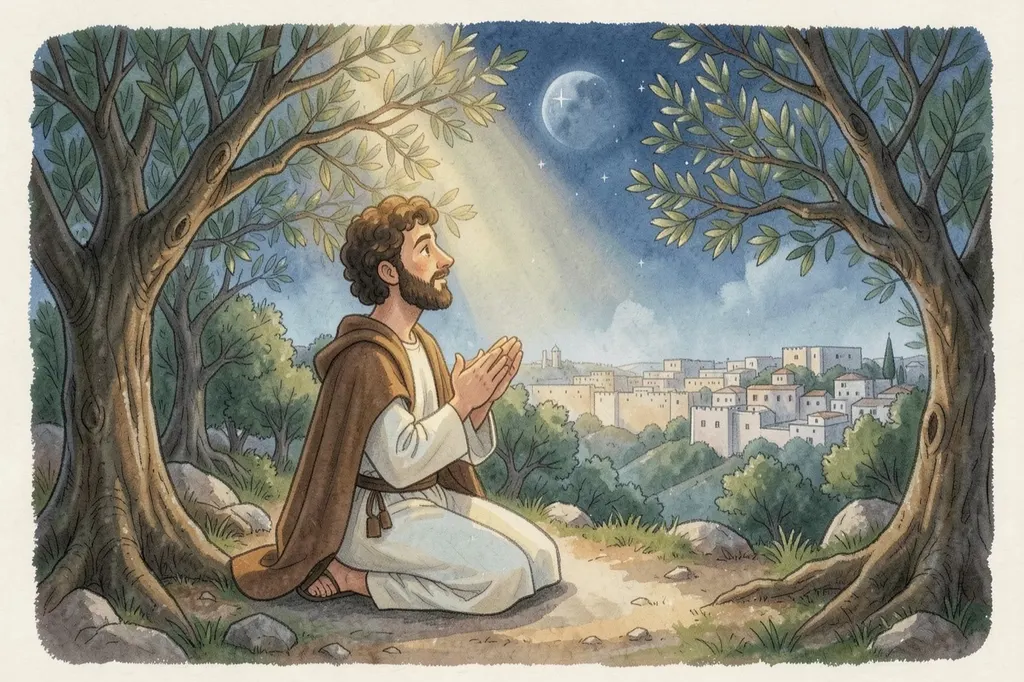
The book of Luke tells us where Jesus went next.
Jesus went out, as he often did, to a hill called the Mount of Olives, and his disciples followed him.
Jesus told them to pray, so they would not fall into temptation. Temptation is being pulled toward doing something wrong.
Then Jesus went a stone's throw away, by himself. He knelt down, and he prayed:
“Father, if thou be willing, remove this cup from me: nevertheless not my will, but thine, be done.”
Jesus asked his Father, if he was willing, to take the hard things away. But even so, he wanted what his Father wanted.
And an angel came from heaven, and made Jesus strong.
When Jesus got up from praying, he went back to his disciples. They were asleep, tired out with sadness. Jesus asked them why they were sleeping, and told them to get up and pray.
Do you remember what Jesus asked his friends to do? This do in remembrance of me.
Can you say it too? This do in remembrance of me.
The bread, broken. The cup, shared. The towel and the basin.
Jesus knew what was coming. And he loved his own unto the end.
How to explain the Last Supper to a child
Start with the Passover, the meal where God's people remembered how he set them free from Egypt. At that supper, Jesus gave his friends bread and a cup and asked them to remember him (Luke 22:19). He also washed their feet, the way a servant would (John 13:14-15). Many churches still share bread and a cup at communion, remembering Jesus as he asked.
What this story shows about God
For grown-ups. The story itself never states a lesson, so here it is, with the verses behind it.
Jesus loved his own to the end
Jesus knew his time had come, and he knew who would betray him. Still he washed his friends' feet. He loved them unto the end.
John 13:1-11God gives his people ways to remember
The Passover helped God's people remember how he set them free from Egypt. At that very supper, Jesus gave his friends bread and a cup to remember him by.
Exodus 12:14; Luke 22:19Jesus trusted his Father
On the Mount of Olives, Jesus told his Father what he wished for, then prayed for his Father's will to be done. And an angel came from heaven to strengthen him.
Luke 22:42-43Questions to ask after
Pick the ones that fit your child. There are no wrong answers.
Ages 3 to 5
- What did Jesus give his friends to eat and drink at the supper?
- What did Jesus wash for his friends?
- What did Jesus ask his friends to do, so they would remember him?
Ages 6 to 9
- Peter said no when Jesus wanted to wash his feet. Why do you think he felt that way?
- Jesus did a servant's job for his friends. What is a kind job you could do for someone at home?
- How do you think the disciples felt when Jesus said one of them would betray him?
Ages 10 to 12
- Jesus knew who would betray him, and still washed all their feet. What does that tell you about Jesus?
- The Passover helped God's people remember how he set them free from Egypt. Why do you think Jesus gave his friends something new to remember at that very meal?
- On the Mount of Olives, Jesus prayed "not my will, but thine, be done". What do you think it means to pray like that?
If your child asks
Honest answers to the hard questions, with the verses behind them.
Why did Judas betray Jesus?
Before the Last Supper, Judas went to the chief priests, who were looking for a way to kill Jesus (Luke 22:2). He asked them, "What will ye give me, and I will deliver him unto you?" and "they covenanted with him for thirty pieces of silver" (Matthew 26:15). John 12:6 says Judas "was a thief", and Luke 22:3 and John 13:27 say Satan entered into him. Jesus knew who would betray him (John 13:11) and still washed his friends' feet. For a young child: Judas chose to do a very wrong thing, and Jesus still loved his friends.
Matthew 26:14-16; Luke 22:2-6; John 12:6
What did Jesus mean when he said "This is my body"?
At the Last Supper, Jesus gave his friends bread and said, "This is my body which is given for you" (Luke 22:19). Christians understand these words in different ways. Catholic and Orthodox Christians believe the bread truly becomes his body; Lutherans believe he is truly present in it; many other Protestants see the bread as a sign of his body. All agree he asked his friends to do it "in remembrance of me".
Luke 22:19
Why did Jesus wash his disciples' feet at the Last Supper?
In those days people walked dusty roads in sandals, and washing feet was a servant's job. At the Last Supper, Jesus did it himself, then told his friends, "I have given you an example, that ye should do as I have done to you" (John 13:15). In Luke 22:27 he says it another way: "I am among you as he that serveth."
John 13:12-15
Is the Last Supper the same as communion?
Communion, also called the Lord's Supper or the Eucharist, comes from the Last Supper. The apostle Paul passed on Jesus' words from that night, "this do in remembrance of me" (1 Corinthians 11:24), and wrote that whenever Christians eat the bread and drink the cup, they "shew the Lord's death till he come" (1 Corinthians 11:26). Churches differ on how often they share it and who takes part.
1 Corinthians 11:23-26
Why was Jesus so sad in the garden after the Last Supper?
Matthew 26:36 calls the place Gethsemane, and John 18:1 says it was a garden. Jesus knew that soon he would suffer and die. In Matthew 26:38 he told his friends, "My soul is exceeding sorrowful, even unto death". He told his Father how he felt, then prayed, "not my will, but thine, be done" (Luke 22:42), and an angel came from heaven to strengthen him (Luke 22:43). What happened next, and how it ended in joy, is the Easter story.
Matthew 26:36-38; Luke 22:42-43
What we added and left out
Every quoted line in this story is the King James Bible, word for word.
What we added
- Plain explanations of old words, in the next breath: Passover, pitcher, furnished, apostles, this do, remembrance, testament, basin, verily, betray, sop, temptation.
- One line of background: in those days, washing feet was a servant's job. John 13 doesn't say so, but Jesus' own words point to it (John 13:16, Luke 22:27).
- The order of the evening. Luke tells of the bread and the cup; John tells of the foot washing. Neither book says which came first, so we tell the bread and the cup first and say where each book picks up. The King James Bible says "supper being ended" (John 13:2); many newer translations, like the Berean Standard Bible beside the story, read it as during the meal.
- One explanation: "this cup" in Jesus' prayer (Luke 22:42) means the hard things he was about to go through, so we say he asked his Father to take the hard things away.
- Three moments where the narrator speaks to your child: the opening question, asking your child to guess what Peter said, and the ending.
What we left out
- Judas' deal with the chief priests before the supper (Luke 22:3-6; Matthew 26:14-16), and that the devil had put it into his heart and "Satan entered into him" (John 13:2, 13:27).
- The first cup Jesus shared before the bread (Luke 22:17-18), and his words that he would not eat the Passover again until the kingdom of God (Luke 22:16).
- Jesus' talk about the foot washing in John 13:10-11 ("ye are clean, but not all"), shortened to one sentence, and what he said next in John 13:16-20.
- Luke's telling of the betrayal at the table (Luke 22:21-23): we tell it as John does.
- The disciples arguing about which of them was the greatest (Luke 22:24-30), Jesus' warning that Peter would deny him three times (Luke 22:31-34; John 13:36-38), and Jesus' long talk after supper, with "love one another" (John 13:31 to 17:26).
- The hymn and the name Gethsemane (Matthew 26:30, 36), Jesus' sweat "as it were great drops of blood" (Luke 22:44), and what happened next: Judas coming with a crowd, and Jesus being arrested (Luke 22:47-53). That belongs to the Easter story.
Not in the Bible, so not in our story
The Bible doesn't say Jesus and his friends sat in a row along one side of a long table, as in Leonardo da Vinci's famous painting. John 13:23 says one disciple was "leaning on Jesus' bosom", the way people leaned at a low table to eat. John's Gospel never names "the disciple whom Jesus loved" (John 21:20), so our story doesn't call him John, though many Christians believe it was.
Words from the story
Old Bible words your child might ask about.
- Passover
- A special supper God's people ate every year, to remember how God set them free from Egypt.
- Upper room
- A room upstairs in a house. Here it was the guest room.
- Furnished
- Set out with everything needed.
- Apostles
- The twelve friends Jesus chose, and later sent out to tell people about him.
- Remembrance
- Remembering. "In remembrance of me" means to remember Jesus.
- Testament
- A promise between God and his people. Another word for it is covenant.
- Basin
- A wide bowl for water. The King James Bible spells it bason.
- Verily
- Truly.
- Betray
- To turn against a friend.
- Sop
- A piece of bread dipped in the dish.
- Temptation
- Being pulled toward doing something wrong.
- Nevertheless
- But even so.
Sources and how we made this story
References
- Luke 22:7-13: King James Version and Berean Standard Bible
- Luke 22:14-20: King James Version and Berean Standard Bible
- John 13:1-15: King James Version and Berean Standard Bible
- John 13:21-30: King James Version and Berean Standard Bible
- Luke 22:39-46: King James Version and Berean Standard Bible
- King James Version (1769 Oxford text), public domain. Berean Standard Bible, public domain since 2023 (berean.bible).
- Background: Last Supper on Wikipedia.
How we made this story
- The retelling. Written by Tinykiwi with AI assistance, following how we tell these stories, then checked line by line against the Bible text. Every quoted line is the King James Version, word for word. What we explained, added and left out is listed above.
- The pictures and narration. The illustrations are AI-generated and chosen by hand. The narration is an AI voice recorded ahead of time, and every recording is checked word for word against the text.
- These stories are part of Tinykiwi, an audio Bible App for Kids we are building. For apps you can use today, see our guide to the best Bible story apps for kids.
More Bible stories for kids
Coming soon: Samson, Pentecost, Gideon, The Baptism of Jesus.
Tinykiwi. Coming soon.
The audio Bible app for kids.
Tinykiwi is an audio Bible app for kids that turns Bible learning into family time at bedtime, in the car, or before church.