
Bible stories for kids
The Easter Story for Kids
The Easter story is how Jesus died on the cross and rose again on the third day, told in Luke 23-24 and Matthew 27-28: the great stone, the angel at the empty tomb, and the risen Jesus with his friends. Here is the resurrection story for kids and children, to read aloud, hear narrated or see as a picture storybook, with the King James words beside every scene.
The storybook opens full screen, one page at a time. The whole story is also below, with the Bible text beside it.
Where it is in the Bible
- Bible passages
- Luke 23:33-49 and 24:33-43, and Matthew 27:57-66 and 28:1-20. Mark 15-16 and John 19-20 tell it too.
- Who is in it
- Jesus, Joseph of Arimathaea, Mary Magdalene and the other Mary, an angel of the Lord, Pilate and Jesus' disciples
- Where it happens
- Calvary and a new rock tomb near Jerusalem, then a mountain in Galilee
- When
- When Pontius Pilate was governor of Judaea: Jesus died the day before the Sabbath and rose on the first day of the week (Luke 23:54, Matthew 28:1)
- Key verse
- “He is not here: for he is risen, as he said. Come, see the place where the Lord lay.” (Matthew 28:6, KJV)
The story
This story is true. It is in the Bible, in the books of Luke and Matthew.
Have you ever been very, very sad, and then so happy you could hardly believe it? That is what happened to Jesus' friends. In this story, an angel brings them the best news in the world, in three small words. Listen for them.
Scene 1 of 6
Father, forgive them
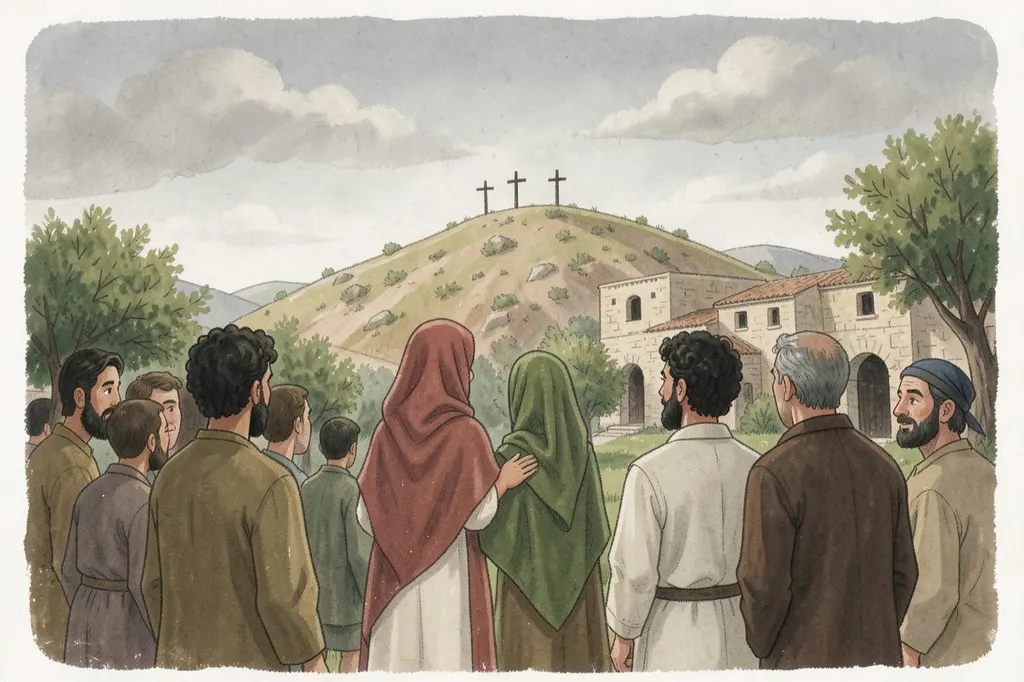
Jesus had made sick people well, and taught everyone about God, his Father. But some of the leaders in Jerusalem wanted Jesus to die. And the Roman governor, Pilate, let them have their way.
Soldiers took Jesus to a place called Calvary. There, they put him on a big wooden cross, to die.
This is the saddest part of the story. But it is not the end.
Even on the cross, Jesus prayed for the people who were hurting him:
“Father, forgive them; for they know not what they do.”
At midday, the sky went dark, and it stayed dark for three hours. Then Jesus called out in a loud voice:
“Father, into thy hands I commend my spirit”
To commend means to give something into someone's care. Jesus gave himself into his Father's hands. And then Jesus died.
His friends, and the women who had followed him all the way from Galilee, stood far off and watched.
Scene 2 of 6
The great stone
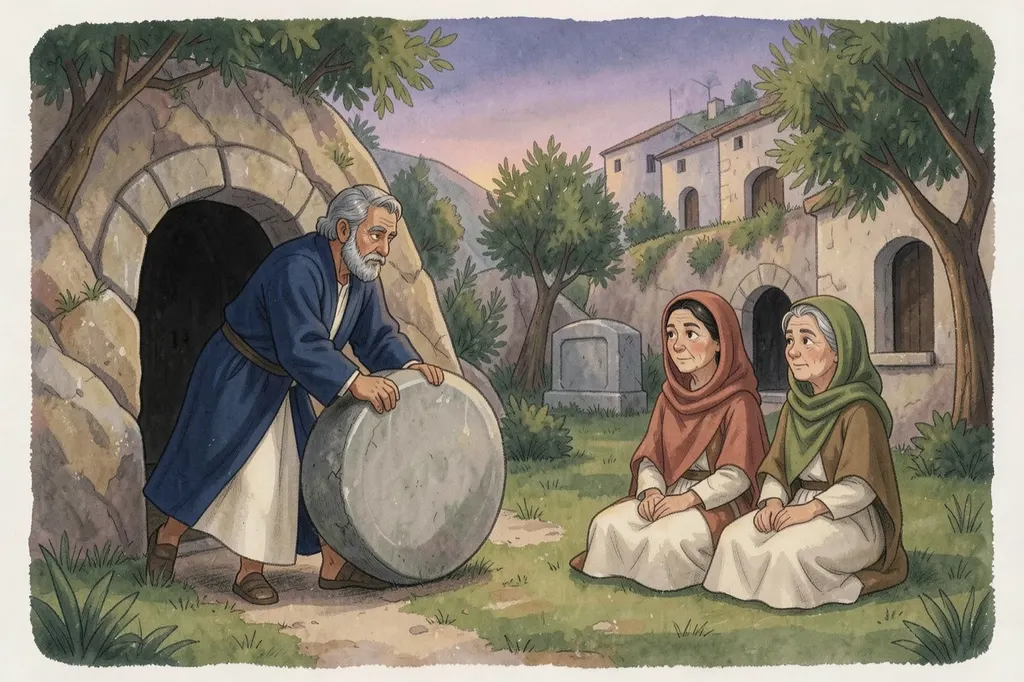
The book of Matthew tells us what happened next.
That evening, a rich man named Joseph went to see Pilate. Joseph came from a town called Arimathaea, and he was a follower of Jesus. He asked for Jesus' body, so that he could bury it. And Pilate said yes.
Joseph wrapped Jesus' body in a clean linen cloth. He laid him in his own new tomb, a small room cut into the rock. Then Joseph rolled a great stone across the door, and went away.
Two women sat across from the tomb. One was Mary Magdalene. The other was also named Mary.
The next day, the leaders went back to Pilate. They remembered that Jesus had once said, "After three days I will rise again." So they asked Pilate to make the tomb safe, in case Jesus' disciples came by night and took his body away.
So the leaders sealed the great stone. And they set soldiers to guard the tomb and keep watch.
Scene 3 of 6
He is not here
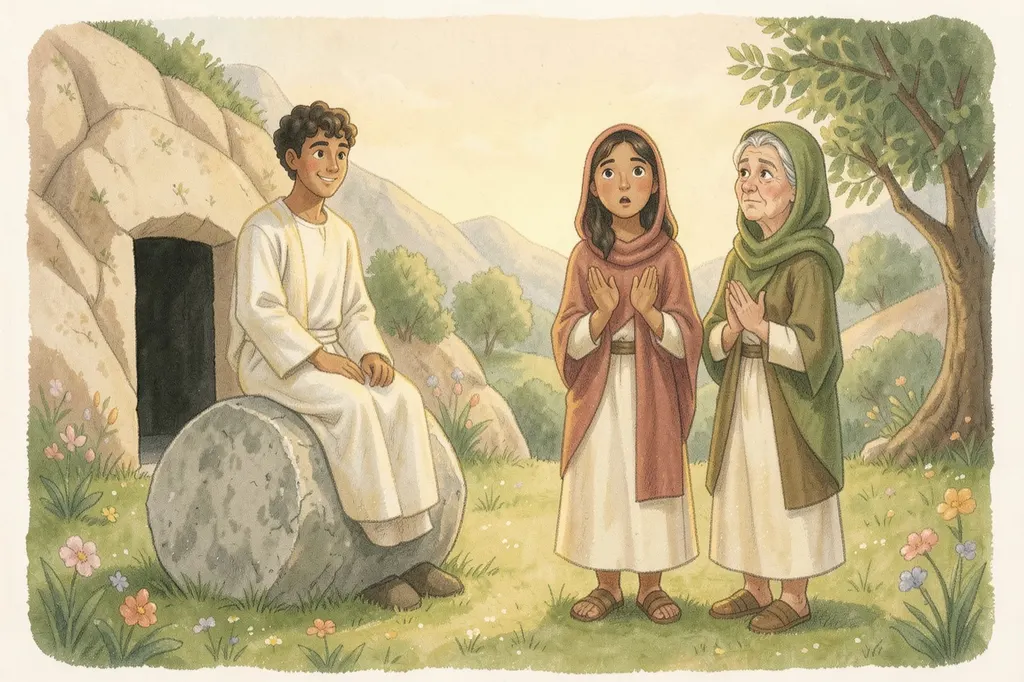
Very early on Sunday morning, as the sky began to grow light, Mary Magdalene and the other Mary came to see the tomb.
Suddenly, the ground shook. An angel of the Lord came down from heaven. He rolled the great stone back from the door, and he sat on it. His face shone like lightning, and his clothes were as white as snow.
The soldiers shook with fear, and fell down, and lay still.
But the angel told the women not to be afraid. He knew they were looking for Jesus. Then the angel said the best news in the world. Can you guess what it was?
“He is not here: for he is risen, as he said. Come, see the place where the Lord lay.”
Risen means alive again. Jesus had died, and now he was alive, just as he had said he would be.
Then the angel told the women to go quickly, and tell Jesus' disciples "that he is risen from the dead".
Scene 4 of 6
All hail
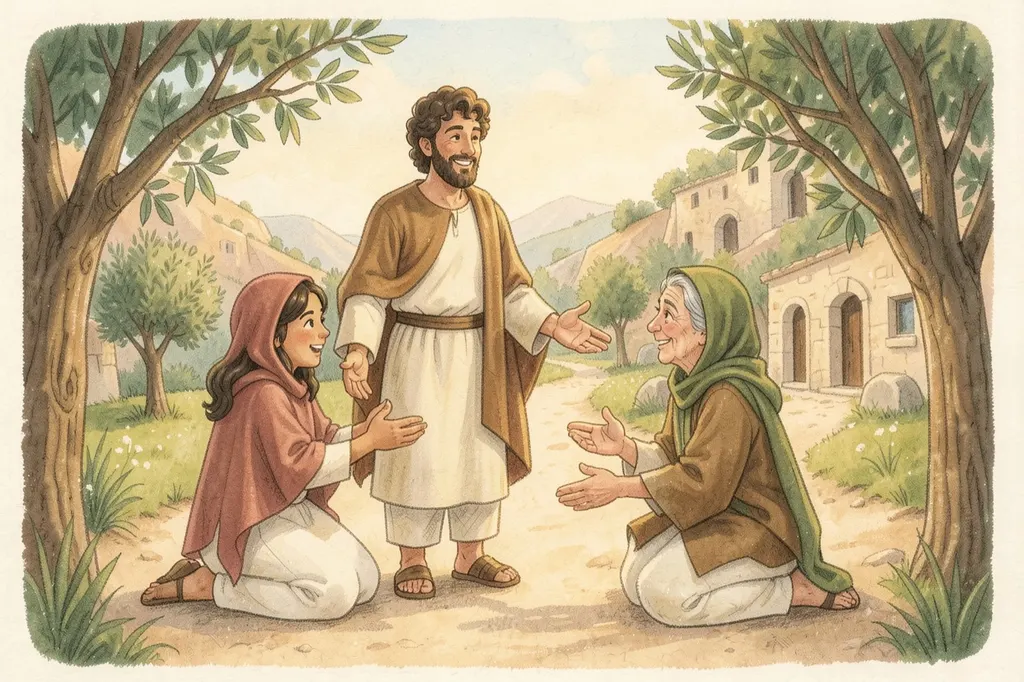
So the women ran from the tomb. They were afraid, and full of great joy, both at the same time. They ran to tell the disciples.
And on the way, all of a sudden, there was Jesus! He had come to meet them.
Jesus said to them, "All hail." That is an old way of saying hello, and be glad.
The women came near and held on to his feet, and they worshipped him.
Then Jesus gave them a message for his friends:
“Be not afraid: go tell my brethren that they go into Galilee, and there shall they see me.”
Brethren means brothers. Jesus called his friends his brothers. Off the women went, running, with the news.
Scene 5 of 6
Peace be unto you
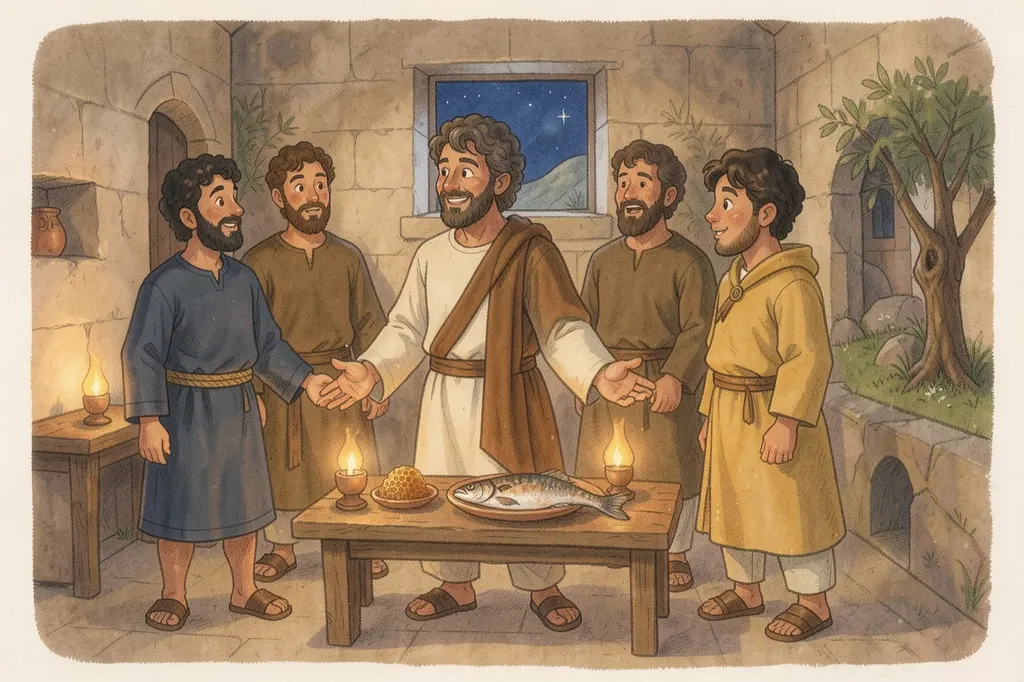
The book of Luke tells us what happened that same evening.
Jesus' friends were gathered together in Jerusalem, and they were saying:
“The Lord is risen indeed, and hath appeared to Simon.”
Simon is another name for Peter. And while they were still talking, Jesus himself stood among them, and said, "Peace be unto you."
His friends were frightened. They thought they were seeing a spirit.
Jesus told them to touch him and see that it was really him. He told them that a spirit does not have flesh and bones, as they could see he had. Then he showed them his hands and his feet.
His friends were so happy that they could hardly believe it.
Then Jesus asked them for something to eat. They gave him a piece of cooked fish, and some honeycomb, which is honey still in the wax. And Jesus ate it, right there in front of them.
Scene 6 of 6
With you always
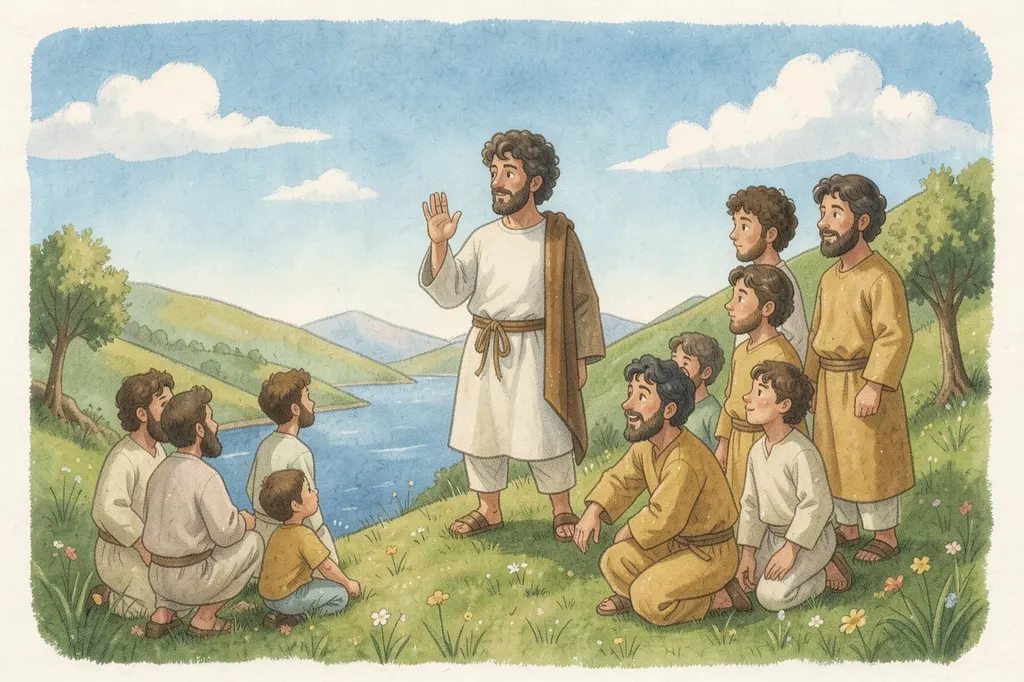
The book of Matthew tells us what happened some time later.
Jesus' eleven disciples went all the way to Galilee, to a mountain, just as Jesus had told them. And there they saw him. They worshipped him, though some of them were still not sure.
Jesus told them that all power in heaven and on earth had been given to him. He sent them out to every nation, to baptize people, and to teach them to do everything he had told them.
Then Jesus made them a promise:
“lo, I am with you alway, even unto the end of the world.”
Lo means look, or listen. Alway is an old way of saying always.
Do you remember the three words the angel said to the women? He is risen.
Can you say them too? He is risen.
Jesus' friends had been so sad. Then the stone was rolled away, and Jesus came to meet them.
He is risen, as he said.
And Jesus said, "I am with you alway."
How to tell the Easter story to a young child
Say the hard part plainly and briefly: Jesus died on a cross, and even there he prayed, "Father, forgive them" (Luke 23:34). Then let the joy carry the story: the great stone rolled away, the empty tomb, and the angel's words, "he is risen, as he said" (Matthew 28:6). Young children need the fact of the cross, not its details.
What this story shows about God
For grown-ups. The story itself never states a lesson, so here it is, with the verses behind it.
God keeps his word
Jesus said he would rise again on the third day. The angel's news at the empty tomb ended with three more words: as he said.
Matthew 28:6Jesus forgives
Even on the cross, Jesus asked his Father to forgive the people who were hurting him.
Luke 23:34Jesus is with his people always
The risen Jesus did not leave his friends alone. His last words in Matthew are a promise to be with them alway, even unto the end of the world.
Matthew 28:20Questions to ask after
Pick the ones that fit your child. There are no wrong answers.
Ages 3 to 5
- What three words did the angel say at the tomb?
- Where did the angel sit?
- What did Jesus eat in front of his friends?
Ages 6 to 9
- The women were afraid and full of joy at the same time. Have you ever felt two feelings at once?
- Jesus prayed for the people who were hurting him. Why do you think he did that?
- Jesus' friends thought he was a spirit. How did Jesus show them he was really alive?
Ages 10 to 12
- The leaders sealed the stone and set guards. Why do you think Matthew tells us that part?
- Some of the disciples on the mountain were still not sure. Why do you think the Bible is honest about that?
- Jesus said he would be with his friends always. What difference do you think that promise made to them?
If your child asks
Honest answers to the hard questions, with the verses behind them.
Why did Jesus have to die?
The Bible says "Christ died for our sins according to the scriptures" (1 Corinthians 15:3). In the Easter story, the risen Jesus tells his friends it was written long ago that he would suffer and rise from the dead the third day, and that forgiveness of sins would be preached in his name among all nations (Luke 24:46-47). For a young child: Jesus loved us and gave himself for us (Galatians 2:20), and God raised him up again.
1 Corinthians 15:3; Luke 24:46-47; Galatians 2:20
Was Jesus a ghost after he rose from the dead?
No. In the Easter story his friends thought so too, and Jesus answered, "handle me, and see; for a spirit hath not flesh and bones, as ye see me have" (Luke 24:39). He showed them his hands and feet, where the nails had been (John 20:25-27), and then ate a piece of broiled fish in front of them (Luke 24:42-43). He was really alive, body and all.
Luke 24:39-43
Was Jesus in the tomb for three whole days?
Not three whole days. In the Easter story Jesus died on "the preparation" (Luke 23:54), "the day before the sabbath" (Mark 15:42), which is our Friday. The tomb was empty very early on the first day of the week, our Sunday (Matthew 28:1). That Sunday, two of his friends said, "to day is the third day since these things were done" (Luke 24:21). Friday, Saturday and Sunday make the three days.
Luke 23:54; Mark 15:42; Matthew 28:1; Luke 24:21
Did anyone see Jesus come out of the tomb?
The Bible doesn't say anyone did. The Easter story in the Bible never describes the moment Jesus rose. In Matthew 28:2-6, an angel rolled back the stone and told the women, "He is not here: for he is risen". The tomb was already empty. Then Jesus met the women on the road (Matthew 28:9).
Matthew 28:2-6
Are the Easter bunny and Easter eggs in the Bible?
No. The Easter story in Matthew 28:1-10 and Luke 24 has no bunnies and no eggs. They are customs that grew up many hundreds of years later. The Bible's Easter is the cross, the great stone rolled away, and the angel's news: "he is risen, as he said" (Matthew 28:6).
Matthew 28:1-10
What we added and left out
Every quoted line in this story is the King James Bible, word for word.
What we added
- Short explanations of old words: commend, linen, risen, all hail, brethren, honeycomb, lo and alway.
- The first lines of the cross scene sum up Luke 23:1-25 in two sentences: some leaders wanted Jesus to die, and Pilate, the Roman governor, gave them their way (Luke 23:23-25). The word Roman is ours; Luke calls Pilate the governor (Luke 3:1).
- The opening question, the "listen for three words" frame, and one line of comfort at the cross: "This is the saddest part of the story. But it is not the end." The three words, he is risen, are the angel's in Matthew 28:6-7.
- The day names Friday and Sunday. The Bible says "the preparation" (Luke 23:54) and "the first day of the week" (Matthew 28:1).
- We say the guards "fell down, and lay still". Matthew 28:4 says they "became as dead men".
- We say Jesus asked for something to eat. The King James words are "Have ye here any meat?" (Luke 24:41), and meat there means food.
What we left out
- Jesus' arrest, Peter's denial and his trials (Luke 22:47 to 23:25), the crown of thorns and the beating (Matthew 27:26-31), and Simon of Cyrene carrying the cross (Luke 23:26). Palm Sunday and the Last Supper (with Jesus praying in the garden) have their own stories.
- How Jesus was put on the cross. We say only that he was put on a cross to die (Luke 23:33).
- The mocking at the cross and the soldiers casting lots for his clothes (Luke 23:34-38).
- The two men crucified beside Jesus, and his promise to one of them, "To day shalt thou be with me in paradise" (Luke 23:39-43).
- The torn curtain in the temple and the centurion's words (Luke 23:45-47), and the earthquake Matthew tells of when Jesus died (Matthew 27:51-54).
- The guards' report and the money they were paid to keep quiet (Matthew 28:11-15).
- Peter running to the tomb (Luke 24:12) and the two friends on the road to Emmaus (Luke 24:13-35).
- Mark's and Luke's tellings of that morning (Mark 16:1-8, Luke 24:1-11), where the women bring spices and find a young man in the tomb (Mark) or two men in shining clothes (Luke), and John's, where Mary Magdalene meets Jesus in the garden (John 20:1-18). We follow Matthew's account of the morning and do not blend them. Thomas and the breakfast on the beach (John 20:24 to 21:14) are left out too.
- What Jesus taught his friends after he ate (Luke 24:44-49), and Jesus going up into heaven (Luke 24:50-53).
Not in the Bible, so not in our story
Matthew, Mark, Luke and John never describe the moment Jesus rose, and none of them says it happened at sunrise: the tomb was already empty when the women came at dawn (Matthew 28:1-6). There are no Easter eggs or bunnies in the Bible. Luke and Matthew each tell part of the story; we tell the events in the order they happened, and say where one book hands over to the other.
Words from the story
Old Bible words your child might ask about.
- Cross
- Two big wooden beams. In Bible times the Romans put people on crosses to die.
- Calvary
- The place outside Jerusalem where Jesus died.
- Commend
- To give something into someone's care.
- Linen
- A soft cloth, often white.
- Tomb
- A place to bury someone. Jesus' tomb was a small room cut into the rock.
- Sepulchre
- An old word for a tomb.
- Risen
- Come back to life. Jesus had died, and God raised him up alive.
- All hail
- An old greeting that means hello, be glad.
- Brethren
- Brothers. Jesus called his friends his brethren.
- Disciples
- Jesus' closest friends and followers.
- Honeycomb
- Honey still in the wax the bees made.
- Alway
- An old way of saying always.
Sources and how we made this story
References
- Luke 23:33-49: King James Version and Berean Standard Bible
- Matthew 27:57-66: King James Version and Berean Standard Bible
- Matthew 28:1-7: King James Version and Berean Standard Bible
- Matthew 28:8-10: King James Version and Berean Standard Bible
- Luke 24:33-43: King James Version and Berean Standard Bible
- Matthew 28:16-20: King James Version and Berean Standard Bible
- King James Version (1769 Oxford text), public domain. Berean Standard Bible, public domain since 2023 (berean.bible).
- Background: Resurrection of Jesus on Wikipedia.
How we made this story
- The retelling. Written by Tinykiwi with AI assistance, following how we tell these stories, then checked line by line against the Bible text. Every quoted line is the King James Version, word for word. What we explained, added and left out is listed above.
- The pictures and narration. The illustrations are AI-generated and chosen by hand. The narration is an AI voice recorded ahead of time, and every recording is checked word for word against the text.
- These stories are part of Tinykiwi, an audio Bible App for Kids we are building. For apps you can use today, see our guide to the best Bible story apps for kids.
More Bible stories for kids
Coming soon: Samson, Pentecost, Gideon, The Baptism of Jesus.
Tinykiwi. Coming soon.
The audio Bible app for kids.
Tinykiwi is an audio Bible app for kids that turns Bible learning into family time at bedtime, in the car, or before church.