
Bible stories for kids
The Palm Sunday Story for Kids
Palm Sunday is the day Christians remember Jesus riding into Jerusalem on a donkey, while the crowds laid coats and branches on the road and shouted Hosanna. The triumphal entry is in Matthew 21, Mark 11, Luke 19 and John 12. Here is the Palm Sunday story for kids, from Matthew 21:1-17, to read aloud, hear narrated or see in the storybook, with the King James words beside every scene.
The storybook opens full screen, one page at a time. The whole story is also below, with the Bible text beside it.
Where it is in the Bible
- Bible passages
- Matthew 21:1-17. Mark 11:1-11, Luke 19:28-44 and John 12:12-19 tell it too.
- Who is in it
- Jesus, two of his disciples, the crowds, the children in the temple, and the chief priests and scribes
- Where it happens
- Bethphage and the Mount of Olives, then Jerusalem and its temple
- When
- A few days before the Passover, in the last week before Jesus died and rose again (John 12:1, John 12:12)
- Key verse
- “And the multitudes that went before, and that followed, cried, saying, Hosanna to the Son of David: Blessed is he that cometh in the name of the Lord; Hosanna in the highest.” (Matthew 21:9, KJV)
The story
This story is true. It is in the Bible, in the book of Matthew.
Have you ever cheered for someone, really loudly, because you were so glad they had come? In this story, a great crowd cheers for Jesus. Grown-ups and children all shout the very same words. Listen for them.
Scene 1 of 5
A donkey and her colt
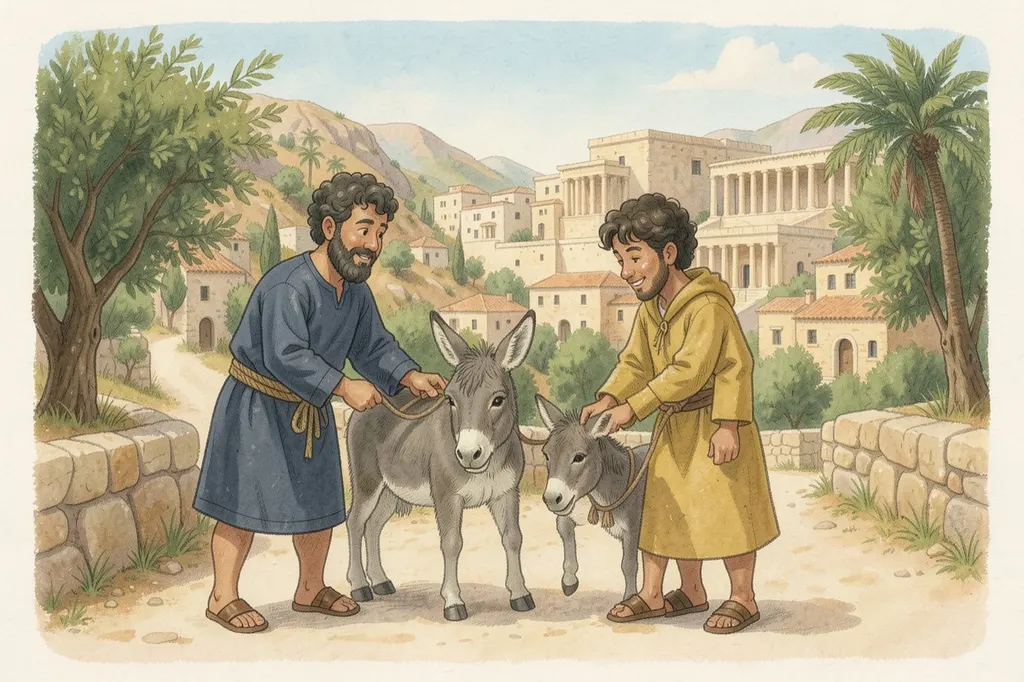
Jesus and his disciples were walking to Jerusalem, the great city where God's temple stood. They came to a place called Bethphage, by a hill called the Mount of Olives.
Jesus sent two of his disciples ahead, into the village nearby. There, he said, they would find a donkey tied up, with her colt beside her. A colt is a young donkey. They should untie them both and bring them to him. If anyone asked why, they should say that the Lord needed them.
Long before, one of God's prophets had said how a King would come:
“Behold, thy King cometh unto thee, meek, and sitting upon an ass”
Meek means gentle. And an ass is an old word for a donkey.
So the two disciples went, and did just as Jesus said. They brought the donkey and the colt. They spread their coats over them, and Jesus sat on top.
Scene 2 of 5
Coats and branches on the road
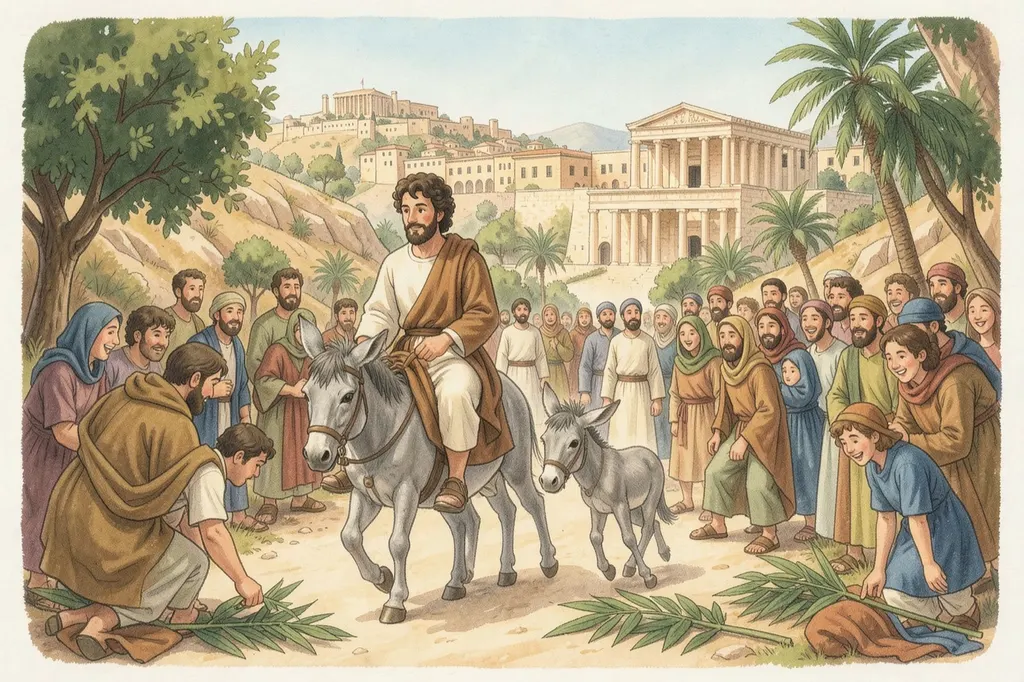
Then Jesus rode on toward Jerusalem, and a very great crowd came with him.
Many people took off their coats and spread them on the road in front of him. Others cut down branches from the trees and laid them on the road too.
The book of John tells us that people also came out to meet Jesus, carrying branches of palm trees. That is why this day is called Palm Sunday.
There were people walking in front of Jesus, and people walking behind him. And they all cried out together:
“Hosanna to the Son of David: Blessed is he that cometh in the name of the Lord; Hosanna in the highest.”
Hosanna is a big, glad shout of praise. Long ago, it meant please save us. And David was the great king of long ago. The people were calling Jesus their King, the King from David's family.
Scene 3 of 5
Who is this?
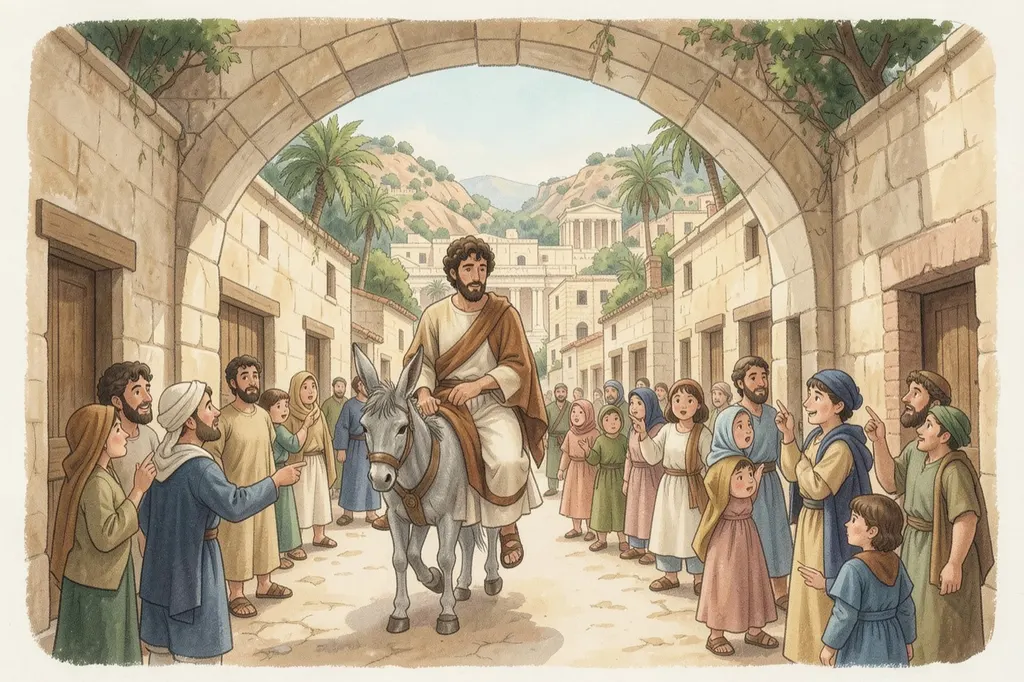
Then Jesus came into Jerusalem.
The whole city was stirred up. Stirred up means everyone was busy wondering and talking. All over Jerusalem, people were asking about the man riding on the donkey.
Everyone wanted to know the same thing:
“Who is this?”
And the crowd answered:
“This is Jesus the prophet of Nazareth of Galilee.”
A prophet is someone who brings messages from God. Nazareth was the small town where Jesus grew up, far to the north, in a land called Galilee. Now he had come all the way to Jerusalem.
Scene 4 of 5
A house of prayer
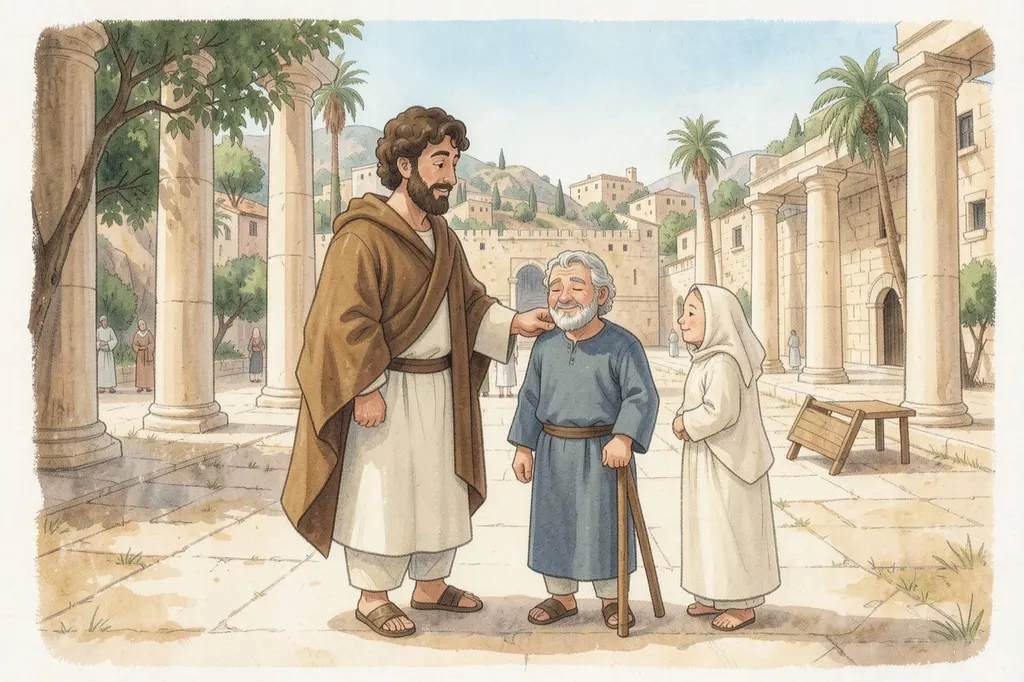
Then Jesus went into the temple of God. The temple was God's house, the great place where people came to pray.
But in the temple, people were buying and selling. Some were selling birds. Moneychangers sat at their tables, swapping one kind of money for another.
Jesus drove out everyone who was buying and selling. He turned over the moneychangers' tables, and the seats of the people selling birds. And he said:
“It is written, My house shall be called the house of prayer; but ye have made it a den of thieves.”
A den of thieves is a hiding place for robbers.
Then, right there in the temple, people who could not see came to Jesus. People who could not walk came too. And Jesus healed them.
Scene 5 of 5
The children's song
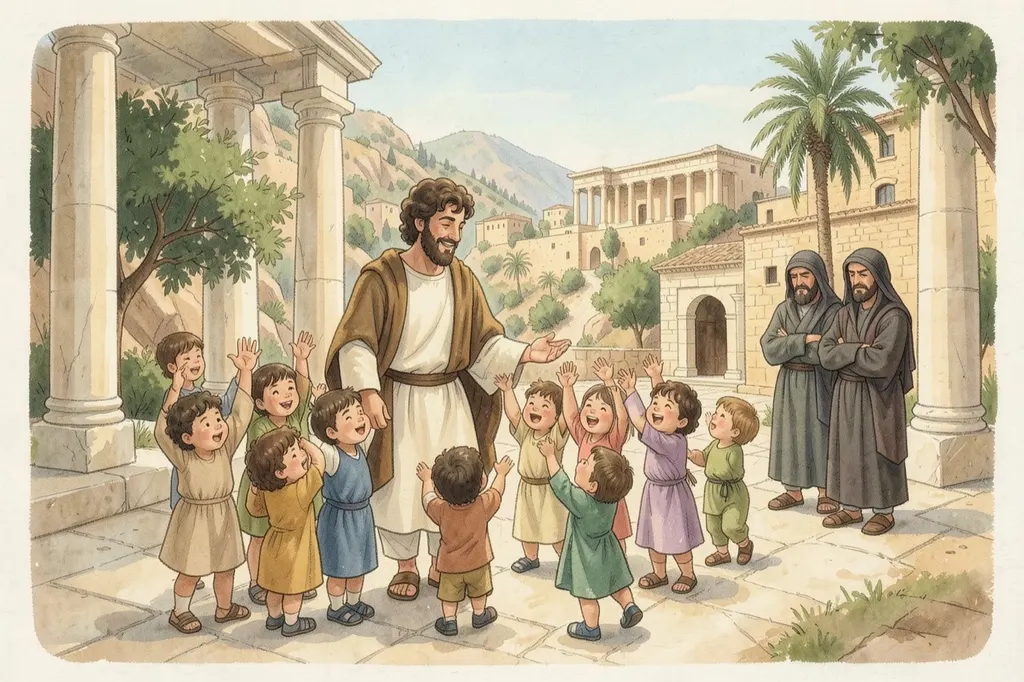
There were children in the temple too. And they were calling out the very same words the crowd had shouted on the road:
“Hosanna to the Son of David”
The chief priests and the scribes were important leaders. They saw the wonderful things Jesus did. They heard what the children were saying. And they were not pleased at all.
They asked Jesus if he could hear what these children were saying. Jesus said yes. Then he answered them with words from the scriptures:
“Out of the mouth of babes and sucklings thou hast perfected praise”
Babes and sucklings are babies and very little children. Perfected means made perfect.
Then Jesus left them. He went out of the city, to Bethany. And there, he stayed the night.
Do you remember the words the people shouted? Hosanna to the Son of David.
The crowd shouted it on the road, with coats and branches in front of Jesus.
The children shouted it in the temple.
Can you say it too? Hosanna to the Son of David.
Blessed is he that cometh in the name of the Lord.
How to explain Palm Sunday to a child
Palm Sunday is the day Jesus rode into Jerusalem on a donkey, and the crowds welcomed him as their King, laying coats and branches on the road and shouting "Hosanna to the Son of David" (Matthew 21:9). Point out that he came gently, just as the prophet said (Matthew 21:5), and that children joined the praise too. The Easter story tells what happened that week.
What this story shows about God
For grown-ups. The story itself never states a lesson, so here it is, with the verses behind it.
God keeps his word
Long before, a prophet said a King would come riding on a donkey. Matthew tells us Jesus' ride into Jerusalem happened so those words would come true.
Matthew 21:4-5The King came gently
Jesus came as a King, but meek, riding a donkey. And after he cleared the temple, the blind and the lame came to him there, and he healed them.
Matthew 21:5; Matthew 21:14God welcomes children's praise
When the leaders were sore displeased at the children's shouts, Jesus answered with the scriptures: out of the mouth of babes and sucklings, praise is made perfect.
Matthew 21:15-16Questions to ask after
Pick the ones that fit your child. There are no wrong answers.
Ages 3 to 5
- What animal did Jesus ride into Jerusalem?
- What did the people put on the road in front of Jesus?
- What words did the children shout in the temple?
Ages 6 to 9
- The prophet said the King would come meek, which means gentle. Why do you think Jesus rode a donkey?
- How do you think the children felt, shouting Hosanna in the temple?
- The whole city asked, Who is this? How would you answer?
Ages 10 to 12
- Why do you think the temple leaders were not pleased when the children praised Jesus?
- Jesus called the temple a house of prayer. What had it become instead, and why do you think that mattered to him?
- The crowd called Jesus the Son of David. What kind of King do you think they hoped for?
If your child asks
Honest answers to the hard questions, with the verses behind them.
Why is it called Palm Sunday?
The name comes from John 12:13, which says the crowd "took branches of palm trees, and went forth to meet him" as Jesus came to Jerusalem. Matthew 21:8 says only "branches from the trees". The Bible doesn't call the day Sunday; Christians remember Jesus riding into Jerusalem on the Sunday before Easter, the start of the week that led to the cross and the empty tomb.
John 12:12-13
Why did Jesus ride a donkey on Palm Sunday?
Matthew 21:4-5 says it happened so that a prophet's words would come true: "Behold, thy King cometh unto thee, meek, and sitting upon an ass". The prophet was Zechariah (Zechariah 9:9). Jesus came as a King, but a gentle one. With a child, you can say Jesus came the way God had said, long before.
Matthew 21:4-5; Zechariah 9:9
Was Jesus angry when he turned over the tables in the temple?
Matthew 21:12-13 doesn't say how Jesus felt. It tells what he did, driving out the buyers and sellers and turning over the moneychangers' tables, and it gives his reason in his own words: God's house should be "called the house of prayer". Right after, the blind and the lame came to him in the temple, and he healed them (Matthew 21:14). With a child, you can say Jesus wanted God's house to be a place for prayer, and then he made people well there.
Matthew 21:12-14
Were the people who shouted Hosanna the same people who later shouted crucify him?
The Bible doesn't say so. Matthew 21:9 tells of the crowds on the road into Jerusalem. Days later, Matthew 27:20-23 says the chief priests and elders persuaded the crowd before Pilate to ask for Barabbas and to destroy Jesus, and that crowd cried out for him to be crucified. Many people assume it was the same crowd, but Matthew never says it was. The Easter story tells what happened that week.
Matthew 21:9; Matthew 27:20-23
What does Hosanna mean?
Hosanna is a Hebrew word that means save now, or please save us. The crowd's words in the Palm Sunday story (Matthew 21:9) echo Psalm 118:25-26: "Save now, I beseech thee, O LORD" and "Blessed be he that cometh in the name of the LORD". By Jesus' time it was also a glad shout of praise, the way the children used it in Matthew 21:15.
Matthew 21:9; Psalm 118:25-26
What we added and left out
Every quoted line in this story is the King James Bible, word for word.
What we added
- Plain explanations of old words, in the next breath: colt, meek, ass, Hosanna, Son of David, stirred up, prophet, moneychangers, den of thieves, babes and sucklings, perfected.
- One sentence from the book of John: people came out to meet Jesus with "branches of palm trees" (John 12:12-13). Matthew 21:8 says only "branches from the trees". The story names John when it says so.
- We follow Matthew's order, where Jesus clears the temple on the day he rides in. Mark 11:11-17 says he looked round the temple that evening and cleared it the next day.
- We say people all over Jerusalem were asking about the man on the donkey. Matthew 21:10 says "all the city was moved, saying, Who is this?"
- Three questions from the narrator to your child, and the "listen for the words" frame. The words, Hosanna to the Son of David, are said in Matthew 21:9 and Matthew 21:15.
What we left out
- The full words of the prophet Zechariah (Zechariah 9:9), of which Matthew 21:5 quotes part, and the colt "the foal of an ass" from the same verse.
- Luke's account of the Pharisees asking Jesus to quiet his disciples, when he said the stones would cry out, and of Jesus weeping over Jerusalem (Luke 19:39-44).
- John's account of the people who came because Jesus had raised Lazarus, and the Pharisees' worry that the world had gone after him (John 12:9-11, John 12:17-19).
- Mark's and Luke's detail that the colt had never been ridden (Mark 11:2, Luke 19:30).
- Everything after that night: the fig tree the next morning (Matthew 21:18-22), the Last Supper and the first Easter, which are stories of their own.
Not in the Bible, so not in our story
The Bible doesn't call this day Palm Sunday or say it was a Sunday. The name comes from John 12:13, where the branches are palm branches, and from the church year. Matthew 21:8 says the branches were laid on the road, and none of the four Gospels says they were waved. Matthew also says the disciples brought two animals, a donkey and her colt (Matthew 21:7), where most pictures show one.
Words from the story
Old Bible words your child might ask about.
- Hosanna
- A shout of praise. It is a Hebrew word that first meant save now, or please save us.
- Son of David
- A name for the promised King from the family of King David.
- Ass
- An old word for a donkey.
- Colt
- A young donkey. The Bible also calls it the foal of an ass.
- Meek
- Gentle and humble.
- Prophet
- Someone who brings messages from God.
- Mount of Olives
- A hill just outside Jerusalem, covered in olive trees.
- Temple
- God's house in Jerusalem, where people came to pray and worship.
- Moneychangers
- People who swapped one kind of money for another, for a fee.
- Den of thieves
- A hiding place for robbers.
- Scribes
- Teachers who copied and explained God's law.
- Babes and sucklings
- Babies and very little children.
- Lodged
- Stayed the night.
Sources and how we made this story
References
- Matthew 21:1-7: King James Version and Berean Standard Bible
- Matthew 21:8-9: King James Version and Berean Standard Bible
- Matthew 21:10-11: King James Version and Berean Standard Bible
- Matthew 21:12-14: King James Version and Berean Standard Bible
- Matthew 21:15-17: King James Version and Berean Standard Bible
- King James Version (1769 Oxford text), public domain. Berean Standard Bible, public domain since 2023 (berean.bible).
- Background: Triumphal entry into Jerusalem on Wikipedia.
How we made this story
- The retelling. Written by Tinykiwi with AI assistance, following how we tell these stories, then checked line by line against the Bible text. Every quoted line is the King James Version, word for word. What we explained, added and left out is listed above.
- The pictures and narration. The illustrations are AI-generated and chosen by hand. The narration is an AI voice recorded ahead of time, and every recording is checked word for word against the text.
- These stories are part of Tinykiwi, an audio Bible App for Kids we are building. For apps you can use today, see our guide to the best Bible story apps for kids.
More Bible stories for kids
Coming soon: Samson, Pentecost, Gideon, The Baptism of Jesus.
Tinykiwi. Coming soon.
The audio Bible app for kids.
Tinykiwi is an audio Bible app for kids that turns Bible learning into family time at bedtime, in the car, or before church.