
Bible stories for kids
Cain and Abel for Kids
Cain and Abel were the first two sons of Adam and Eve, and their story is in Genesis 4:1-16: two gifts for God, a warning about sin at the door, and a question God asked in the field. Here is the Cain and Abel story for kids and children, told gently, to read aloud, hear narrated or see as a picture storybook, with the King James words beside every scene.
The storybook opens full screen, one page at a time. The whole story is also below, with the Bible text beside it.
Where it is in the Bible
- Bible passages
- Genesis 4:1-16, with Seth's birth in Genesis 4:25-26. Adam and Eve's story comes just before it, in Genesis 2 and 3.
- Who is in it
- Cain, his brother Abel, their parents Adam and Eve, and the Lord
- Where it happens
- The fields outside Eden; afterwards Cain dwelt in the land of Nod, on the east of Eden (Genesis 4:16)
- When
- At the very beginning, after Adam and Eve left the garden of Eden (Genesis 4:1)
- Key verse
- “And the LORD said unto Cain, Where is Abel thy brother? And he said, I know not: Am I my brother's keeper?” (Genesis 4:9, KJV)
The story
This story is true. It is in the Bible, in the book of Genesis.
Have you ever felt so angry that your whole face went cloudy? In this story, a big brother gets very angry. Then God asks him a question about his little brother. Listen for it.
Scene 1 of 6
Two brothers
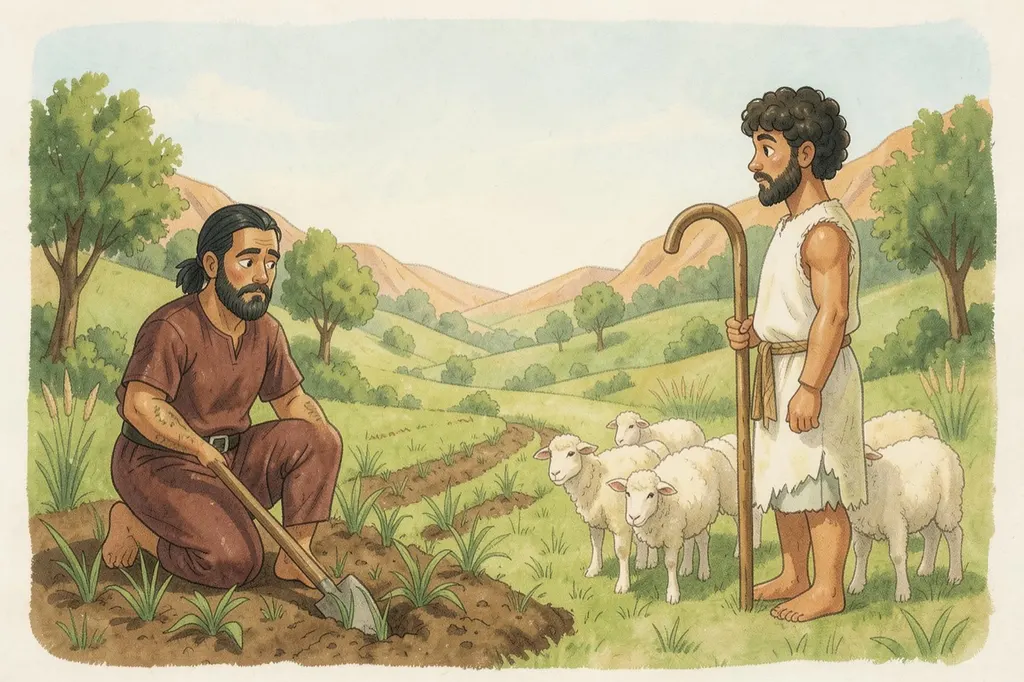
Adam and Eve were the first man and woman God made. After they left the garden of Eden, God gave them a baby boy.
Eve called him Cain. She said the Lord had helped her to have him.
Then Eve had another baby boy. His name was Abel. Cain was the big brother, and Abel was the little brother.
The two boys grew up, and each of them had his own work to do.
“And Abel was a keeper of sheep, but Cain was a tiller of the ground.”
A keeper of sheep is a shepherd, who looks after a flock. A tiller of the ground is a farmer. Cain dug the soil and grew good things to eat.
So Abel had his sheep. And Cain had his fields.
Scene 2 of 6
Two gifts for God
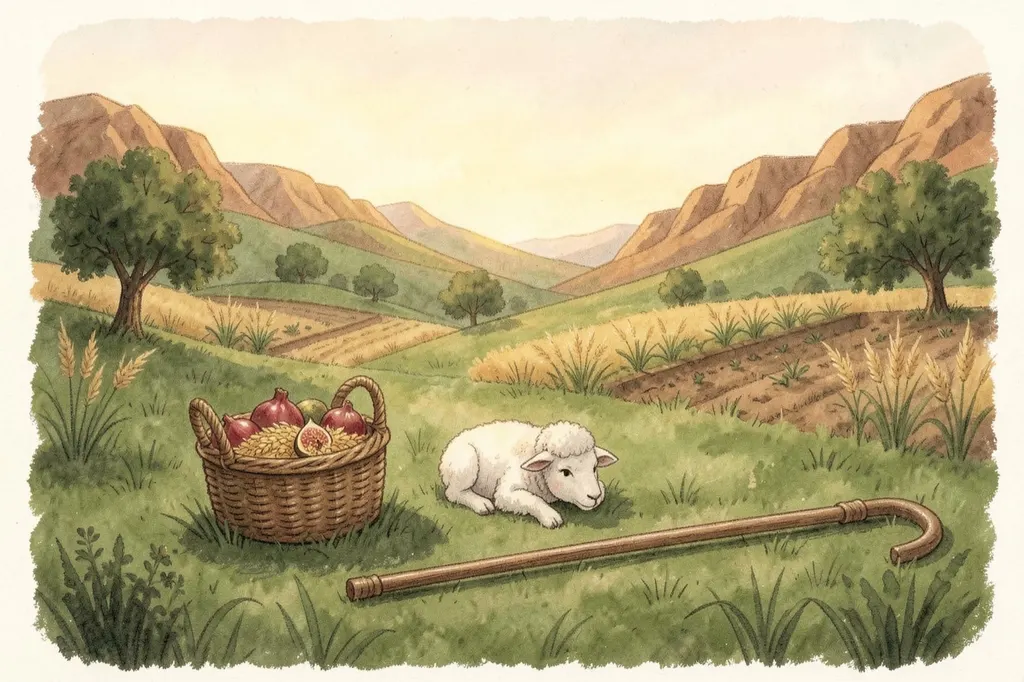
After a while, the two brothers each brought an offering to the Lord. An offering is a gift given to God.
Cain brought some of the fruit of the ground, from the food he had grown in his fields.
Abel brought some of the firstlings of his flock, the very first lambs to be born. He brought the fat parts too, the richest part of all.
Then the Bible tells us what God did.
“And the LORD had respect unto Abel and to his offering:”
Had respect means God looked at Abel and his gift, and was pleased. But God did not look that way at Cain and his gift.
The book of Genesis doesn't tell us why. It only tells us what Cain did next.
Cain was very wroth. Wroth is an old word for angry. And his countenance fell. Countenance means a face, and the look on it. Cain's face went dark and heavy.
Scene 3 of 6
Sin at the door
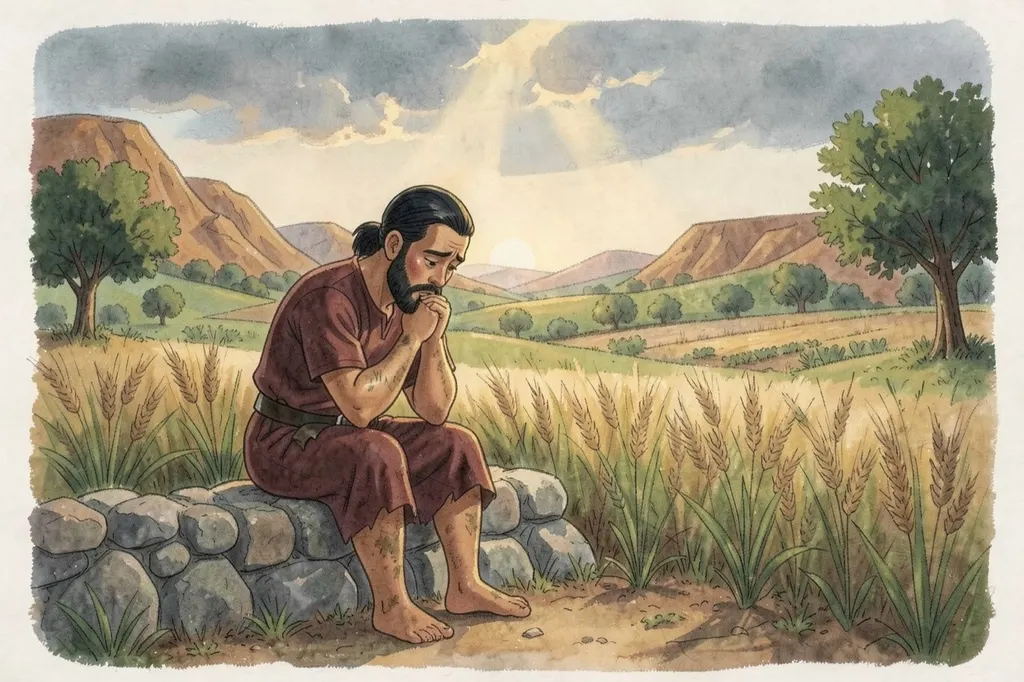
Then the Lord spoke to Cain.
God asked Cain why he was so angry. And God asked why his face had fallen.
Then God told Cain something very important.
“If thou doest well, shalt thou not be accepted? and if thou doest not well, sin lieth at the door.”
If thou doest well means if you do what is right. If Cain did what was right, God would welcome him too.
But if not, sin was waiting for him, right at his door, like something lying outside, ready to come in. Sin is doing what God says is wrong.
God told Cain that sin wanted to have him. But Cain must rule over it.
God had warned Cain. Now what would Cain do?
Scene 4 of 6
A question in the field
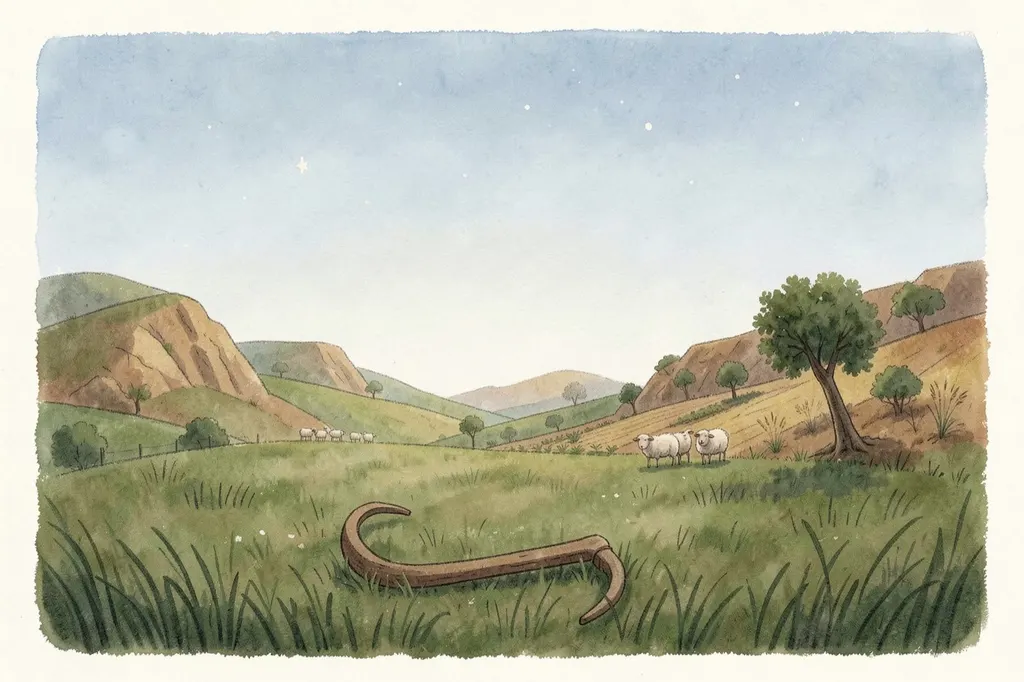
Cain talked with his brother Abel. And when the two of them were out in the field, Cain turned against Abel.
This is the saddest part of the story. Cain killed his brother Abel.
Then the Lord spoke to Cain again. Listen to what God asked him:
“And the LORD said unto Cain, Where is Abel thy brother? And he said, I know not: Am I my brother’s keeper?”
A keeper is someone who looks after someone else. Abel had been a keeper of sheep. Now Cain asked if he was supposed to look after his brother.
But God knew what had happened. God asked Cain what he had done. And God said that the voice of Abel's blood was crying out to him from the ground.
Then God told Cain that the ground would not grow good food for him any more. Cain would have to leave his home, and wander from place to place.
Scene 5 of 6
God's mark on Cain
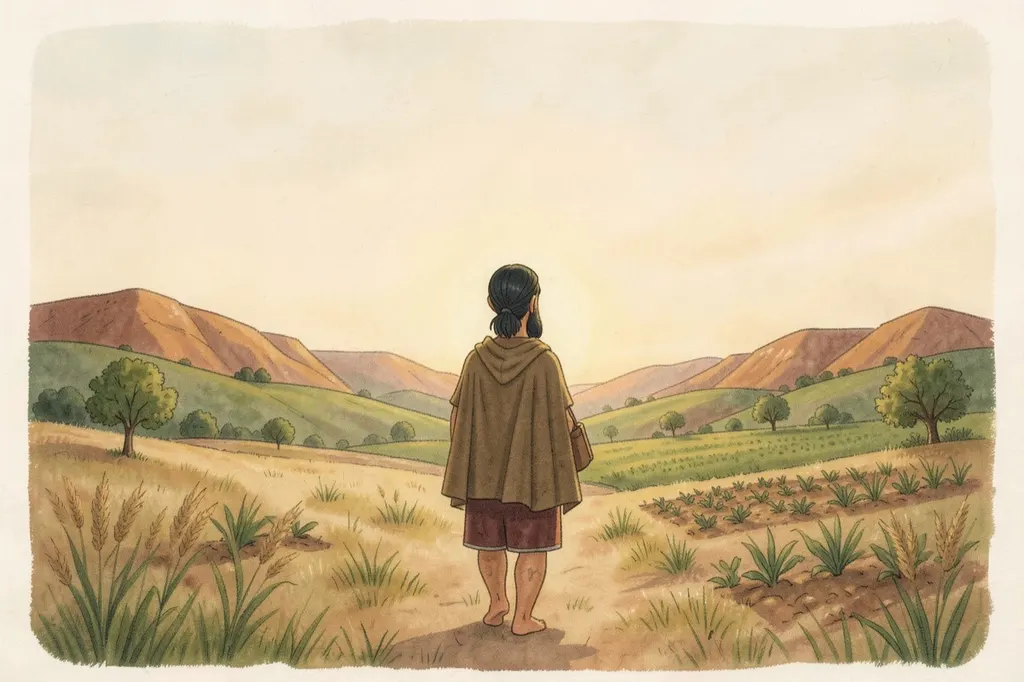
Cain said to the Lord:
“My punishment is greater than I can bear.”
Cain was afraid. He would be sent away from his home, and away from God's face. And he was afraid that anyone who found him might kill him.
But God answered Cain. God said that anyone who killed Cain would be punished seven times over.
“And the LORD set a mark upon Cain, lest any finding him should kill him.”
Lest means so that it would not happen. God put the mark on Cain to keep him safe. The Bible doesn't tell us what the mark looked like.
Then Cain went out, away from the Lord. He made his home in a land called Nod, to the east of Eden.
Scene 6 of 6
A new baby
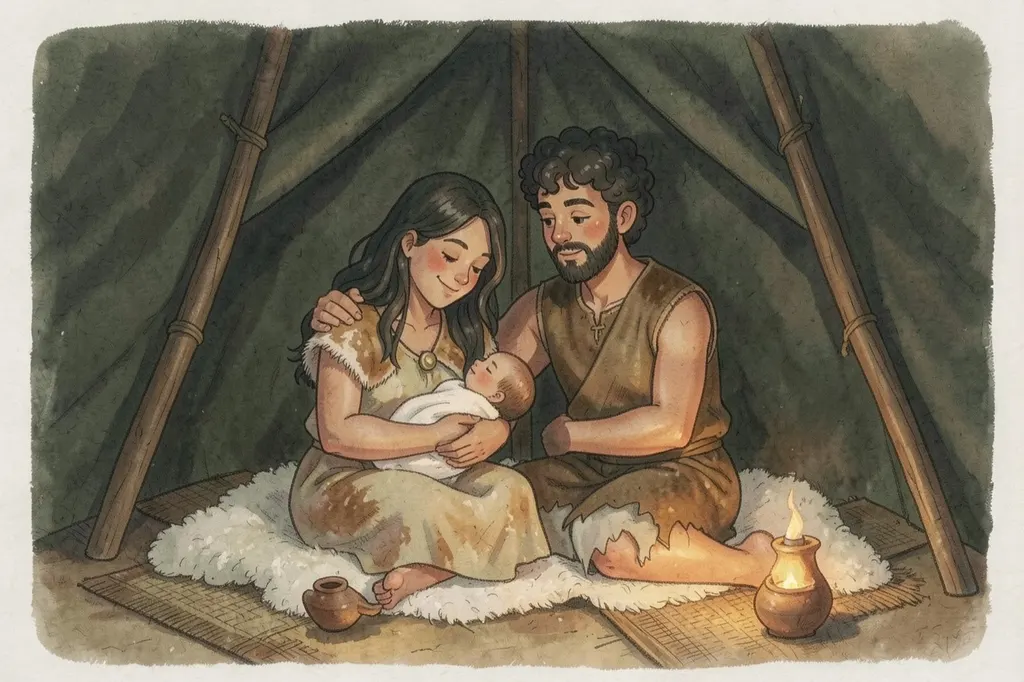
Some time later, God gave Adam and Eve another baby boy.
Eve called him Seth. She said that God had given her another child, in place of Abel.
Seth grew up, and he had a son of his own. His name was Enos.
And the Bible tells us what began to happen, in the days of Seth and Enos:
“then began men to call upon the name of the LORD.”
To call upon the name of the Lord means to pray to God, and worship him, and call him by his name.
Do you remember the question God asked Cain, out in the field? Where is Abel thy brother?
Can you say it too? Where is Abel thy brother?
Abel kept his sheep. Cain worked his fields. And each of them brought a gift to God.
God set a mark on Cain, to keep him safe.
And Adam and Eve had a new baby, Seth.
Then began men to call upon the name of the Lord.
How to explain Cain and Abel to a child
Tell the hard part plainly, once: Cain was angry, and he killed his brother Abel (Genesis 4:8). Then point to what God did around it. Before, God warned Cain and told him he could still do well (Genesis 4:7). After, God asked, "Where is Abel thy brother?" (Genesis 4:9), and still set a mark on Cain to keep him safe (Genesis 4:15).
What this story shows about God
For grown-ups. The story itself never states a lesson, so here it is, with the verses behind it.
God warned Cain before anything happened
When Cain was angry, God came to him, asked why, and told him he could still do well. He warned Cain that sin was at the door, and that he must rule over it.
Genesis 4:6-7God asked after Abel
God asked Cain, "Where is Abel thy brother?" Abel mattered to God, and God said, "the voice of thy brother's blood crieth unto me from the ground."
Genesis 4:9-10God protected Cain
Even after Cain killed his brother, God set a mark on him so that no one would kill him.
Genesis 4:15God gave a new beginning
God gave Adam and Eve another son, Seth, and in his days people began to call upon the name of the Lord.
Genesis 4:25-26Questions to ask after
Pick the ones that fit your child. There are no wrong answers.
Ages 3 to 5
- What work did Abel do? What work did Cain do?
- What question did God ask Cain in the field?
- What did God give Adam and Eve at the end of the story?
Ages 6 to 9
- God warned Cain that sin was waiting at his door. What do you think that means?
- God talked to Cain before anything bad happened. What did God want Cain to do?
- Have you ever felt so angry with someone you love that it scared you? What helped?
Ages 10 to 12
- Cain answered God, "Am I my brother's keeper?" How would you answer that question?
- God punished Cain, and also protected him with a mark. Why do you think God did both?
- Genesis doesn't say why God was pleased with Abel's gift and not Cain's. What do you think the story wants us to notice instead?
If your child asks
Honest answers to the hard questions, with the verses behind them.
Why did God accept Abel's offering and not Cain's?
Genesis 4:4-5 doesn't say why. It tells us that Abel brought "the firstlings of his flock and of the fat thereof", and that God had respect unto Abel and his offering, but not unto Cain and his. Hebrews 11:4 adds that Abel offered "a more excellent sacrifice than Cain", and did it "by faith". And in the Cain and Abel story, God still told Cain, "If thou doest well, shalt thou not be accepted?" (Genesis 4:7).
Genesis 4:4-7; Hebrews 11:4
How do I tell a young child that Cain killed Abel?
Keep it as short as the Bible does. Genesis 4:8 tells it in one line: Cain "rose up against Abel his brother, and slew him." Say it plainly, once, without detail. Then move to what God did next in the Cain and Abel story: he spoke to Cain and asked, "Where is Abel thy brother?" (Genesis 4:9). Children can hold a sad fact when it is told calmly.
Genesis 4:8-9
What was the mark of Cain?
The Bible never says what the mark looked like or where it was. In the Cain and Abel story, Genesis 4:15 says only why God gave it: "lest any finding him should kill him". It was God's protection. It has nothing to do with skin colour, though some people in the past wrongly taught that it did.
Genesis 4:15
Why did God protect Cain after what he did?
Genesis doesn't tell us why, only what God did. Cain was punished: the ground would not grow food for him, and he had to wander far from home (Genesis 4:12-16). But when Cain was afraid of being killed, "the LORD set a mark upon Cain, lest any finding him should kill him" (Genesis 4:15). In the Cain and Abel story, God stayed merciful even to Cain.
Genesis 4:12-16
Who were the other people Cain was afraid of, and who did he marry?
The Cain and Abel story doesn't say. Genesis 5:4 tells us that Adam "begat sons and daughters", so the first family was bigger than the three sons the Bible names. Genesis 4:17 mentions Cain's wife but not her name. Many Christians understand that, at the very beginning, people married within the one family.
Genesis 4:17; Genesis 5:4
What we added and left out
Every quoted line in this story is the King James Bible, word for word.
What we added
- Plain explanations of old words, in the next breath: keeper of sheep, tiller of the ground, offering, firstlings, had respect, wroth, countenance, sin lieth at the door, keeper, lest, call upon the name of the Lord.
- A short opening nod to Adam and Eve, whose story is told on its own page. Genesis 4:1 begins straight away with Cain's birth.
- We call Cain the big brother and Abel the little brother. Genesis 4:1-2 says Cain was born first, then "his brother Abel".
- We describe sin lying at the door as something lying outside, ready to come in. The Berean Standard Bible says sin is "crouching at your door".
- We say Cain turned against Abel and killed his brother. The King James says Cain "rose up against Abel his brother, and slew him" (Genesis 4:8).
- We say God knew what had happened before he asked Cain, and give his words in plain speech: "the voice of thy brother's blood crieth unto me from the ground" (Genesis 4:10).
- We say Cain was afraid. Genesis 4:14 gives his words: "every one that findeth me shall slay me."
- We say God put the mark on Cain to keep him safe. Genesis 4:15 says it was given "lest any finding him should kill him".
- The question to the child, "Have you ever felt so angry that your whole face went cloudy?", and the "listen for it" frame. God's question, "Where is Abel thy brother?", is in Genesis 4:9.
What we left out
- Adam and Eve's own story (Genesis 2 and 3), told on its own page. We give it one sentence.
- The exact words of Eve at Cain's birth, "I have gotten a man from the LORD" (Genesis 4:1), given in plain words.
- What Cain said to Abel before they went to the field. The King James says only "Cain talked with Abel his brother" (Genesis 4:8); some modern Bibles, like the Berean Standard Bible, add "Let us go out to the field."
- God's words that Cain was cursed from the earth, "which hath opened her mouth to receive thy brother's blood from thy hand" (Genesis 4:11), and the words "a fugitive and a vagabond" (Genesis 4:12, 14), given in plain words.
- Cain's family and the city he built, and Lamech's song (Genesis 4:17-24).
- Eve's words that Cain slew Abel, at Seth's birth (Genesis 4:25). We say only that God gave her another child in place of Abel.
- The New Testament verses about Abel: Hebrews 11:4, Hebrews 12:24, 1 John 3:12 and Matthew 23:35. Some are in the questions below.
Not in the Bible, so not in our story
Genesis never says why God was pleased with Abel's gift and not Cain's (Genesis 4:4-5), and it never uses the word jealous: it says Cain was "very wroth", very angry. It doesn't say how Abel died or what Cain used, or what the mark on Cain looked like (Genesis 4:15). And it doesn't say Cain and Abel were boys when it happened: they were old enough to have work of their own (Genesis 4:2).
Words from the story
Old Bible words your child might ask about.
- Keeper of sheep
- A shepherd: someone who looks after a flock of sheep.
- Tiller of the ground
- A farmer who digs the soil and grows food.
- Offering
- A gift given to God.
- Firstlings
- The very first lambs born in a flock.
- Had respect unto
- Looked at with favour, and was pleased with.
- Wroth
- An old word for angry.
- Countenance
- Your face, and the look on it.
- Sin
- Doing what God says is wrong.
- Keeper
- Someone who looks after someone or something.
- Fugitive and vagabond
- Someone who has to keep moving, with no home to stay in.
- Nod
- The land east of Eden where Cain made his home.
- Seed
- In the Bible, seed can mean a child, and children after them.
Sources and how we made this story
References
- Genesis 4:1-2: King James Version and Berean Standard Bible
- Genesis 4:3-5: King James Version and Berean Standard Bible
- Genesis 4:6-7: King James Version and Berean Standard Bible
- Genesis 4:8-12: King James Version and Berean Standard Bible
- Genesis 4:13-16: King James Version and Berean Standard Bible
- Genesis 4:25-26: King James Version and Berean Standard Bible
- King James Version (1769 Oxford text), public domain. Berean Standard Bible, public domain since 2023 (berean.bible).
- Background: Cain and Abel on Wikipedia.
How we made this story
- The retelling. Written by Tinykiwi with AI assistance, following how we tell these stories, then checked line by line against the Bible text. Every quoted line is the King James Version, word for word. What we explained, added and left out is listed above.
- The pictures and narration. The illustrations are AI-generated and chosen by hand. The narration is an AI voice recorded ahead of time, and every recording is checked word for word against the text.
- These stories are part of Tinykiwi, an audio Bible App for Kids we are building. For apps you can use today, see our guide to the best Bible story apps for kids.
More Bible stories for kids
Coming soon: Samson, Pentecost, Gideon, The Baptism of Jesus.
Tinykiwi. Coming soon.
The audio Bible app for kids.
Tinykiwi is an audio Bible app for kids that turns Bible learning into family time at bedtime, in the car, or before church.