
Bible stories for kids
Jacob and Esau for Kids
Jacob and Esau were twin brothers, the sons of Isaac and Rebekah, and their story is in Genesis 25 to 33: the bowl of red stew, the stolen blessing, and the day Esau ran to meet Jacob. Here is the Jacob and Esau story for kids and children, to read aloud, hear narrated or see as a picture storybook, with the King James words beside every scene.
The storybook opens full screen, one page at a time. The whole story is also below, with the Bible text beside it.
Where it is in the Bible
- Bible passages
- Genesis 25:19-34, 27, 32 and 33. Jacob's ladder dream (Genesis 28) and his years with Laban (Genesis 29 to 31) come in between.
- Who is in it
- Isaac, his wife Rebekah, and their twin sons Esau and Jacob
- Where it happens
- Beersheba in Canaan, where Isaac lived (Genesis 28:10); Haran, where Jacob ran to his uncle Laban; and the road home, where Esau came from Seir to meet him (Genesis 32:3)
- When
- In the days of Abraham's son Isaac, who was sixty when the twins were born (Genesis 25:26). Jacob was away from home for twenty years (Genesis 31:41)
- Key verse
- “And Esau ran to meet him, and embraced him, and fell on his neck, and kissed him: and they wept.” (Genesis 33:4, KJV)
The story
This story is true. It is in the Bible, in the book of Genesis.
Do you have a brother or a sister? Have you ever been so cross with them that you stayed away? In this story, two brothers stay apart for twenty years. Listen for two words that keep coming back: my brother.
Scene 1 of 6
Two babies at once
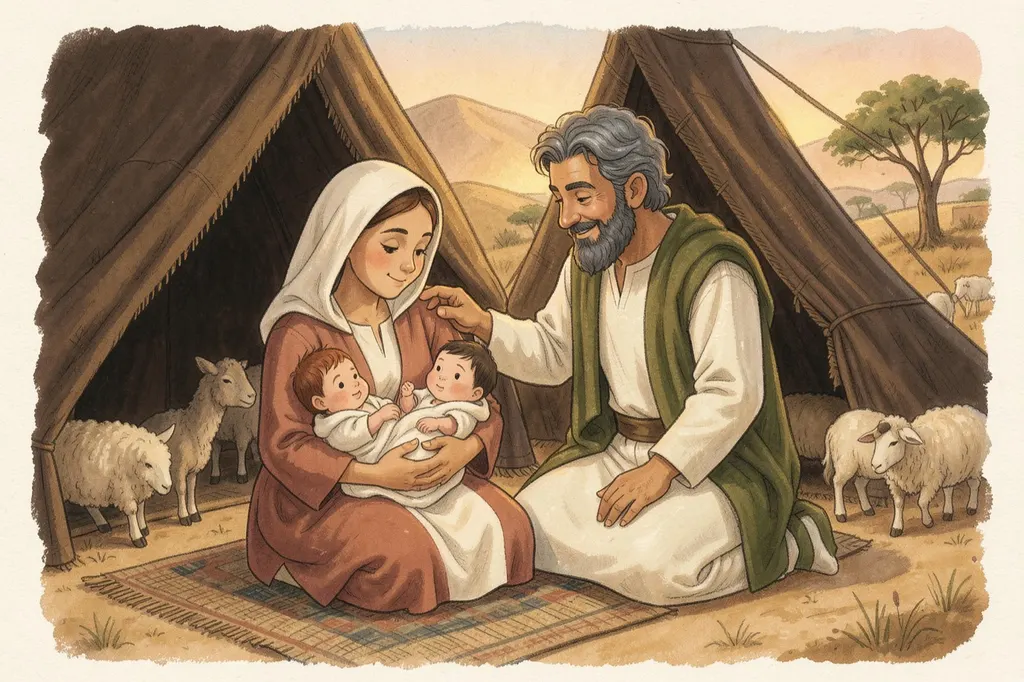
Isaac and his wife Rebekah had no children. So Isaac prayed for her, and the Lord heard him. Rebekah was going to have a baby. Not just one baby. Two.
The babies struggled inside her, and Rebekah asked the Lord why. The Lord told her that two nations were inside her. One would be stronger than the other.
“and the elder shall serve the younger.”
The elder is the one born first.
The first baby came out red, and hairy all over. They called him Esau. Then his brother came out, holding on to Esau's heel. They called him Jacob.
The boys grew up. Esau became a skilful hunter, a man of the fields. Jacob was a quiet man, who stayed near the tents. Isaac loved Esau, because he liked the meat Esau hunted. But Rebekah loved Jacob.
Scene 2 of 6
A bowl of red stew
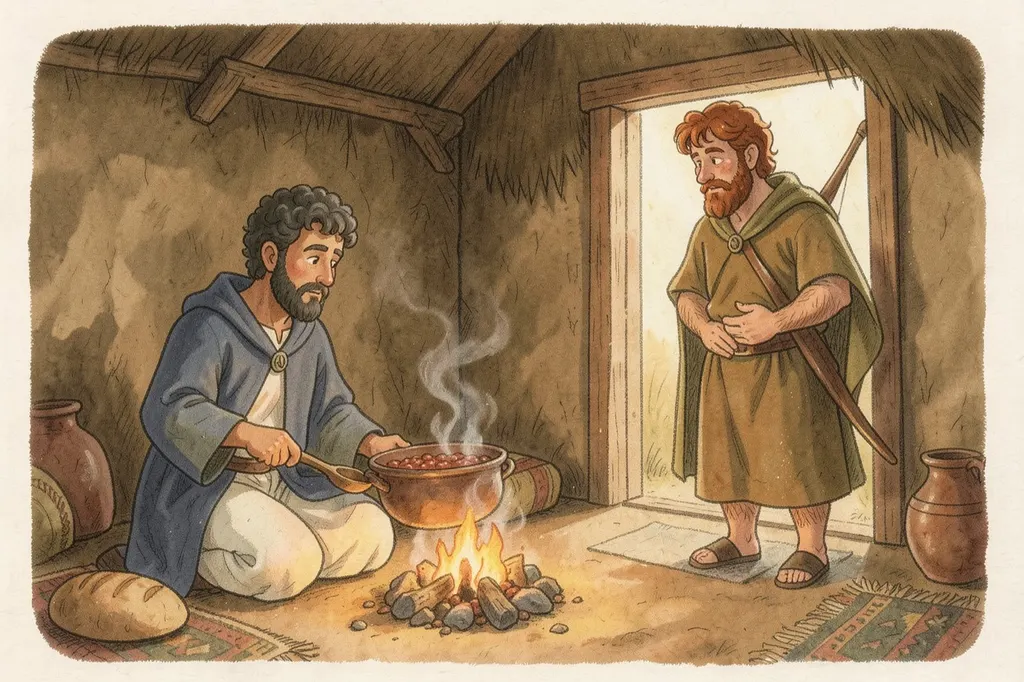
One day, Jacob was cooking a pot of stew. Esau came in from the fields, faint with hunger. And Esau said, "Feed me, I pray thee, with that same red pottage". Pottage is a thick stew.
Esau was born first, so he had the birthright: a double share of everything his father had.
Jacob said, "Sell me this day thy birthright."
Esau said he was about to die of hunger. What good was a birthright to him now?
So Jacob made Esau promise, and Esau sold his birthright to Jacob. Then Jacob gave Esau bread and the stew, made of lentils. Esau ate, and went on his way.
The Bible says, "thus Esau despised his birthright." Despised means he treated it as if it did not matter.
Scene 3 of 6
The voice is Jacob's voice
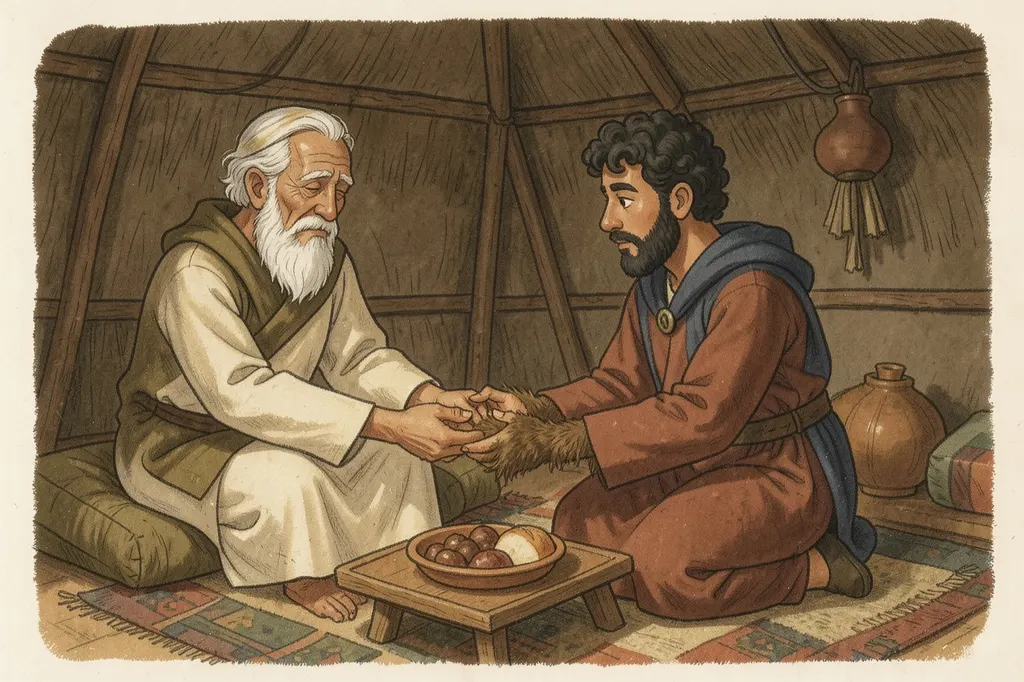
Many years later, Isaac was old, and his eyes were so dim that he could not see. He asked Esau to hunt and cook him the meat he loved, and then he would bless him. A blessing was a father's special prayer for his son.
Rebekah heard this. She told Jacob to fetch two young goats for her to cook, so that Jacob would get the blessing instead. But Jacob said:
“Behold, Esau my brother is a hairy man, and I am a smooth man”
So Rebekah dressed Jacob in Esau's best clothes, and put goat skins on his hands and neck.
Jacob took the food to his father, and said, "I am Esau thy firstborn". It was not true. Jacob was lying to his father.
Isaac felt his hands, and said:
“The voice is Jacob’s voice, but the hands are the hands of Esau.”
Isaac asked again if he really was Esau. Jacob said he was. So Isaac blessed Jacob instead of Esau.
Scene 4 of 6
Bless me, even me also
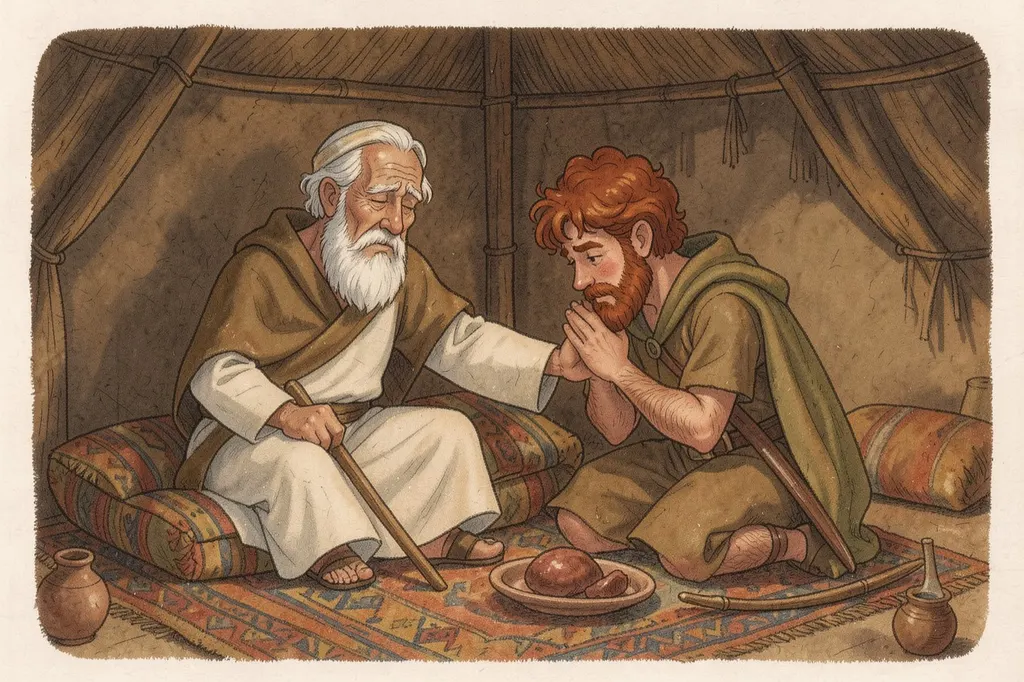
Just then, Esau came in with the meat for his father.
Isaac asked who he was, and Esau said, "I am thy son, thy firstborn Esau." Then Isaac trembled all over. He had already blessed someone else.
Esau gave a great and bitter cry, and said:
“Bless me, even me also, O my father.”
But Isaac said, "Thy brother came with subtilty, and hath taken away thy blessing." Subtilty means a sneaky trick.
Esau cried and cried. Isaac gave him a blessing too, but the first blessing could not be taken back.
Esau hated Jacob because of the blessing. He said to himself that after their father died, he would kill Jacob.
Someone told Rebekah, and she told Jacob to run, far away to her brother in Haran, until Esau was not angry any more.
So Jacob left home.
Scene 5 of 6
From the hand of my brother
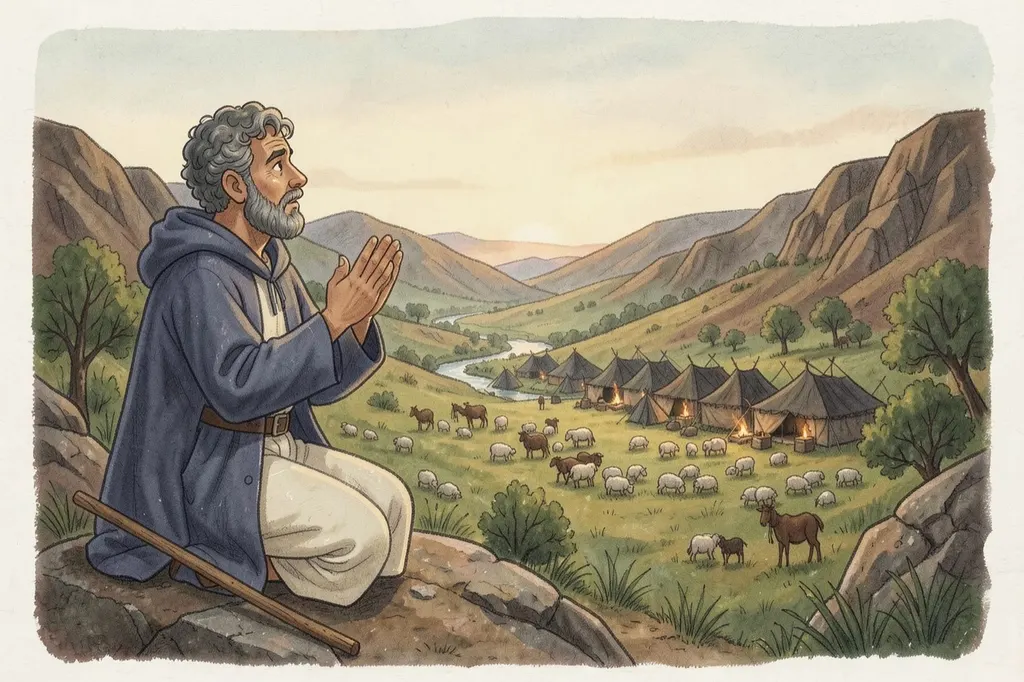
Jacob stayed with his uncle Laban for twenty years. He married, and had many children, and great flocks of sheep and goats. Then God told Jacob to go back home.
On the way, Jacob sent messengers to Esau. They came back and said Esau was coming to meet him, with four hundred men.
Jacob was very afraid. Then he prayed. He told God he did not deserve all God's kindness to him. And he said:
“Deliver me, I pray thee, from the hand of my brother, from the hand of Esau: for I fear him”
Deliver means rescue.
Then Jacob chose a present for Esau: hundreds of goats and sheep, camels with their young, cows and bulls and donkeys. He sent them on ahead. Jacob hoped the presents would calm Esau's anger, so that Esau would welcome him.
Scene 6 of 6
And they wept
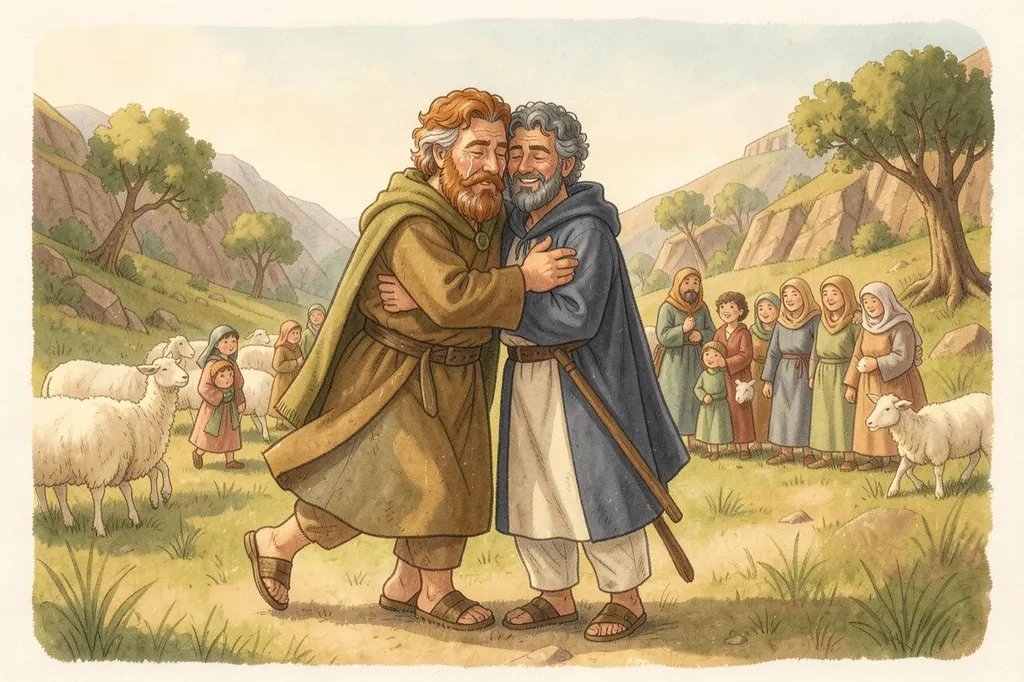
Jacob looked up. There was Esau, coming, with his four hundred men.
Jacob went out in front of his family. He bent down low to the ground, seven times, as he came near his brother.
And then what do you think Esau did?
“And Esau ran to meet him, and embraced him, and fell on his neck, and kissed him: and they wept.”
To fall on someone's neck means to throw your arms around them and hold on tight.
Jacob told Esau the animals were a present. But Esau said:
“I have enough, my brother; keep that thou hast unto thyself.”
Jacob begged him to take it. Seeing Esau's face, he said, was like seeing the face of God. God had been good to him, and he had enough too. So Esau took the present.
Do you remember the two words? My brother.
Can you say them too? My brother.
Jacob took his brother's blessing, and ran away. Twenty years later, he came home afraid.
But Esau ran to meet him.
And they wept.
How to explain Jacob and Esau to a child
Tell the wrong plainly: Jacob lied to his blind father, "I am Esau thy firstborn" (Genesis 27:19), and the family broke apart. The Bible doesn't excuse it. Then let the ending carry the weight: twenty years later, the brother Jacob feared ran to meet him, "and they wept" (Genesis 33:4). Through it all, God was gracious to Jacob, as Jacob himself said (Genesis 33:11).
What this story shows about God
For grown-ups. The story itself never states a lesson, so here it is, with the verses behind it.
God knew the twins before they were born
Before Jacob and Esau were born, the Lord told Rebekah that two nations were inside her, and that the elder would serve the younger.
Genesis 25:23God hears prayers
Isaac prayed for Rebekah, and the Lord heard him. Years later, when Jacob was afraid of his brother, he prayed to the God of his fathers to deliver him.
Genesis 25:21; Genesis 32:9-12God was gracious to Jacob
Jacob did not deserve God's kindness, and he said so. At the end, he told Esau that God had dealt graciously with him and given him enough.
Genesis 32:10; Genesis 33:11Questions to ask after
Pick the ones that fit your child. There are no wrong answers.
Ages 3 to 5
- Which twin was hairy, Jacob or Esau?
- What did Jacob cook in his pot?
- What did Esau do when he saw Jacob coming home?
Ages 6 to 9
- How do you think Esau felt when he found out about the trick?
- Jacob was afraid to meet Esau. What did he do while he was afraid?
- Have you ever made up with a brother, a sister or a friend after a fight? What happened?
Ages 10 to 12
- Esau gave away his birthright for one meal. Why do you think he did it?
- Rebekah planned the trick, and Jacob carried it out. Who do you think was to blame?
- Jacob said seeing Esau's face was like seeing the face of God. What do you think he meant?
If your child asks
Honest answers to the hard questions, with the verses behind them.
If Jacob lied, why did God still choose him?
The Jacob and Esau story never says the lie was right. Isaac called it a trick: "Thy brother came with subtilty" (Genesis 27:35), and Jacob had to run from home because of it. God's choice came first: before the twins were born, he told Rebekah "the elder shall serve the younger" (Genesis 25:23), and Romans 9:11-12 says this was before either boy had done any good or evil.
Genesis 25:23; Genesis 27:35; Romans 9:11-12
Why did Rebekah help Jacob trick Isaac?
Genesis doesn't tell us why. In the Jacob and Esau story we are told only that Rebekah loved Jacob (Genesis 25:28), and that the Lord had told her before the twins were born that the elder would serve the younger (Genesis 25:23). She said that if the trick brought a curse, it should fall on her (Genesis 27:13). The Bible tells what she did without praising it, and in the end she had to send Jacob far away (Genesis 27:43-45).
Genesis 25:23; Genesis 25:28; Genesis 27:13; Genesis 27:43-45
What is a birthright, and why did Esau sell it for soup?
A birthright belonged to the firstborn son. God's later law says it meant a double portion of all his father had (Deuteronomy 21:17). In the Jacob and Esau story, Esau came in faint with hunger and traded it for bread and a stew of lentils (Genesis 25:29-34). The Bible doesn't call it a good deal: "thus Esau despised his birthright" (Genesis 25:34), and Hebrews 12:16 says he sold it "for one morsel of meat".
Genesis 25:29-34; Deuteronomy 21:17; Hebrews 12:16
Does God hate Esau?
That line is not in the Jacob and Esau story itself. Parents meet it in Romans 9:13, quoting Malachi 1:2-3: "Jacob have I loved, but Esau have I hated." In Malachi, God is speaking of two nations: Israel, and Edom, the people who came from Esau (Malachi 1:4). Romans uses it to show that God's choice did not depend on anything either twin had done (Romans 9:11-12). The same Bible says God gave Esau's family their own land, "I have given mount Seir unto Esau for a possession" (Deuteronomy 2:5), and told Israel, "Thou shalt not abhor an Edomite; for he is thy brother" (Deuteronomy 23:7).
Malachi 1:2-4; Romans 9:11-13; Deuteronomy 2:5; Deuteronomy 23:7
Did Esau forgive Jacob?
Genesis never uses the word forgive in the Jacob and Esau story, but it shows it. Jacob came home afraid, sending presents ahead, and Esau "ran to meet him, and embraced him, and fell on his neck, and kissed him: and they wept" (Genesis 33:4). Esau didn't want the presents: "I have enough, my brother" (Genesis 33:9). Years later, the two brothers buried their father Isaac together (Genesis 35:29).
Genesis 33:4; Genesis 33:9; Genesis 35:29
What we added and left out
Every quoted line in this story is the King James Bible, word for word.
What we added
- Plain explanations of old words, in the next breath: elder, pottage, birthright, despised, blessing, subtilty, deliver, fell on his neck.
- We say a birthright was a double share of everything the father had. Genesis 25 doesn't explain it; that comes from God's later law in Deuteronomy 21:17.
- We say Esau cried and cried. The Bible says "Esau lifted up his voice, and wept" (Genesis 27:38). We say the first blessing could not be taken back; Isaac says of Jacob, "yea, and he shall be blessed" (Genesis 27:33).
- A few sentences from outside the scene passages, so the scenes make sense: Jacob's twenty years with Laban, his wives, children and flocks (Genesis 29 to 31; Genesis 31:41), and God telling him to go home (Genesis 31:3).
- We say Jacob told God he did not deserve all God's kindness. The Bible says "I am not worthy of the least of all the mercies" (Genesis 32:10).
- We say Esau told himself he would kill Jacob, and someone told Rebekah. The Bible says "Esau said in his heart" and that "these words of Esau her elder son were told to Rebekah" (Genesis 27:41-42).
- We say Jacob hoped the presents would calm Esau's anger. That is Jacob's own reason in Genesis 32:20: "I will appease him with the present that goeth before me".
- The question to the child about being cross with a brother or sister, and the "listen for two words" frame. "My brother" is said by Jacob (Genesis 27:11 and 32:11) and by Esau (Genesis 33:9).
What we left out
- The family line of Isaac and Rebekah (Genesis 25:19-20), Esau's other name, Edom (Genesis 25:30), and Isaac's age when the twins were born, sixty (Genesis 25:26).
- Isaac's life in Gerar and the quarrels over wells (Genesis 26), and Esau's Hittite wives, who grieved Isaac and Rebekah (Genesis 26:34-35).
- Jacob's fear that the trick would bring a curse, and Rebekah's answer (Genesis 27:12-13), and Jacob's second untrue answer, that "the LORD thy God" had brought him the meat so quickly (Genesis 27:20).
- Isaac kissing Jacob and smelling Esau's clothes on him (Genesis 27:26-27), and the words of Isaac's blessings in full (Genesis 27:27-29 and 27:39-40), including that Esau would live by the sword and serve his brother, and one day break his yoke from his neck.
- Esau's words "Is not he rightly named Jacob? for he hath supplanted me these two times" (Genesis 27:36). Supplant means to take someone's place by a trick, and the name Jacob sounds like the Hebrew word for heel.
- Isaac sending Jacob to find a wife, and Esau marrying a daughter of Ishmael (Genesis 27:46 to 28:9).
- Jacob's dream of a ladder at Bethel (Genesis 28:10-22), which is its own story.
- Jacob's years with Laban: Rachel and Leah, Laban tricking Jacob in turn, the birth of his children and the speckled flocks (Genesis 29 to 31).
- The angels who met Jacob at Mahanaim (Genesis 32:1-2), and Jacob wrestling through the night at Peniel and being given the new name Israel (Genesis 32:22-32).
- Jacob dividing his people and flocks into two camps (Genesis 32:7-8), setting his family out in order with Rachel and Joseph last (Genesis 33:1-2, 33:6-7), Esau asking who the children were (Genesis 33:5), and the end of the meeting: Esau offered to travel with Jacob, but Jacob went his own way to Succoth (Genesis 33:12-17).
Not in the Bible, so not in our story
Genesis says the red stew was lentils: "pottage of lentiles" (Genesis 25:34). The old saying about a mess of pottage is not in the King James text of Genesis. Genesis doesn't say how old the twins were when Esau sold his birthright, only that they had grown (Genesis 25:27). Genesis 27 never gives Rebekah's reason for the trick, and Genesis 33 never uses the word forgive: it shows Esau running to meet Jacob instead (Genesis 33:4).
Words from the story
Old Bible words your child might ask about.
- Twins
- Two babies born to the same mother at the same time.
- Elder
- Older. The elder twin is the one born first.
- Pottage
- A thick stew. Jacob's red pottage was made of lentils.
- Lentils
- Small round seeds, cooked soft in a stew. Red lentils turn the stew red.
- Birthright
- The special share that belonged to the firstborn son: a double share of everything his father had.
- Despised
- Treated something as if it did not matter.
- Blessing
- A father's special prayer and promise for his son, asking God to do him good.
- Venison
- Meat from a wild animal caught by hunting.
- Subtilty
- An old spelling of subtlety. Here it means a sly, sneaky trick.
- Deliver
- To rescue someone from danger.
- Fell on his neck
- Threw his arms around him and held him tight.
Sources and how we made this story
References
- Genesis 25:19-28: King James Version and Berean Standard Bible
- Genesis 25:29-34: King James Version and Berean Standard Bible
- Genesis 27:1-29: King James Version and Berean Standard Bible
- Genesis 27:30-45: King James Version and Berean Standard Bible
- Genesis 32:3-21: King James Version and Berean Standard Bible
- Genesis 33:1-11: King James Version and Berean Standard Bible
- King James Version (1769 Oxford text), public domain. Berean Standard Bible, public domain since 2023 (berean.bible).
- Background: Jacob and Esau on Wikipedia.
How we made this story
- The retelling. Written by Tinykiwi with AI assistance, following how we tell these stories, then checked line by line against the Bible text. Every quoted line is the King James Version, word for word. What we explained, added and left out is listed above.
- The pictures and narration. The illustrations are AI-generated and chosen by hand. The narration is an AI voice recorded ahead of time, and every recording is checked word for word against the text.
- These stories are part of Tinykiwi, an audio Bible App for Kids we are building. For apps you can use today, see our guide to the best Bible story apps for kids.
More Bible stories for kids
Coming soon: Samson, Pentecost, Gideon, The Baptism of Jesus.
Tinykiwi. Coming soon.
The audio Bible app for kids.
Tinykiwi is an audio Bible app for kids that turns Bible learning into family time at bedtime, in the car, or before church.