
Bible stories for kids
Noah's Ark for Kids
Noah and the ark is the true story, in Genesis 6 to 9, of the great flood and the boat God told Noah to build for his family and the animals. Here is the Noah's ark story for kids and children, to read aloud, hear narrated or see as a picture storybook, with the King James words beside every scene.
The storybook opens full screen, one page at a time. The whole story is also below, with the Bible text beside it.
Where it is in the Bible
- Bible passages
- Genesis 6:5 to 9:17. Noah's story runs through Genesis 6 to 9; his birth is in Genesis 5:28-32.
- Who is in it
- Noah, his wife, their sons Shem, Ham and Japheth, and their sons' wives
- Where it happens
- The ark on the waters, and the mountains of Ararat, where it came to rest (Genesis 8:4)
- When
- Long after Adam (Noah is the tenth name in the family line of Genesis 5), when Noah was six hundred years old (Genesis 7:6)
- Key verse
- “I do set my bow in the cloud, and it shall be for a token of a covenant between me and the earth.” (Genesis 9:13, KJV)
The story
This story is true. It is in the Bible, in the book of Genesis.
Have you ever been stuck indoors, waiting and waiting for the rain to stop? Noah and his family wait for months inside a great big boat, with water all around. Then God does something. Listen for it.
Scene 1 of 6
Noah found grace
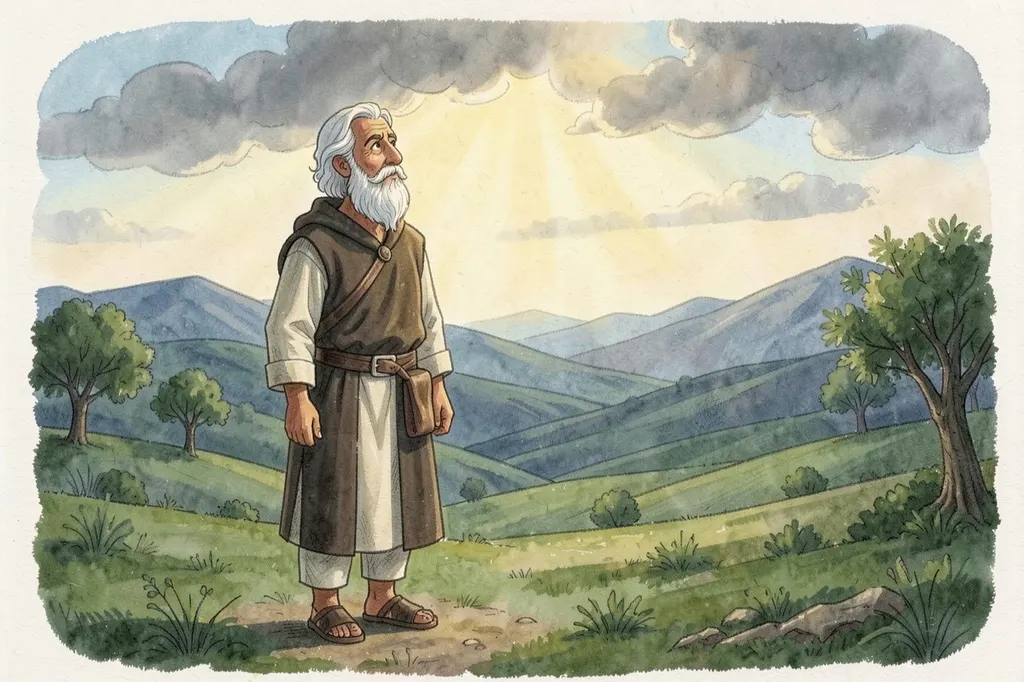
Long after Adam and Eve, there were many people on the earth.
But God saw that people had become very wicked. Wicked means very bad. Every thought in their hearts was only bad, all the time.
The earth was full of violence. People were hurting each other everywhere.
The Lord was sorry that he had made people. It grieved him at his heart: it made him very sad.
“But Noah found grace in the eyes of the LORD.”
Grace is kindness and favour.
Noah was a good man, and Noah walked with God. He had three sons.
Then God told Noah something very serious. Because of the violence, God would bring an end to every living thing on the earth.
Scene 2 of 6
Make thee an ark
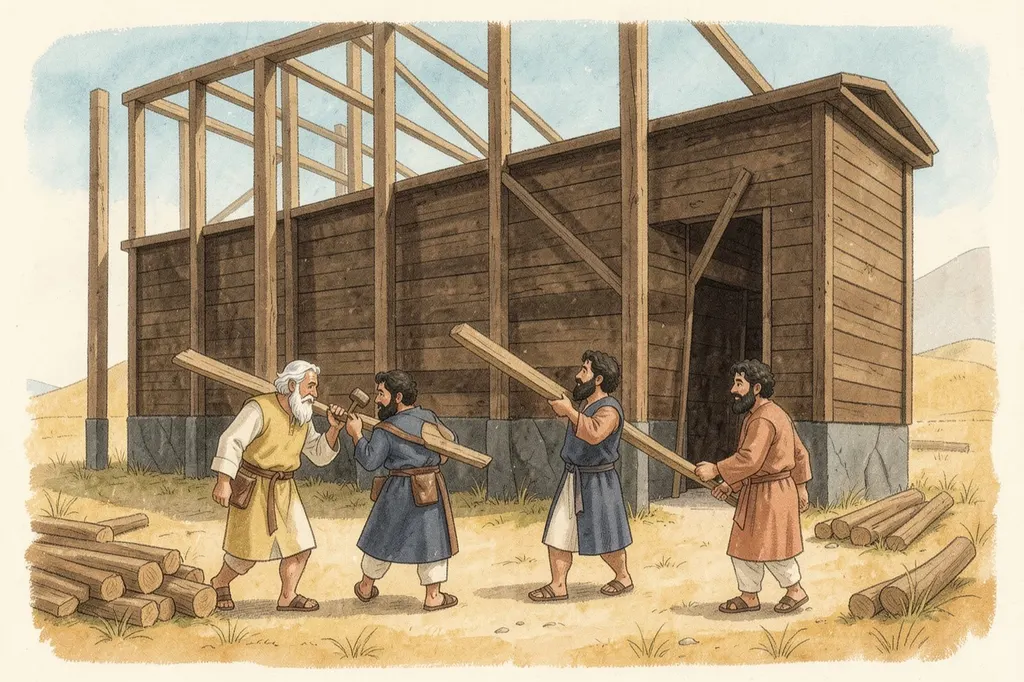
God told Noah to build an ark, a great big wooden boat.
It was to be made of gopher wood, and covered with pitch, a sticky tar that keeps the water out.
The ark was to be three hundred cubits long. A cubit is about as long as a grown-up's arm, from the elbow to the fingertips. So the ark would be longer than a football field, and taller than a big house, with a window, a door, and three floors.
God was going to bring a flood of waters on the earth. But he would make a covenant with Noah. A covenant is a very big promise. Noah would come into the ark with his wife, his sons, and his sons' wives.
Two of every kind of animal and bird would come too, a male and a female, to be kept alive. And Noah was to gather food for them all.
“Thus did Noah; according to all that God commanded him, so did he.”
Scene 3 of 6
The Lord shut him in
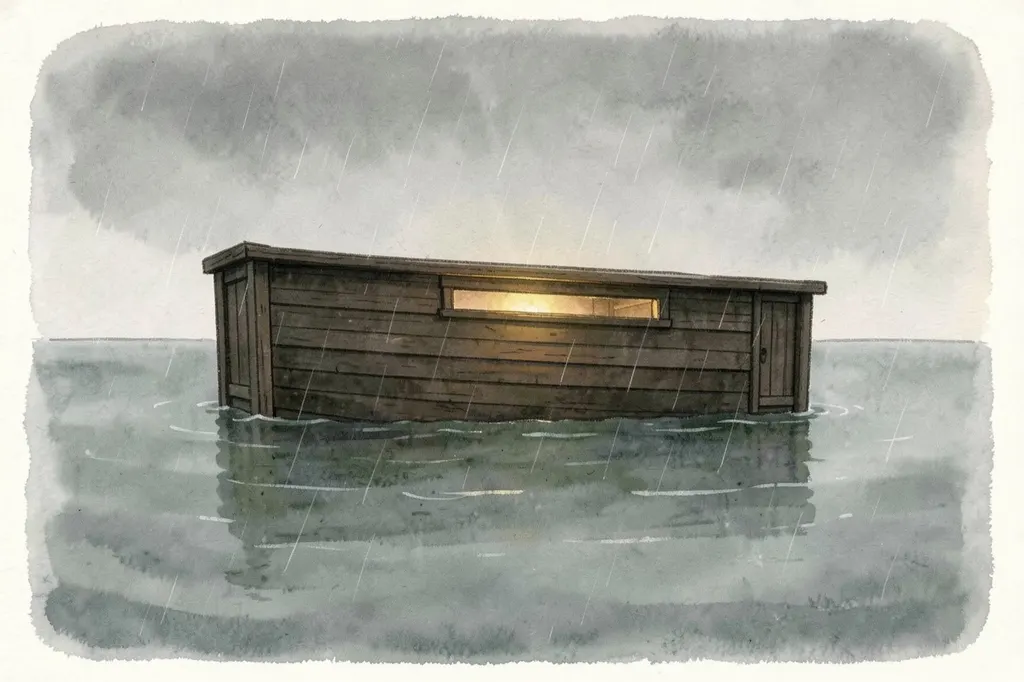
Then the Lord told Noah to come into the ark, with all his family.
Of the clean animals, God said, Noah was to take seven pairs. Clean animals were the kinds that could be offered to God. Of the birds, seven pairs too. And of all the other animals, two: a male and a female.
So Noah went into the ark with his family. And the animals came to Noah, two and two. When they were all inside:
“and the LORD shut him in.”
Then the rain came, for forty days and forty nights. The waters rose, and the ark floated. Higher and higher the waters rose, until even the mountains were covered.
All the people and animals on the land, outside the ark, died in the flood. Only Noah, and those with him in the ark, were kept alive.
And the waters stayed on the earth for a hundred and fifty days.
Scene 4 of 6
An olive leaf
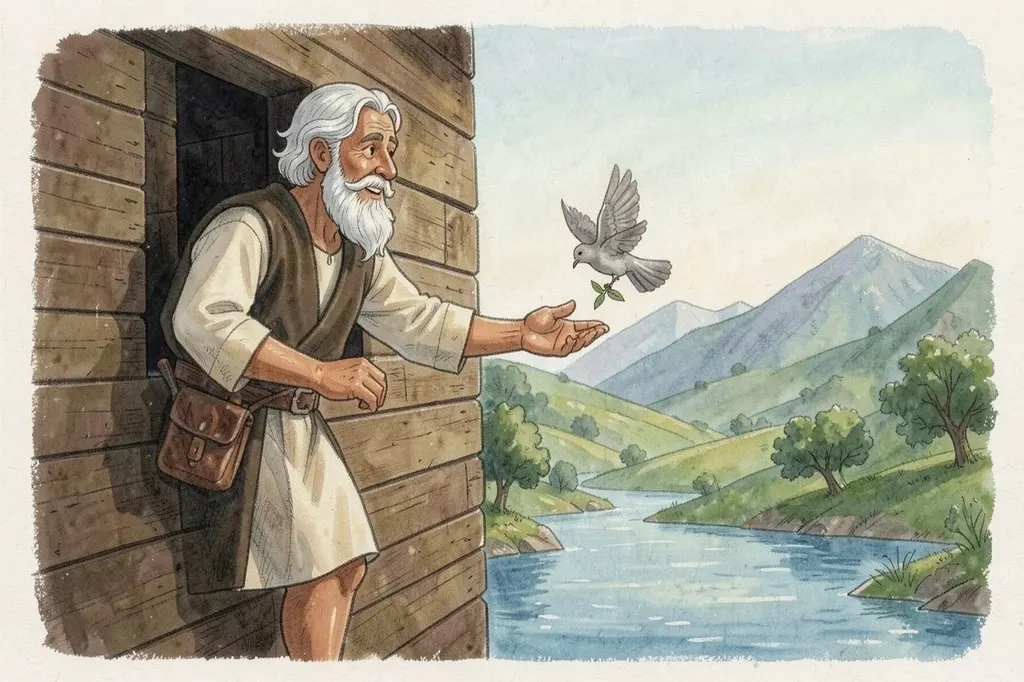
“And God remembered Noah, and every living thing, and all the cattle that was with him in the ark:”
Cattle means farm animals.
God made a breeze blow over the earth, and the rain stopped. The waters went down, and the ark came to rest on the mountains of Ararat.
Noah opened the window and sent out a raven, a big black bird. The raven flew to and fro, until the waters dried up.
Then Noah sent out another bird. But she found no place to rest her feet, and came back. Noah put out his hand and took her in.
Seven days later, he sent her out again.
“And the dove came in to him in the evening; and, lo, in her mouth was an olive leaf pluckt off:”
Pluckt means picked fresh. So Noah knew the waters had gone down.
Seven days later, he sent her out once more, and she did not come back.
Scene 5 of 6
Out of the ark
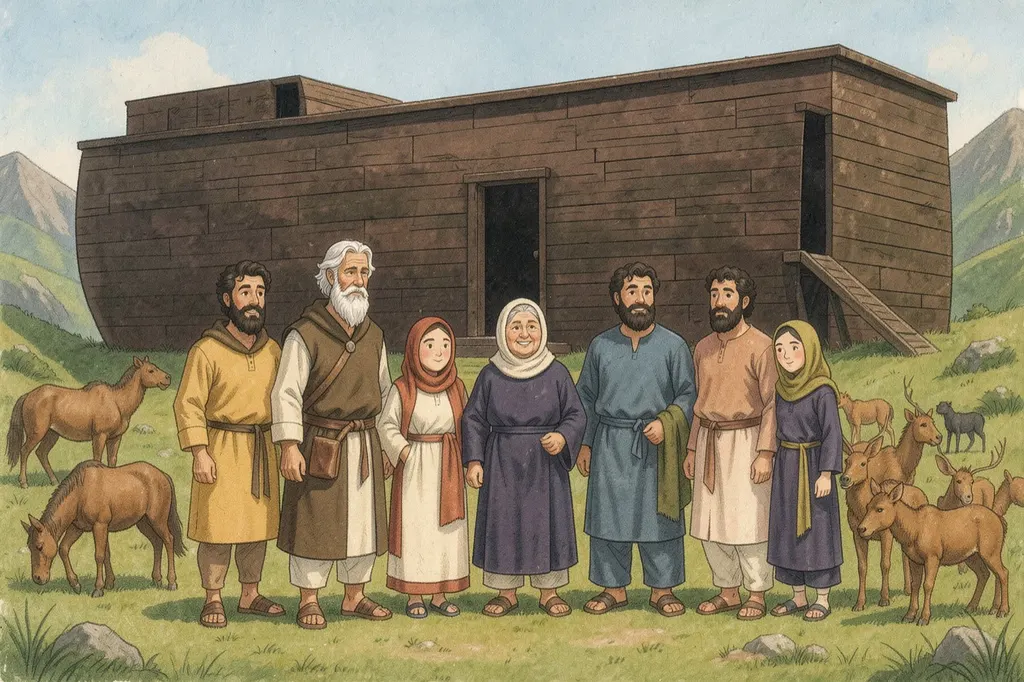
At last, Noah took the covering off the ark and looked out. The ground was dry.
Then God told Noah to go out of the ark, with his family and every living thing. They had been in the ark for more than a year.
So out they came, Noah's family and all the animals.
Noah built an altar to the Lord. An altar is a place for giving gifts to God. Noah offered some of the clean animals and birds as burnt offerings.
The sweet smell pleased the Lord. And the Lord said in his heart that he would never again destroy every living thing, as he had done.
As long as the earth remained, God said, there would always be seedtime and harvest, cold and heat, summer and winter, and day and night.
Scene 6 of 6
A sign in the cloud
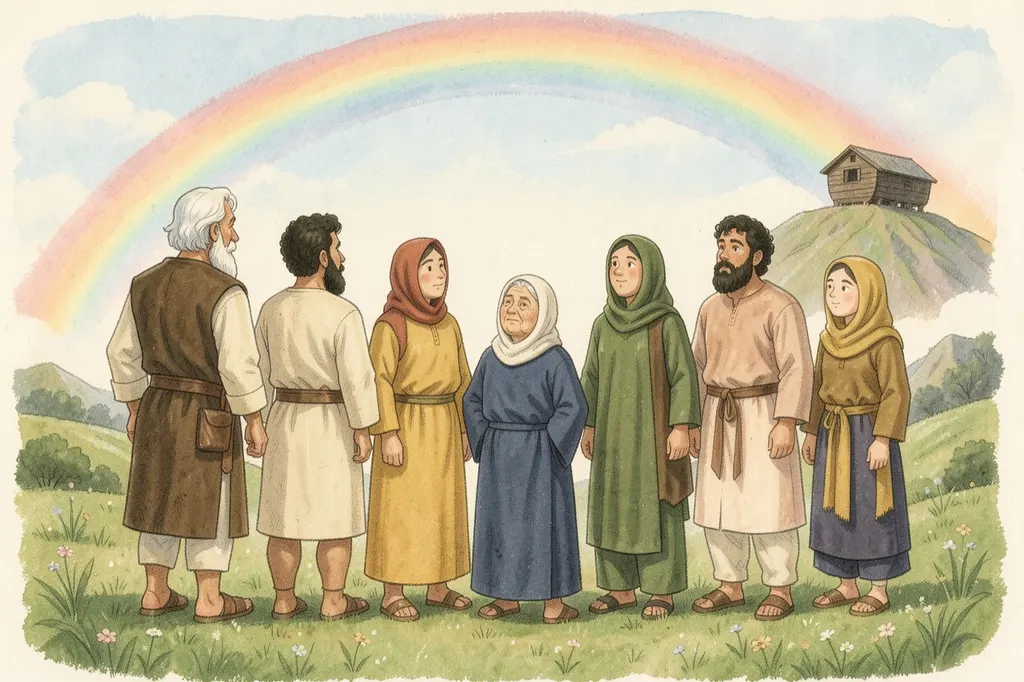
Then God spoke to Noah and his sons. God made his covenant, his very big promise, with them, and with their children after them, and with every living creature too.
Never again, God said, would there be a flood to destroy the earth.
And God gave a sign of his promise, a rainbow, for all the years to come:
“I do set my bow in the cloud, and it shall be for a token of a covenant between me and the earth.”
That is the rainbow. A token is a sign.
Whenever God brought clouds over the earth, he said, the rainbow would be seen in the cloud.
God would look at the rainbow, and remember, for ever.
Do you remember what God did? God remembered Noah.
Can you say it too? God remembered Noah.
The rain stopped. The waters went down. A bird came back with an olive leaf.
And God set the rainbow in the cloud, so he would remember his promise.
God remembered Noah.
How to explain Noah's ark to a child
Start with God's heart. The violence filling the earth grieved the Lord at his heart (Genesis 6:6), but Noah found grace in his eyes (Genesis 6:8), and God kept Noah's family and the animals safe in the ark. Say plainly that the flood was serious and sad. Then let the ending carry the weight: God remembered Noah (Genesis 8:1) and set the rainbow as his promise (Genesis 9:13).
What this story shows about God
For grown-ups. The story itself never states a lesson, so here it is, with the verses behind it.
God sees wrong, and it grieves him
God saw the wickedness and violence filling the earth, and it grieved him at his heart. People hurting each other matters to God.
Genesis 6:5-6; Genesis 6:11God remembered Noah
God remembered Noah and every animal with him in the ark. He sent a wind over the earth, stopped the rain, and brought the waters down.
Genesis 8:1-3God keeps his promises
God promised never again to destroy the earth with a flood, and set the rainbow in the cloud as the token of his covenant with every living creature.
Genesis 9:11-16Questions to ask after
Pick the ones that fit your child. There are no wrong answers.
Ages 3 to 5
- What did God tell Noah to build?
- What did the bird bring back to Noah in her mouth?
- What did God put in the cloud as a sign of his promise?
Ages 6 to 9
- Noah did all that God commanded him, even building a boat longer than a football field. What do you think that was like?
- Why do you think Noah sent the bird out more than once?
- When you see a rainbow, what can it help you remember?
Ages 10 to 12
- The violence on the earth grieved God at his heart. What does that tell you about how God feels when people hurt each other?
- Noah found grace in the eyes of the Lord. What do you think grace means?
- After the flood, God said people's hearts were still not good (Genesis 8:21), and he promised never to send a flood like it again. Why do you think he made that promise anyway?
If your child asks
Honest answers to the hard questions, with the verses behind them.
Did Noah take two of every animal on the ark?
Two of most kinds, but not of all. In the Noah's ark story, God first says two of every sort, a male and a female (Genesis 6:19-20). Then Genesis 7:2-3 adds that the clean animals and the birds go in "by sevens, the male and his female", which most modern Bibles read as seven pairs. Noah offered some of those clean animals to God after the flood (Genesis 8:20).
Genesis 6:19-20; Genesis 7:2-3
Why did God send the flood in Noah's time?
Genesis 6:5 says the wickedness of people was great, and their thoughts were "only evil continually". Genesis 6:11 says the earth "was filled with violence". Genesis also shows how God felt about it: it grieved the Lord at his heart (Genesis 6:6). With a young child you could say: people were hurting each other everywhere, God was very sad, and he put an end to it.
Genesis 6:5-6; Genesis 6:11
What happened to the people and animals who were not on Noah's ark?
Genesis 7:21-23 says that every living thing on the dry land outside the ark died, and Noah only remained alive, and those with him in the ark. Our story says so in one plain sentence. For a young child: the flood was very sad and very serious, God kept Noah's family and the animals safe, and afterwards God promised never to flood the earth like that again (Genesis 9:11).
Genesis 7:21-23; Genesis 9:11
Did people laugh at Noah while he built the ark?
The Bible doesn't say so. Many Noah's ark retellings add crowds laughing at Noah, but Genesis tells only that Noah did all that God commanded him (Genesis 6:22). The New Testament calls Noah "a preacher of righteousness" (2 Peter 2:5) and says he built the ark by faith (Hebrews 11:7), but neither describes anyone mocking him.
Genesis 6:22; 2 Peter 2:5; Hebrews 11:7
How long were Noah and his family on the ark?
More than a year. In the Noah's ark story the rain lasted forty days and forty nights (Genesis 7:12), but the waters stayed on the earth much longer. Noah went in during the six hundredth year of his life, on the seventeenth day of the second month (Genesis 7:11-13), and God told him to go out after the earth was dry, on the twenty-seventh day of the second month a year later (Genesis 8:14-16).
Genesis 7:11-13; Genesis 8:14-16
What we added and left out
Every quoted line in this story is the King James Bible, word for word.
What we added
- Plain explanations of old words, in the next breath: wicked, grieved, grace, gopher wood, pitch, cubit, covenant, clean animals, cattle, pluckt and token.
- We explain violence as people hurting each other, and cattle as farm animals (Genesis 6:11; Genesis 8:1).
- Size comparisons for the ark. A cubit was about 18 inches (45 cm), so 300 cubits is roughly 450 feet (137 metres), longer than a football field, and the 30 cubits of its height (Genesis 6:15) are about 45 feet (14 metres), taller than a big house. These are close estimates, not the Bible's own words.
- Seven pairs: the King James says the clean beasts and the birds went in "by sevens, the male and his female" (Genesis 7:2-3). We follow the modern Berean Standard Bible, which reads it as seven pairs; some readers take it as seven animals of each kind.
- We explain clean animals as the kinds that could be offered to God, because Noah offers clean animals and birds in Genesis 8:20. The full list of clean and unclean animals comes much later, in Leviticus 11.
- We say God made a breeze blow over the earth. Genesis 8:1 says "a wind". We chose a different word so the narrator reads it clearly.
- We call the raven a big black bird, and we call the dove another bird until the King James line names her, so the narrator reads the word clearly. "Two and two" is the King James wording (Genesis 7:9 and 7:15); many people say two by two.
- We say Noah's family was in the ark for more than a year, from the dates in Genesis 7:11 and Genesis 8:14.
- The question to the child, "Have you ever been stuck indoors, waiting and waiting for the rain to stop?", and the "listen for it" frame. The refrain "God remembered Noah" is in Genesis 8:1.
What we left out
- The sons of God and the daughters of men, and the giants in the earth (Genesis 6:1-4), which come just before Noah's story.
- The ark's width (fifty cubits) and exact height (thirty cubits; we say only that it was taller than a big house), its rooms, and the cubit at the top of the window (Genesis 6:14-16), and God's words "for thee have I seen righteous" (Genesis 7:1).
- Noah's age (six hundred, Genesis 7:6), the seven days before the rain (Genesis 7:4, 7:10), and the exact dates of the flood, the ark's resting and the drying of the earth (Genesis 7:11; Genesis 8:4-5; Genesis 8:13-14). We say only that Noah's family was in the ark for more than a year.
- The fountains of the great deep and the windows of heaven (Genesis 7:11; Genesis 8:2), the waters fifteen cubits above the mountains (Genesis 7:20), the mountain tops appearing (Genesis 8:5), and the forty days before Noah opened the window (Genesis 8:6).
- The fuller lists of who died in the flood: fowl, cattle, beast, creeping thing, and every man (Genesis 7:21-23). We say it once, in one plain sentence.
- God's words that "the imagination of man's heart is evil from his youth" and that he would not again curse the ground (Genesis 8:21), left for the questions for older children.
- God's blessing and new rules after the flood (Genesis 9:1-7): be fruitful and multiply, animals given for food, not eating blood, and a life for a life.
- Noah's drunkenness and Ham (Genesis 9:20-27). For grown-ups: Noah planted a vineyard, drank too much wine and lay uncovered in his tent; his son Ham saw him and told his brothers, Shem and Japheth covered their father without looking, and Noah cursed Ham's son Canaan. With a child you could say: even Noah, a good man, did wrong after the flood, and the Bible tells the truth about him. Noah lived 350 years after the flood and died at 950 (Genesis 9:28-29).
Not in the Bible, so not in our story
Genesis never says it had never rained before the flood (Genesis 2:5 speaks only of the time before the first plants grew), or that crowds laughed at Noah while he built the ark. It gives the ark's size, its window, its door and its three floors (Genesis 6:14-16), but not its shape, so the curved boat with animals peeking out is from pictures, not the Bible. Genesis doesn't name Noah's wife or his sons' wives, and it doesn't say the dove was white. And it isn't two of every animal only: Genesis 7:2-3 says the clean animals and the birds went in by sevens.
Words from the story
Old Bible words your child might ask about.
- Ark
- A great big boat. God told Noah to build one of gopher wood.
- Wicked
- Very bad, doing wrong on purpose.
- Grieved
- Made very sad. People's wickedness grieved God at his heart.
- Grace
- Kindness and favour. Noah found grace in the eyes of the Lord.
- Gopher wood
- The wood God told Noah to use. Nobody knows today what kind of tree it was.
- Pitch
- Thick, sticky tar, spread inside and outside the ark to keep the water out.
- Cubit
- A measure of length, about a grown-up's arm from the elbow to the fingertips.
- Covenant
- A very big promise. God made a covenant with Noah, and with every living creature.
- Clean animals
- The kinds of animals that could be offered to God.
- Raven
- A big black bird. It was the first bird Noah sent out of the ark.
- Dove
- A gentle bird, like a small pigeon. It brought Noah the olive leaf.
- Pluckt
- An old spelling of plucked: picked fresh from a tree.
- Ararat
- The mountains where the ark came to rest.
- Altar
- A place built for giving gifts to God.
- Burnt offering
- A gift to God, burned on an altar.
- Token
- A sign. The rainbow is the token of God's covenant.
Sources and how we made this story
References
- Genesis 6:5-13: King James Version and Berean Standard Bible
- Genesis 6:14-22: King James Version and Berean Standard Bible
- Genesis 7:1-24: King James Version and Berean Standard Bible
- Genesis 8:1-12: King James Version and Berean Standard Bible
- Genesis 8:13-22: King James Version and Berean Standard Bible
- Genesis 9:8-17: King James Version and Berean Standard Bible
- King James Version (1769 Oxford text), public domain. Berean Standard Bible, public domain since 2023 (berean.bible).
- Background: Noah's Ark on Wikipedia.
How we made this story
- The retelling. Written by Tinykiwi with AI assistance, following how we tell these stories, then checked line by line against the Bible text. Every quoted line is the King James Version, word for word. What we explained, added and left out is listed above.
- The pictures and narration. The illustrations are AI-generated and chosen by hand. The narration is an AI voice recorded ahead of time, and every recording is checked word for word against the text.
- These stories are part of Tinykiwi, an audio Bible App for Kids we are building. For apps you can use today, see our guide to the best Bible story apps for kids.
More Bible stories for kids
Coming soon: Samson, Pentecost, Gideon, The Baptism of Jesus.
Tinykiwi. Coming soon.
The audio Bible app for kids.
Tinykiwi is an audio Bible app for kids that turns Bible learning into family time at bedtime, in the car, or before church.