
Bible stories for kids
The Story of Moses for Kids
The story of Moses is in the book of Exodus: baby Moses in a basket on the river, the burning bush, the plagues of Egypt, the first Passover, and the Red Sea opening for God's people. Here is the Moses story for kids and children, in order, to read aloud, hear narrated or see as a picture storybook, with the King James words beside every scene.
The storybook opens full screen, one page at a time. The whole story is also below, with the Bible text beside it.
Where it is in the Bible
- Bible passages
- Exodus 2 to 14. The Ten Commandments that follow at Mount Sinai are in Exodus 19 and 20.
- Who is in it
- Moses, his brother Aaron, Pharaoh the king of Egypt, and the children of Israel
- Where it happens
- Egypt, the river Nile, the land of Midian, Mount Horeb and the Red Sea
- When
- While the children of Israel were slaves in Egypt. Moses was 80 when he spoke to Pharaoh (Exodus 7:7), and Israel left Egypt 430 years after they came there (Exodus 12:40-41)
- Key verse
- “And he said, Certainly I will be with thee; and this shall be a token unto thee, that I have sent thee: When thou hast brought forth the people out of Egypt, ye shall serve God upon this mountain.” (Exodus 3:12, KJV)
The story
This story is true. It is in the Bible, in the book of Exodus.
Have you ever had a job that felt too big for you? In this story, God gives Moses a big job: take a message to the king of Egypt. Listen for the message.
Scene 1 of 6
A basket in the river
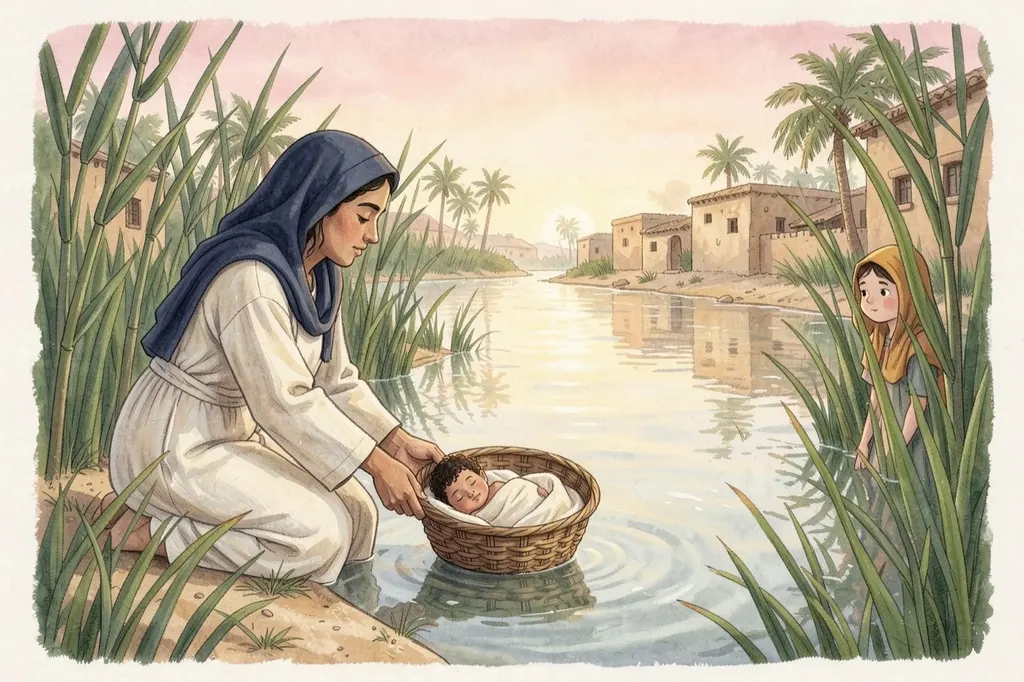
God's people, the Hebrews, were slaves in Egypt. The king, called Pharaoh, gave a cruel order: every Hebrew baby boy must be thrown into the river.
A Hebrew mother had a baby boy, and she hid him for three months.
When she could hide him no longer, she got him a little ark of bulrushes. That is a basket boat of tall reeds. She sealed it with pitch, laid her baby inside, and set it in the reeds by the river. His sister stood far off, to watch.
Then Pharaoh's daughter came down to wash at the river. She opened the basket, and the baby cried. She felt sorry for him.
His sister offered to find a Hebrew nurse, and fetched the baby's own mother. Pharaoh's daughter paid her to nurse him.
When he grew, he became the son of Pharaoh's daughter. She named him Moses, and she said:
“Because I drew him out of the water.”
Scene 2 of 6
Far away in Midian
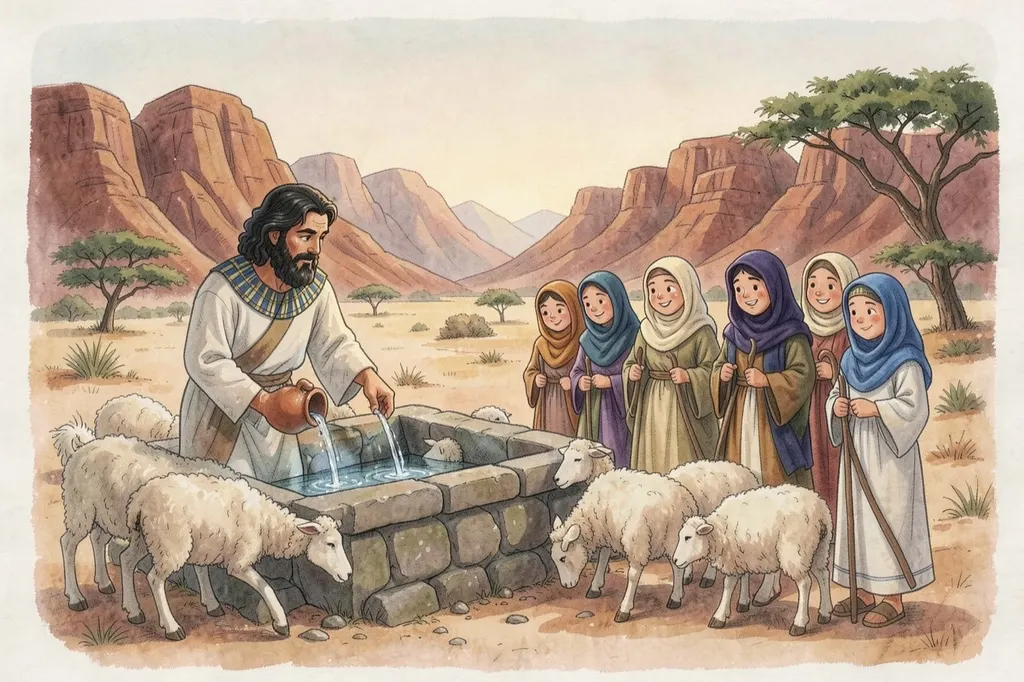
When Moses was grown, he went out to his own people. He saw an Egyptian beating a Hebrew man. Moses looked this way and that way. Then he killed the Egyptian, and hid him in the sand.
Pharaoh heard, and wanted to kill Moses. So Moses ran away to Midian, and sat down by a well.
Seven sisters came to water their father's sheep. Some shepherds drove them away, but Moses stood up and helped them.
Their father, the priest of Midian, invited Moses to eat with them. Moses stayed, and married one of the sisters, Zipporah.
Years went by, and the king of Egypt died. God's people cried out to God.
“And God heard their groaning”
Scene 3 of 6
The bush that did not burn up
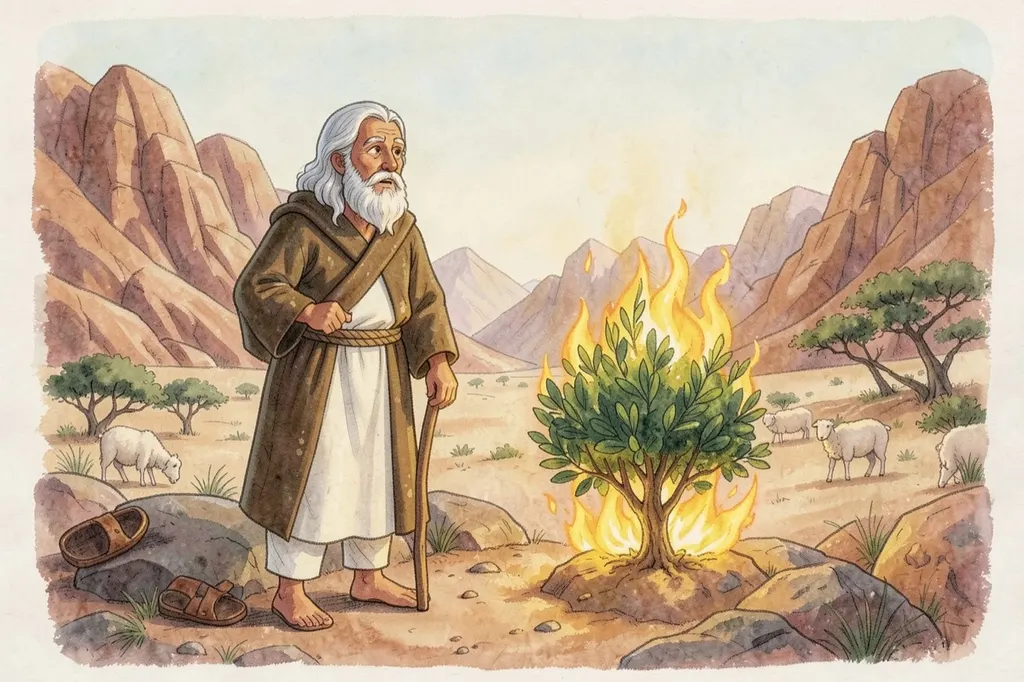
One day, Moses led the sheep far across the desert, to Horeb, the mountain of God.
There, the angel of the Lord appeared to him in a flame of fire, in the middle of a bush. The bush was on fire, but it was not burning up.
Moses went closer to see. God called to him from the bush. "Moses, Moses." And Moses said, "Here am I."
God told Moses to take off his shoes, because he was standing on holy ground. Holy means it belongs to God. Moses hid his face. He was afraid to look at God.
God had heard his people crying in Egypt. He was sending Moses to Pharaoh, to bring them out.
Moses said, "Who am I, that I should go unto Pharaoh?" And God said:
“Certainly I will be with thee”
Scene 4 of 6
Let my people go
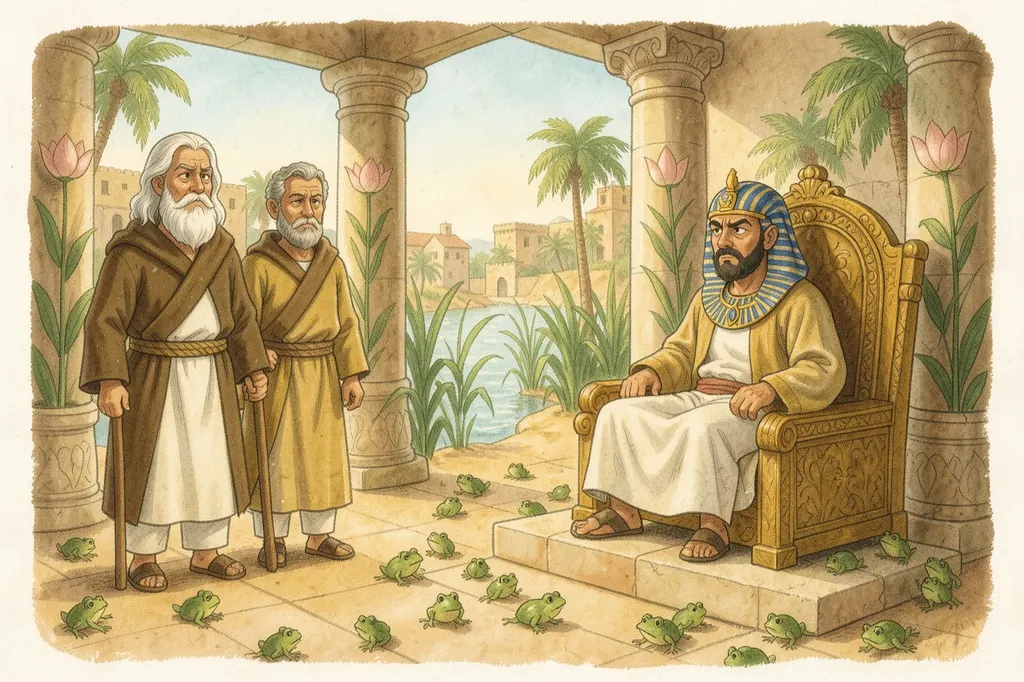
So Moses went back to Egypt, with his brother Aaron. But Pharaoh would not listen, even when God turned the river to blood.
God sent Moses back with this message:
“Thus saith the LORD, Let my people go, that they may serve me.”
God warned that if Pharaoh refused, frogs would come. Then Aaron stretched out his hand over the waters, and frogs covered the land. Frogs in the houses. Frogs on the beds. Frogs in the ovens.
Pharaoh asked Moses to pray, and promised to let the people go. So Moses prayed, and the frogs died. But then Pharaoh made his heart hard.
God sent trouble after trouble, called plagues: lice, flies, sick animals, sores, hail, locusts, and thick darkness. Again and again, God's message was the same: let my people go. And every time, Pharaoh would not let them go.
Scene 5 of 6
The night of the Passover
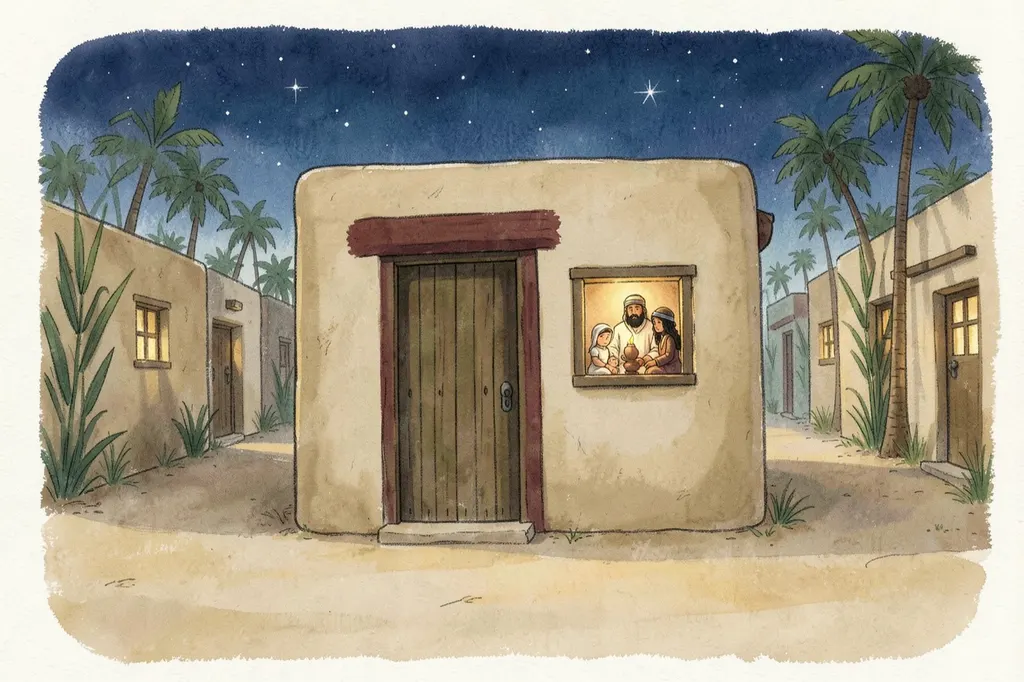
Then God told Moses of one last plague.
Moses told each family of God's people to choose a lamb for a special meal, called the Passover. They were to mark the top and sides of their door with the lamb's blood, and stay inside until morning. Moses told them why:
“when he seeth the blood upon the lintel, and on the two side posts, the LORD will pass over the door”
The lintel is the beam across the top of a door.
That night, the Lord passed over every house with the mark on its door, and everyone inside was safe. But in the homes of Egypt, the Lord struck down the firstborn, as he had warned, even in Pharaoh's palace.
In the night, Pharaoh told Moses and Aaron to take their flocks and go.
Scene 6 of 6
A path through the sea
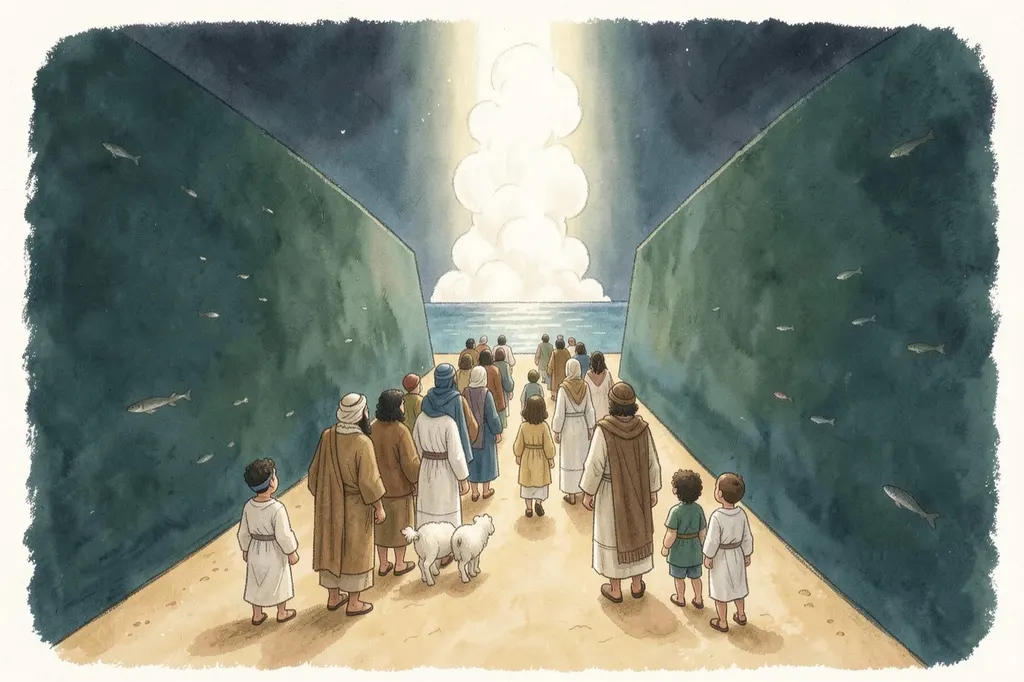
God's people left Egypt. But Pharaoh changed his mind again, and chased them with his chariots.
God's people were camped beside the Red Sea. They saw the army coming, and they were very afraid. Moses said:
“Fear ye not, stand still, and see the salvation of the LORD”
Salvation means being saved. Moses stretched out his hand over the sea, and all night the Lord pushed the sea back, and made dry land.
Can you picture it?
“And the children of Israel went into the midst of the sea upon the dry ground: and the waters were a wall unto them on their right hand, and on their left.”
The Egyptians followed them in. In the morning, with God's people safe on the other side, Moses stretched out his hand again, and the sea came back. It covered all of Pharaoh's army. Not one of them was left.
God's people saw what the Lord had done, and they believed him.
Do you remember God's message for Pharaoh? Let my people go.
Can you say it too? Let my people go.
Pharaoh said no, again and again. But God was with Moses, just as he had promised.
Thus the Lord saved Israel that day.
How to explain the story of Moses to a child
Start with God, not Moses. Moses was a baby saved from the river and a man who ran away, and when God called him he asked, "Who am I?" God answered, "Certainly I will be with thee" (Exodus 3:12). The plagues and the sea show what the story is about: God heard his people crying and brought them out himself (Exodus 3:7-8; Exodus 14:30).
What this story shows about God
For grown-ups. The story itself never states a lesson, so here it is, with the verses behind it.
God hears his people
God's people cried out in Egypt, and God heard them and remembered his promise to Abraham, Isaac and Jacob.
Exodus 2:23-25God goes with the ones he sends
Moses felt far too small for the job. God did not tell him he was big enough; he promised to be with him.
Exodus 3:11-12God keeps his people safe
On the Passover night and at the sea, God made a way for his people to be safe, and then he fought for them.
Exodus 12:23; Exodus 14:13-14Questions to ask after
Pick the ones that fit your child. There are no wrong answers.
Ages 3 to 5
- Where did baby Moses' mother put him to keep him safe?
- What was strange about the bush Moses saw?
- What message did God tell Moses to give Pharaoh?
Ages 6 to 9
- Moses asked, "Who am I?" Why do you think he felt too small for the job?
- Pharaoh kept saying no, even after he promised yes. Why do you think he kept changing his mind?
- God's people were scared at the edge of the sea. What did Moses tell them to do?
Ages 10 to 12
- God did not tell Moses he was strong enough. He said, "Certainly I will be with thee." Why might that be the better answer?
- Moses ran away after he killed the Egyptian, and God still chose him. What does that tell you about God?
- Jewish families still keep the Passover to remember that night. Why do you think God wanted it remembered?
If your child asks
Honest answers to the hard questions, with the verses behind them.
Why did Moses kill the Egyptian?
Exodus 2:11-12 says Moses saw an Egyptian beating a Hebrew, one of his own people, and he killed the Egyptian and hid him in the sand. Exodus gives no reason; Acts 7:24 says he was defending the man who was being hurt. Moses was afraid when it became known, and he ran away to Midian (Exodus 2:14-15). With a child you could say: Moses did it in secret and had to run away, and God still chose him to lead his people (Exodus 3:10).
Exodus 2:11-15; Acts 7:24
Why did God harden Pharaoh's heart in the Moses story?
Exodus says it both ways. Before the plagues, God told Moses, "I will harden his heart" (Exodus 4:21). After the frogs, Pharaoh "hardened his heart" himself (Exodus 8:15), and later "the LORD hardened the heart of Pharaoh" (Exodus 9:12). For a child: Pharaoh kept saying no to God, and God used even his no, so that the Egyptians would know that he is the Lord (Exodus 14:18).
Exodus 4:21; Exodus 8:15; Exodus 9:12
Why did the firstborn die at the first Passover?
This is the hardest part of the Moses story. Egypt had made the Hebrews slaves, and an earlier Pharaoh had ordered their baby boys thrown into the river (Exodus 1:22; Exodus 2:23). God warned this Pharaoh from the start: "Israel is my son, even my firstborn" (Exodus 4:22-23), and again before the last plague (Exodus 11:4-7). He refused through nine plagues. God gave his people a way to be safe, the blood on the door (Exodus 12:23). Our story says it in one sentence and stays with the families who were kept safe.
Exodus 4:22-23; Exodus 11:4-7; Exodus 12:23-29
Did the Egyptian soldiers drown in the Red Sea?
Yes. Exodus 14:28 says the waters covered the chariots and horsemen of Pharaoh's army, and not one of them was left. Our story says this plainly and briefly. With a young child you could put it this way: the army was chasing God's people to hurt them (Exodus 15:9), and God kept his people safe (Exodus 14:30).
Exodus 14:28-30
Was it really the Red Sea that Moses crossed?
The King James Bible calls it the Red sea (Exodus 13:18 and Exodus 15:4). The Hebrew words are yam suph, often translated as Sea of Reeds, and people still discuss exactly where the crossing was. The Bible is clear on what happened: God made a dry path through the sea, and his people walked across (Exodus 14:22).
Exodus 13:18; Exodus 15:4
What we added and left out
Every quoted line in this story is the King James Bible, word for word.
What we added
- Plain explanations of old words, in the next breath: ark of bulrushes, holy, plagues, Passover, lintel, salvation.
- We say Pharaoh's daughter felt sorry for the baby. The Bible says "she had compassion on him" (Exodus 2:6). We say Pharaoh made his heart hard; the Bible says "he hardened his heart" (Exodus 8:15).
- A few sentences of background from outside the scene passages, so the scenes make sense: the slavery and Pharaoh's order about the baby boys (Exodus 1:11-22); Aaron going with Moses and Pharaoh's first refusal (Exodus 4:27-31 and 5:1-2); the river turned to blood, the first plague (Exodus 7:14-25); God's warning of one last plague (Exodus 11:1); and Pharaoh chasing the people with his chariots (Exodus 14:5-9).
- The plagues after the frogs are named in one sentence (Exodus 8:16 to 10:29).
- We say the Lord pushed the sea back. The Bible says he did it "by a strong east wind all that night" (Exodus 14:21).
What we left out
- The Hebrew midwives who would not obey Pharaoh (Exodus 1:15-21).
- The second day after the Egyptian died, when two Hebrews quarrelled and Moses learned his deed was known (Exodus 2:13-14), and the name of his son, Gershom (Exodus 2:22).
- God's name, I AM THAT I AM (Exodus 3:13-15), Moses' staff turning into a snake, his excuses about being slow of speech, and God's anger at them (Exodus 4:1-17).
- The bricks without straw (Exodus 5), Aaron's rod becoming a serpent before Pharaoh and the magicians copying the river of blood and the frogs (Exodus 7:8-22 and 8:7), and the heaps of dead frogs (Exodus 8:14).
- The Passover meal's full instructions and the unleavened bread (Exodus 12:1-20), the firstborn of the cattle and the great cry in Egypt that night (Exodus 12:29-30), and the gold and silver the Egyptians gave (Exodus 12:35-36).
- The people complaining to Moses at the sea (Exodus 14:11-12), the pillar of cloud standing between the two camps all night (Exodus 14:19-20, shown in the picture but not told), the chariot wheels coming off (Exodus 14:25), and Moses and Miriam's song (Exodus 15).
Not in the Bible, so not in our story
The Bible never names the Pharaoh of the Moses story; Ramses, as in many films, is a later guess (Raamses in Exodus 1:11 is a city). In Exodus 2, Moses' mother and sister are not named either: Exodus 6:20 names his mother Jochebed, and his sister is later called Miriam (Numbers 26:59). The Bible calls the basket "an ark of bulrushes" daubed with slime and pitch (Exodus 2:3), and Pharaoh's daughter found it among the flags, the reeds at the river's edge, not floating far downstream.
Words from the story
Old Bible words your child might ask about.
- Hebrews
- Another name for God's people, the children of Israel.
- Pharaoh
- The title of the king of Egypt.
- Ark of bulrushes
- A little basket boat woven from tall river reeds and sealed with tar.
- Holy ground
- Ground that belongs to God, because God is there.
- Plague
- A terrible trouble that comes on a whole land at once.
- Passover
- The night the Lord passed over the houses of his people, and the meal Jewish families still eat to remember it.
- Firstborn
- The first child born in a family.
- Lintel
- The beam of wood across the top of a doorway.
- Salvation
- Being saved or rescued.
Sources and how we made this story
References
- Exodus 2:1-10: King James Version and Berean Standard Bible
- Exodus 2:11-25: King James Version and Berean Standard Bible
- Exodus 3:1-12: King James Version and Berean Standard Bible
- Exodus 8:1-15: King James Version and Berean Standard Bible
- Exodus 12:21-32: King James Version and Berean Standard Bible
- Exodus 14:10-31: King James Version and Berean Standard Bible
- King James Version (1769 Oxford text), public domain. Berean Standard Bible, public domain since 2023 (berean.bible).
- Background: Moses on Wikipedia.
How we made this story
- The retelling. Written by Tinykiwi with AI assistance, following how we tell these stories, then checked line by line against the Bible text. Every quoted line is the King James Version, word for word. What we explained, added and left out is listed above.
- The pictures and narration. The illustrations are AI-generated and chosen by hand. The narration is an AI voice recorded ahead of time, and every recording is checked word for word against the text.
- These stories are part of Tinykiwi, an audio Bible App for Kids we are building. For apps you can use today, see our guide to the best Bible story apps for kids.
More Bible stories for kids
Coming soon: Samson, Pentecost, Gideon, The Baptism of Jesus.
Tinykiwi. Coming soon.
The audio Bible app for kids.
Tinykiwi is an audio Bible app for kids that turns Bible learning into family time at bedtime, in the car, or before church.