
The best Bible learning app for kids in 2026
By Sankalp Jonna · Last reviewed 2026-05 · 8 apps reviewed
A Bible learning app for kids is a Bible product whose job is not entertainment but knowledge transfer: comprehension quizzes after each story, memory-verse mode with real tracking, reading-level adaptability per kid, doctrinal or catechism Q and A, sequenced learning paths instead of a random library, and a parent view that shows what the kid actually learned. Most apps in the kids Bible category were not built against that brief.
Parents looking for a learning app are not the same audience the rest of the kids Bible category is pitched to. A parent on this page wants to KNOW whether their kid retained the story of Joseph this week, not just whether the kid spent twenty quiet minutes in front of the iPad. That parent needs comprehension checks the app actually grades, a memory-verse mode that records which verses are locked in and which are not, a per-kid reading level so a 5 year old and a 9 year old in the same household are not stuck on the same text, and a caregiver-facing log they can glance at on a Sunday afternoon. Most kids Bible apps quietly fail every one of those bars. They optimize for screen time, not for learning outcomes.
We installed each of the apps below on a real iPad and a real Android phone in 2026, ran them through one week of structured-learning use (story plus quiz plus memory-verse check plus parent log review), and ranked them on four axes: comprehension and recall mechanics, memory-verse mode and tracking, reading-level adaptability across siblings, and parent visibility into what has actually been learned. The honest verdict is that two of the apps below were genuinely engineered as learning tools, two more sit in the middle, and the rest are story players with a quiz bolted on. The full methodology and how learning fits into the wider Bible App for Kids category lives in that overview, and the side-by-side scripture, memory-verse pattern, and parent-visible learning log are the same shape our own audio storybook app is built around.
How we tested
Every app here was installed and used personally. We capture raw findings (typed notes, screenshots, screen recordings, voice memos) and the writing is AI-assisted from those raw notes. Scores, rankings, and "best for / skip if" calls reflect our actual experience with each app. Read the full methodology →
How we evaluated apps for Learning
Every app on this list was scored against the same 4 criteria. Hands-on testing, AI-assisted writing.
Comprehension and recall mechanics
We tested whether the app actually checks what the kid remembered after a story: real quizzes, recall prompts, multiple-choice doctrinal questions, or short-answer prompts the parent can review. Apps that ship a quiz that gates the next story scored highest. Apps that mark a story 'complete' the moment audio finishes, with zero recall check, scored a flat zero on this axis. A learning tool that does not measure learning is not a learning tool.
Memory-verse mode and tracking
Scripture memorization is the single most-requested learning outcome in the kids Bible category. We rated each app on whether it ships a dedicated memory-verse mode (fill-in-the-blank, drag-the-word, audio recall), whether it tracks which verses a kid has actually locked in versus merely seen once, and whether the parent can see that tracking log. Apps that surface a memorize feature without a tracking log got demoted. Apps that lack a memory-verse mode entirely scored zero on this axis.
Reading-level adaptability across siblings
Households with multiple kids do not have one reading level. We tested whether the app supports multiple kid profiles, whether each profile can hold its own reading level or difficulty calibration, and whether content actually adjusts (vocabulary, sentence length, question difficulty) rather than just gating off advanced stories. Apps that ship a single global difficulty (or no profiles at all) penalized the household with a 5 year old AND a 9 year old and got marked down.
Parent visibility into what has been learned
Learning the kid does not retain is not learning that counts. We rated each app on whether the parent can see, in one place, which stories the kid covered, which quizzes they passed, which memory verses they actually nailed, and how much time was spent in the app this week. Apps that hide all progress behind the kid's interface scored zero on this axis. A learning tool without a caregiver view is asking the parent to take the kid's word for it.
Comparison at a glance
The full ranked list with our score, real-user ratings, pricing, and the buyer profile each app fits.
| # | App | Score | Users | Pricing | Best for |
|---|---|---|---|---|---|
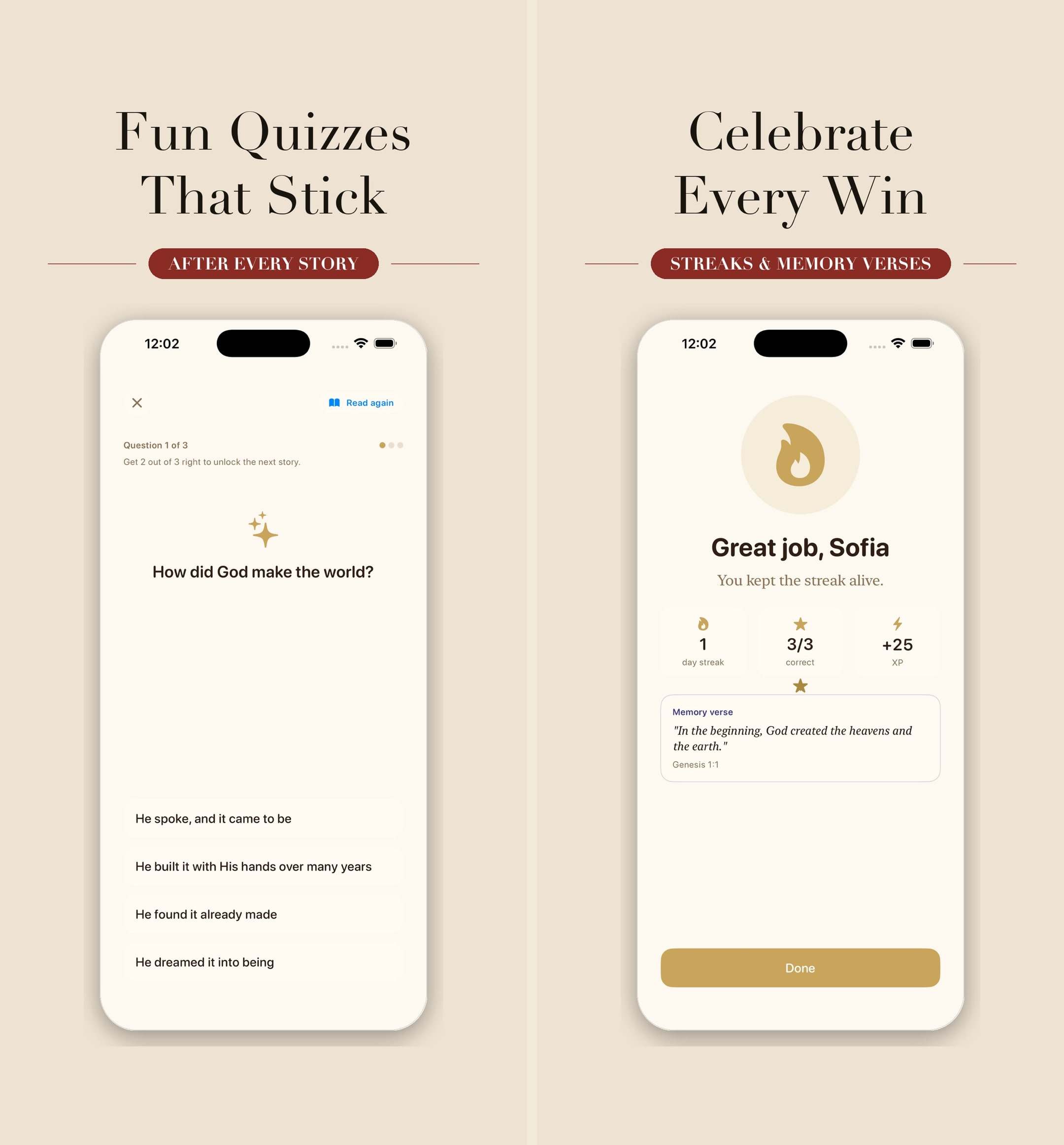
| 1 | BibleBuddy Kids | 8.2/10 | 4.7(76) | From $4.99/mo Know more → | iPhone and iPad families who want a real learning loop: a sequential 82-story arc, a quiz after every story, full KJV verses on the same screen as the retelling for memory-verse work, and a parent dashboard that shows weekly progress, completion stats, and time-in-app. |
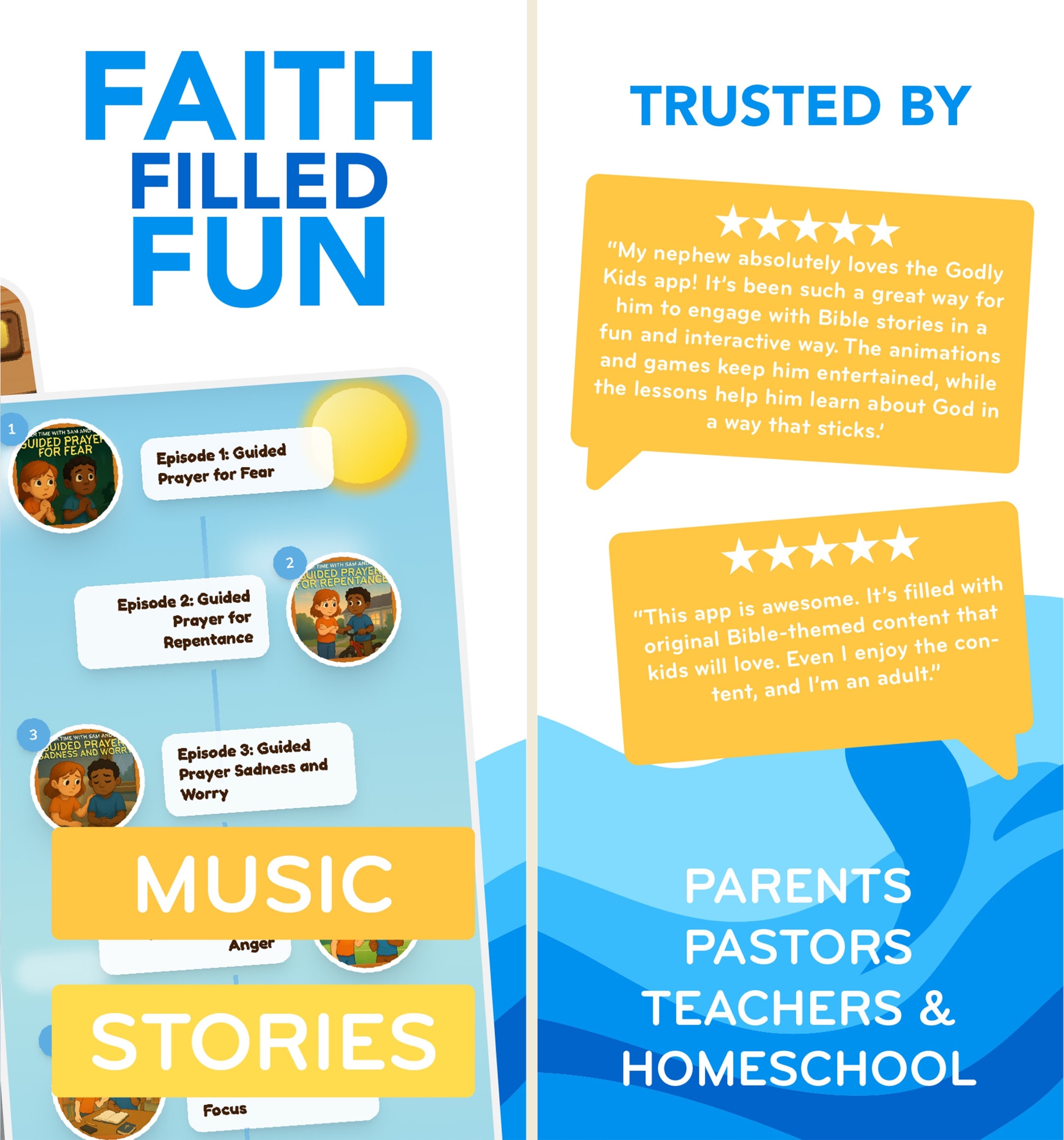
| 2 | Godly Kids: Bible app for kids | 7.1/10 | 4.8(60) | From $5.99/mo Know more → | Households with multiple kids who want per-kid reading level inside one app: a daily structured sequence (story plus memory verse plus game plus worship plus prayer) with profile-level progress tracking and a $19.99 lifetime unlock that beats any subscription on long-term value. |
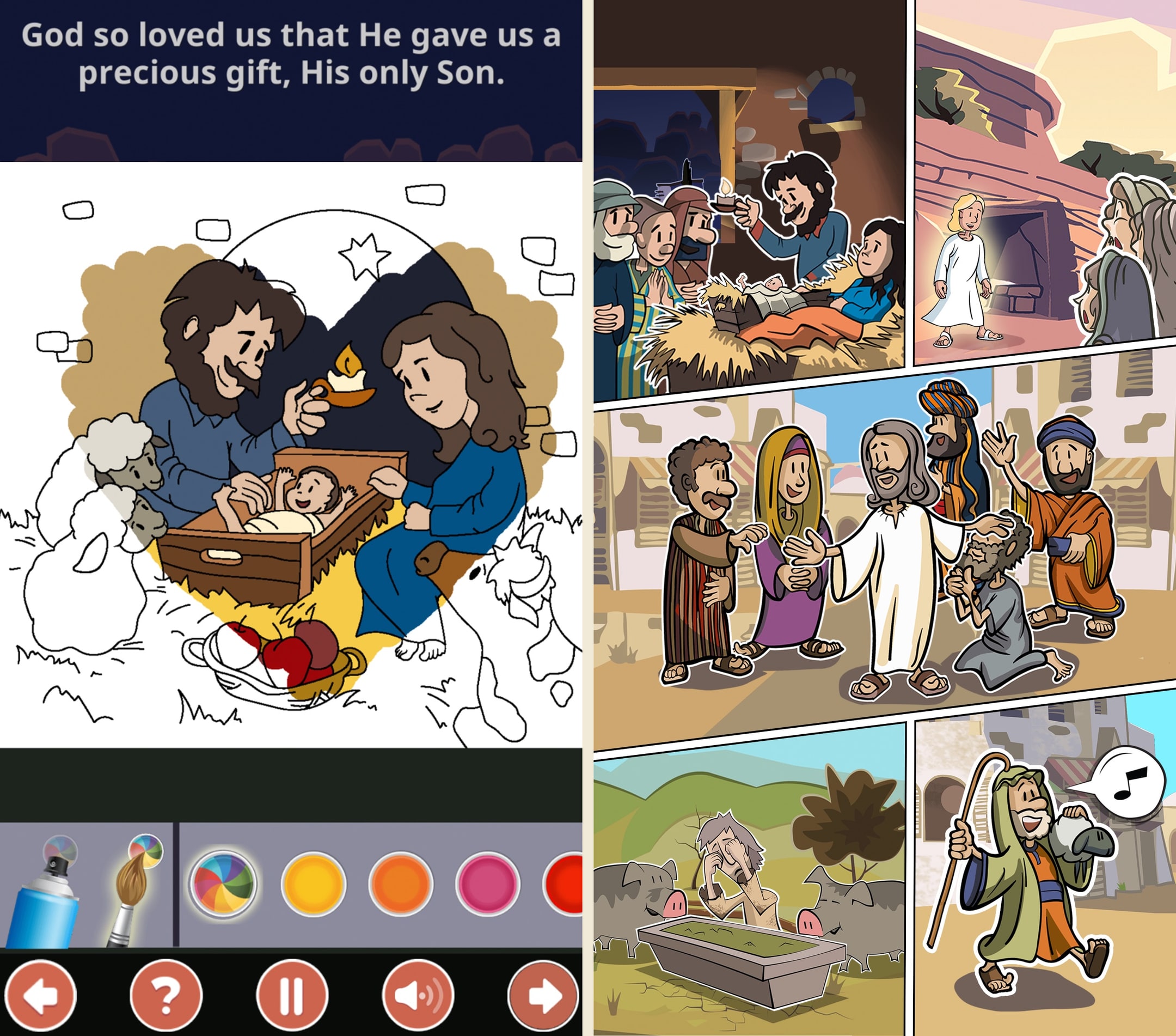
| 3 | SunScool - Bible for Kids | 7.0/10 | 4.8(684) | Free | Free, cross-platform learning with the deepest curriculum library in the category: 600 plus structured lessons, six puzzle modes that double as comprehension checks (word search, crossword, bubble-pop), lesson search by Bible reference, and 22 interface languages for multilingual households. |
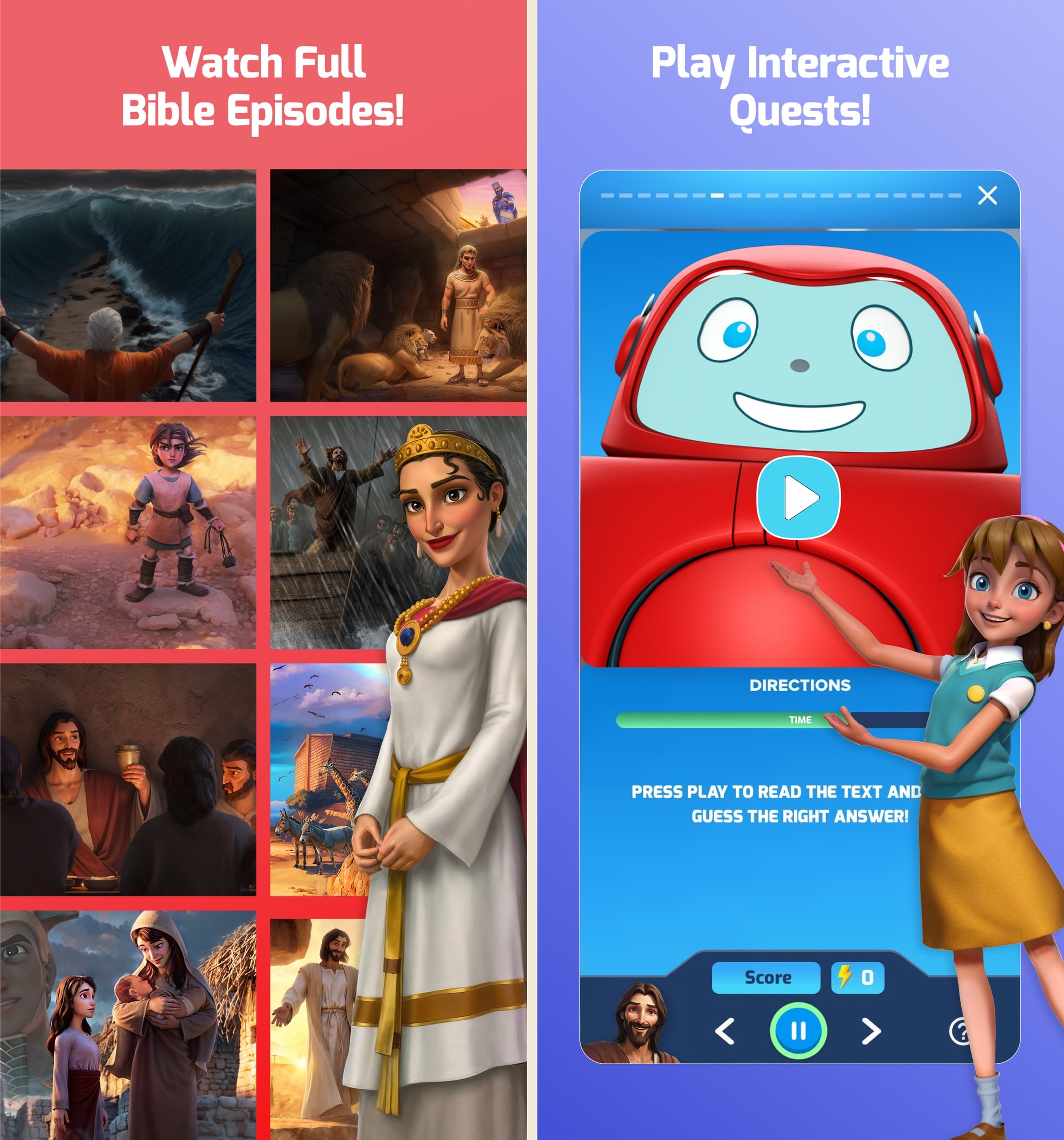
| 4 | Superbook Kids Bible | 7.8/10 | 4.8(18K) | Free | Free cross-platform households who want a real Bible reader (KJV, NIV, ESV, NLT) bundled alongside long-form animated episodes, Devotional Quests, and 20 plus Bible games that work as informal recall checks, all funded by CBN with no IAPs. |
| 5 | Little Saint Adventures | 7.5/10 | 4.4(72) | From $1.99 one-time Know more → | Catholic households with kids ages 3 to 8 who want sacrament, saint, and parish-life learning that no Protestant kids Bible app delivers, with 50 plus games and activities across 9 themed worlds and a Parent Portal that surfaces real content guides. |
| 6 | I Read: The Bible app for kids | 6.8/10 | 4.4(183) | From $1.99 one-time Know more → | Independent readers (roughly age 6 and up) whose parents want quiet reading-and-comprehension practice: 98 stories with quizzes after each passage, six interface languages, offline support, no subscription, and one-time IAPs at $1.99, $4.99, or $9.99 for whole-library access. |
| 7 | God for Kids: Family Bible App | 7.0/10 | 4.7(1.3K) | Free | Free theology-focused learning for younger kids: 31 devotions structured around God's character, Jesus, and the Holy Spirit (verse plus prayer plus game), with a Grown-Up Tips section that scripts the parent-led discussion, six interface languages, and zero paywalls. |
| 8 | Grace - Bible for Kids | 5.8/10 | 4.8(83) | From $1.99/wk Know more → | Older kids on iPhone or iPad whose parents want to try the novel Create-a-Story authoring mode at the $24.99 annual price: a values-focused (kindness, forgiveness, honesty) set of text stories with quizzes and a planned coloring and memory-game roadmap. |
How they ranked
The 8-app shortlist, ordered by how well each one fits the audience this page is written for.
BibleBuddy Kids
KJV side-by-side scripture, AI tutor, and parent dashboard for ages 4-12.
- Our score
- 8.2/10
- Platforms
- iOS
BibleBuddy Kids is the most ambitious recent entry — KJV side-by-side, AI tutor, and a real dashboard is a serious feature set that nobody else in the kids category bundles together. The catches are real though: iOS-only locks out roughly half the US market, the sequential unlock annoys parents who just want to read Noah's Ark tonight, and the AI tutor remains a leap of faith. At $99 lifetime it is a strong value if you commit, but the gamification is a meaningfully different vibe from a calm bedtime read.
What we like
- Displays full KJV verses side-by-side with the kid-friendly retelling — rare in this category
- Parent dashboard with weekly summary, completion stats, and time-in-app reporting
- AI tutor is scripture-grounded and parent-filtered, with logged questions for caregiver oversight
- Sequential unlock learning path with quizzes after each story builds genuine retention
- 82 stories with active expansion into Advent, Holy Week, Acts, and Prophets packs
What to know
- iOS-only as of mid-2026 — no Android, no Kindle Fire, no web
- Sequential unlock can frustrate parents who want their kid to pick a specific story
- Heavy gamification (stars, streaks, unlocks) is off-brand for families who want calm devotional time
- AI tutor is novel but unproven — long-term safety of LLM-generated answers for kids is an open question
- Static illustrations only — no animated stories, which is a tough sell against YouVersion and Superbook
Best for
iPhone and iPad families who want a real learning loop: a sequential 82-story arc, a quiz after every story, full KJV verses on the same screen as the retelling for memory-verse work, and a parent dashboard that shows weekly progress, completion stats, and time-in-app.
Skip if
You are on Android (iOS-only is a hard wall), you run a classical or Charlotte Mason method that avoids gamified streaks and quiz mechanics, or you want animated video rather than static illustrations behind the learning loop.
How I feel
I feel very good about it cause it asked me questions. I learned about God and yeah, that’s probably it.
— Dobex007 · March 1, 2026
Godly Kids: Bible app for kids
Guided sequential lessons with stories, music, prayers, and games for ages 5-12.
- Our score
- 7.1/10
- Platforms
- iOS
This is the strongest entry on the homeschool angle — the daily sequence is well-structured and the per-kid reading level is a real differentiator. The $19.99 lifetime price is a steal if it holds. Two warnings: the dual pricing model (subscription plus credit packs) creates the wrong vibe for a kids app, and the user base is still tiny so quality issues might not be surfaced yet. Worth a trial, not yet a confident recommendation.
What we like
- Lifetime tier at $19.99 is dramatically cheaper than peers — strong value if you commit
- Multiple child profiles with per-kid reading level — useful for households with siblings
- Daily structured sequence (story + memory + game + worship + prayer) is genuinely curriculum-like
- Active development with version 2.0 shipped in early 2025
- Independent learning block explicitly designed for homeschool schedules
What to know
- iOS-only — no Android distribution
- Tiny review count means quality signal is thin
- Pricing structure with both subscription AND credit-pack IAPs is confusing
- No scripture text view despite the structured learning framing
- No animations, just illustrated stills
Best for
Households with multiple kids who want per-kid reading level inside one app: a daily structured sequence (story plus memory verse plus game plus worship plus prayer) with profile-level progress tracking and a $19.99 lifetime unlock that beats any subscription on long-term value.
Skip if
You are on Android, you want full scripture text surfaced alongside the kid retelling (Godly Kids does not expose translations), or the dual pricing model (subscription plus consumable credit packs) feels manipulative for a kids product.
Nephew approves!
My nephew absolutely loves the Godly Kids app! It’s been such a great way for him to engage with Bible stories in a fun and interactive way. The animations and games keep him entertained, while the lessons help him learn about God in a way that sticks. I love that it reinforces biblical values in a way that’s easy for kids to understand. Highly recommend for any parents or family members looking for a faith-based app for their little ones!
— AlphaRim · February 6, 2025
SunScool - Bible for Kids
600+ lessons and puzzles in 22 languages — built for missionary Sunday schools.
- Our score
- 7.0/10
- Pricing
- Free
- Platforms
- iOS, Android
If you measure on lesson volume per dollar, SunScool wins by a wide margin — 600 lessons free is unmatched. The catches are design polish and the somewhat utilitarian missionary-tool feel. For a Sunday school teacher building lesson plans or a multilingual family, this is a serious resource. For a parent looking for bedtime storytime, the vibe is off.
What we like
- 600+ Bible lessons — by far the largest learning-focused library in the category
- 22+ language interfaces including Chinese, Korean, Vietnamese, Turkish, Indonesian
- Six different puzzle modes (word search, crossword, sea-battle, bubble-pop) keep engagement varied
- Free with no IAPs — funded as a missionary tool
- Designed for Sunday school structure with lesson search by Bible reference
What to know
- Visual design is utilitarian and feels translated rather than native English
- No central narrative arc — feels more like a curriculum tool than a kids app
- Sea-battle game mode in a Bible app is an unusual creative choice
- Solo developer with limited transparency on the publisher
- Activity quality varies significantly across the 600 lessons
Best for
Free, cross-platform learning with the deepest curriculum library in the category: 600 plus structured lessons, six puzzle modes that double as comprehension checks (word search, crossword, bubble-pop), lesson search by Bible reference, and 22 interface languages for multilingual households.
Skip if
You want consumer-grade polish, a single coherent story arc rather than a 600-lesson grid, or a caregiver-facing dashboard (SunScool has per-kid progress inside the app but no real parent summary view).
Amazing App
This app is so nice, and teaches not only younger kids but also older kids. You can pick the language so it’s easier for you to understand and the stories are short and fun, there are little games like coloring and crosswords, there’s so much fun things to do, all for the glory of God. So greatful for all the people that made this app. My little brother plays it everyday, the first thing he asks when he comes home from school is “can I play Sunschool please!” It’s an amazing app with lots of good stories from the Bible. Definitely recommend getting! <3
— anastasia.aes · November 30, 2021
Superbook Kids Bible
Full-length animated Superbook episodes plus a kid-friendly full Bible from CBN.
- Our score
- 7.8/10
- Pricing
- Free
- Platforms
- iOS, Android, Kindle Fire
Superbook punches above the YouVersion app on raw content volume — 68 long-form episodes and the full Bible is genuinely a lot for free. The catch is the package: the 2011 reboot animation skews older and more action-driven than most preschool Bible content, and CBN's broader media identity is polarizing. If your kid already loves the show, this is a clear install. If you are looking for calm bedtime stories or a clean parent dashboard, this is not it.
What we like
- 68 full-length episodes (~25 min each) of the Superbook animated series — more video runtime than any competitor
- Includes the entire Bible text with multiple translations, not just retellings
- 23 languages and 35 dubbing tracks for the show — strong missionary global reach
- Avatar customization and SuperPoints reward system make it sticky for kids who like games
- Completely free with no IAPs and no ads, funded by CBN
What to know
- Episodes are 1980s-style adventure animation that some parents find dated or theatrically violent
- App is large (216MB) and battery-heavy on older tablets
- CBN's political branding is a non-starter for families who do not align with that ministry
- No parent dashboard or progress export — you cannot see what your kid actually watched
- Games and Quests can feel grindy and pull kids away from the actual stories
Best for
Free cross-platform households who want a real Bible reader (KJV, NIV, ESV, NLT) bundled alongside long-form animated episodes, Devotional Quests, and 20 plus Bible games that work as informal recall checks, all funded by CBN with no IAPs.
Skip if
You want a caregiver dashboard (Superbook tracks SuperPoints but does not expose a real parent summary), you avoid CBN-branded content for political or theological reasons, or you want short audio-led learning rather than 25-minute animated episodes.
THANKFUL777MOM
We love Superbook! The daily verse that is sent is a great way to start the day with my child. The videos are so enjoyable and Bible-based. The characters of Chris, Joy and Gizmo are very relatable. Not only are lessons learned by the characters from first-hand observation or interaction with a Biblical person, but the scripture is also brought to life through accurate depictions of places, clothing, and customs. Even the dialogue is most often what is actually written in The Bible. We have had so many discussions about God, life, our character, history, and geography after watching. It’s been a launching pad for learning. My child and her friends have not tired of seeing these videos for the last 5-6 years, and it’s still an exciting day to receive a new one in the mail. As a former film and television artist, I like the visual and voice quality of these videos. They are enjoyable for me to watch as well. We even watch the old, original videos produced, which are sometimes included in the extras section of the disc. We enjoy seeing the evolution of the storytelling and animation. We have given the extra videos to friends, family and a Christian school for Bible class. People ask us all the time, “Where can I get these??” Because extra discs are part of the sign up, we have extra copies to give out. This is so helpful because we were lending them out so much we didn’t get the benefit of them, and I want to keep an intact set for my grandchildren.
— THANKFUL777MOM · July 20, 2019
Little Saint Adventures
The leading Catholic kids app — saints, sacraments, and faith games for ages 3-8.
- Our score
- 7.5/10
- Platforms
- iOS, Android
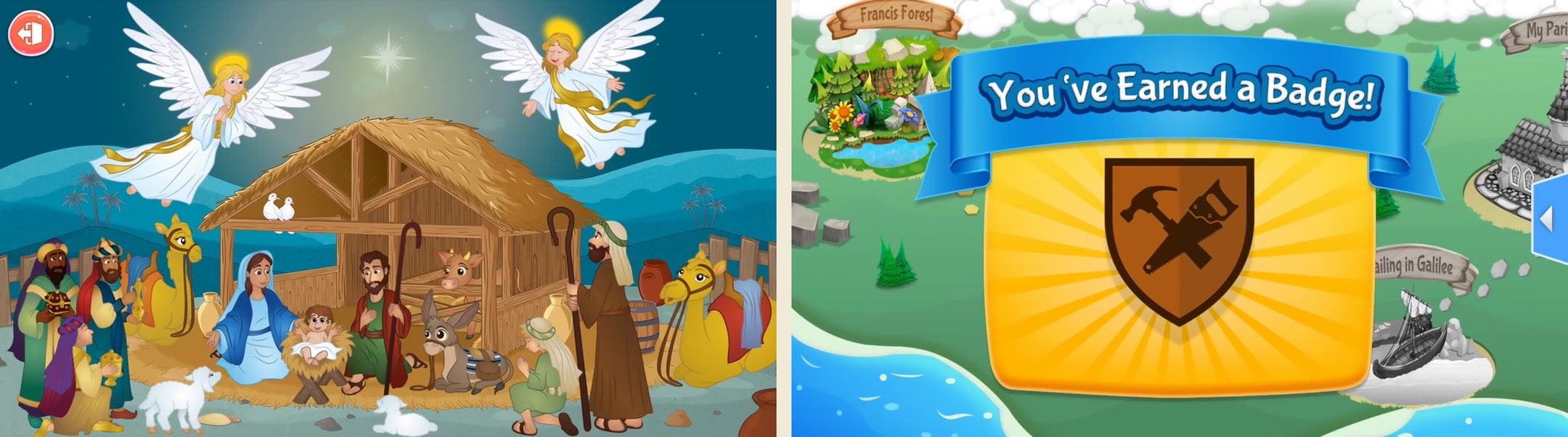
There is essentially no competition for Catholic families with young kids — Little Saint Adventures owns this niche. The content depth on saints and sacraments is genuinely good, and the Parent Portal is more thoughtful than most. The risks are the pricing structure (paid app plus IAPs feels old-school) and the slowing update cadence. Best path: pay the $12.99 Full Access one-time and skip the per-world IAPs entirely.
What we like
- The only serious purpose-built Catholic kids app on either store
- 50+ games and activities across 9 themed worlds (saints, parish life, Galilee, etc.)
- Sacramental and saint-focused content not available in Protestant kids apps
- Parent Portal gives caregivers real visibility and content guides
- Published by Fuzati, which partners with Sophia Institute Press for Catholic content credibility
What to know
- Paid download ($8.99) on top of optional IAPs creates a high upfront barrier
- Last meaningful update was in 2023 — content cadence has slowed
- Not a Bible reader — focus is on Catholic faith formation, sacraments, and saints
- Iconography and visual style is dated compared to current premium kids apps
- Sells separate IAPs per world which adds up fast if you go that route
Best for
Catholic households with kids ages 3 to 8 who want sacrament, saint, and parish-life learning that no Protestant kids Bible app delivers, with 50 plus games and activities across 9 themed worlds and a Parent Portal that surfaces real content guides.
Skip if
You are Protestant or non-denominational, you want Bible storytelling and scripture text rather than Catholic faith formation, or you are uncomfortable paying $8.99 for the base app plus a $12.99 Full Access unlock on top.
Kids enjoy- but pricey
Kids definitely enjoy and are learning a lot. So nice to have an app for Catholic children. However, it would be nice to just pay one (affordable) flat fee instead of ongoing payments. My kids don’t play this game or the iPad daily to make it worth me paying a monthly subscription (it adds up!). For now, they won’t advance in levels unfortunately because I don’t want to pay a monthly subscription.
— Vernon105 · July 3, 2018
I Read: The Bible app for kids
98 short Bible stories with reading comprehension quizzes, offline, ad-free, multilingual.
- Our score
- 6.8/10
- Platforms
- iOS
An underrated entry in the category specifically because it bucks the streaming/animation/subscription trend. If you have an independent reader, the quizzes turn this into a real literacy tool that happens to also teach Bible. One-time IAPs are a parent-friendly model. The dealbreaker for younger kids is the absence of audio — if your kid is not yet reading on their own, look elsewhere.
What we like
- 98 total stories (48 OT + 50 NT) — strong story count for the price
- No subscriptions — one-time IAP model is parent-friendly
- Six interface languages (English, French, German, Italian, Portuguese, Spanish) — strong for multilingual families
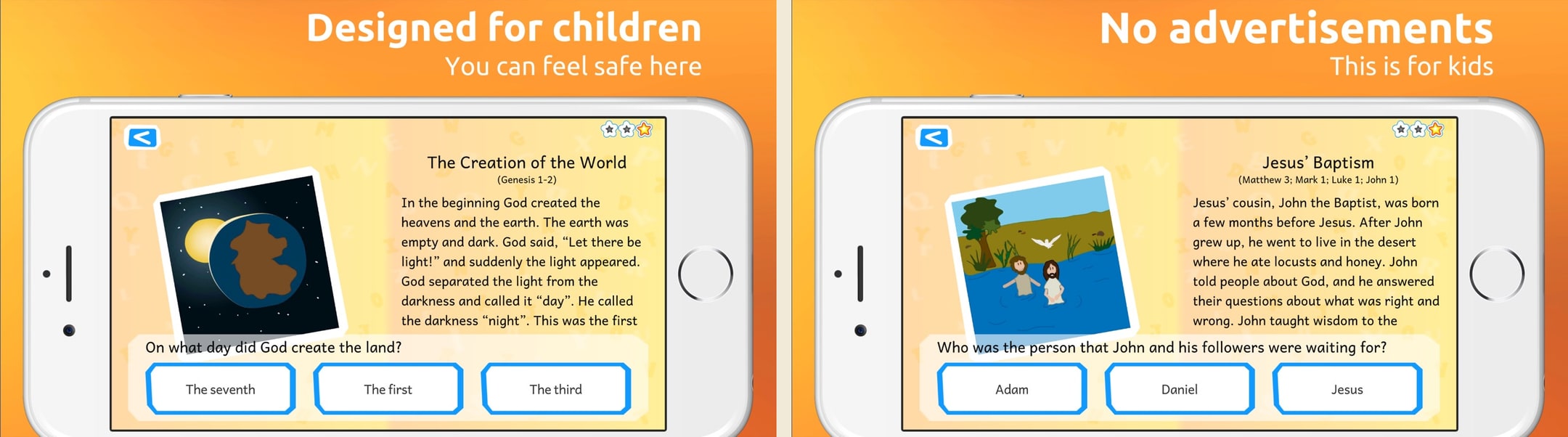
- Reading comprehension quizzes after each passage make this genuinely a reading app
- No data collection and no ads — clean privacy posture
What to know
- No audio narration — kids who cannot yet read independently get little out of it
- No animations or interactive illustrations
- iOS-only
- Tier contents at each IAP level are not clearly disclosed in the listing
- Visual design is dated and budget-feeling
Best for
Independent readers (roughly age 6 and up) whose parents want quiet reading-and-comprehension practice: 98 stories with quizzes after each passage, six interface languages, offline support, no subscription, and one-time IAPs at $1.99, $4.99, or $9.99 for whole-library access.
Skip if
Your kid cannot yet read independently (no audio narration is a hard wall), you want animations or a caregiver dashboard, or you are on Android.
Simple but awesome Bible reading practice
I love this as a reading and comprehension practice for early readers. I would suggest 2nd grade up and remedial higher grades. The comprehension questions are great and the offline feature. I would suggest leveling the stories and adding word work games would make it more appropriate, level friendly and easier to adapt to the needs of each child. But those are just suggestions. With those upgrades I would give it 5 stars.
— BarbFW · March 21, 2023
God for Kids: Family Bible App
31 thought-provoking child-centered devotions on God, Jesus, and the Holy Spirit.
- Our score
- 7.0/10
- Pricing
- Free
- Platforms
- iOS, Android, Kindle Fire
A quietly thoughtful app that has not gotten the attention it deserves. The devotional structure (verse + prayer + game) is closer to how a children's pastor would actually teach than any of the story-only apps. The catch is that 31 devotions is a one-cycle product — after your kid runs through them once, there is not much pull to return. Use it as a season, not a permanent install.
What we like
- Fully free with no paywalls — donations are genuinely optional
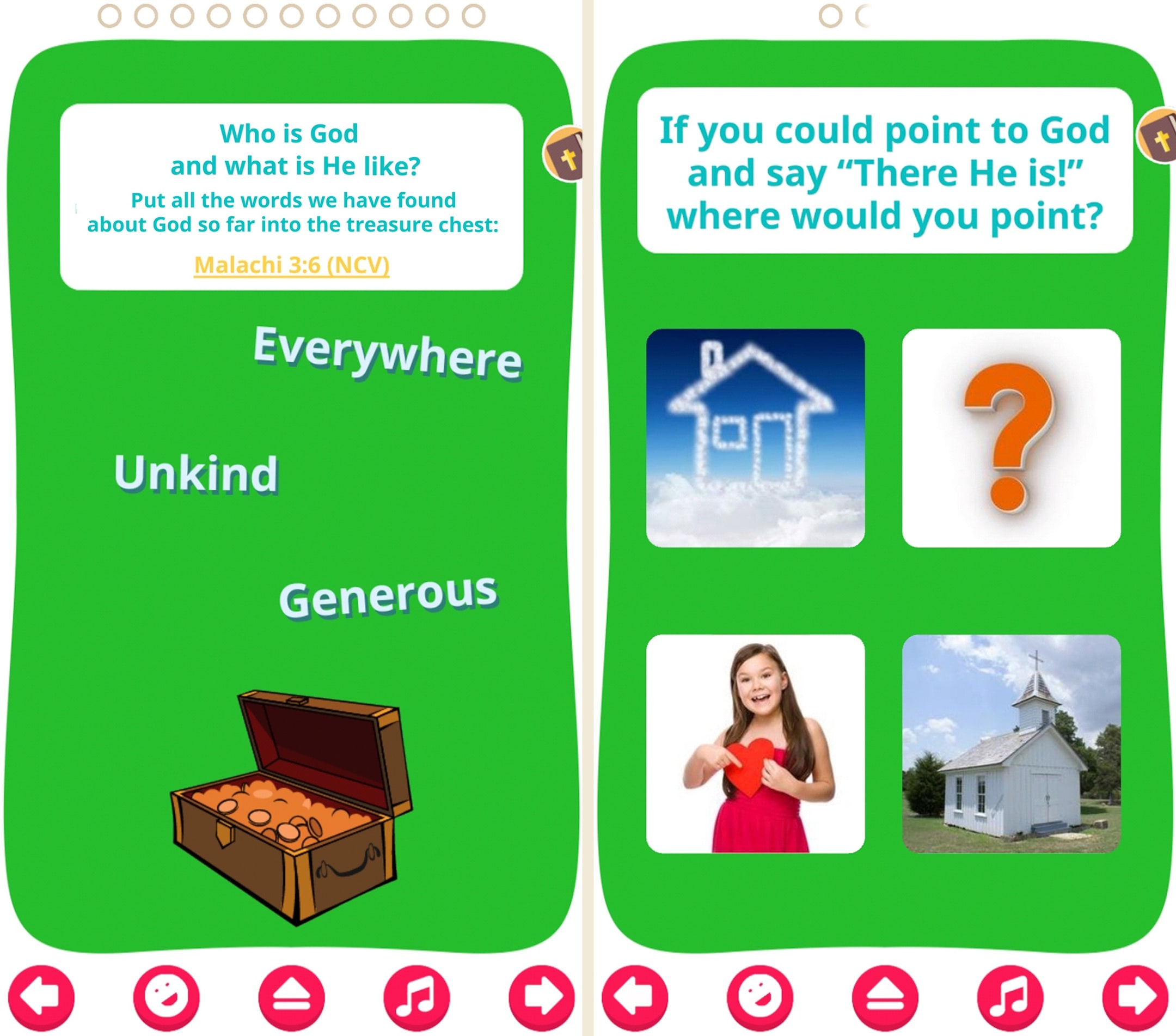
- 31 devotions structured around God's character, Jesus, and the Holy Spirit — theology-focused rather than story-focused
- Each devotion includes a verse, a prayer, and a game — proper devotional rhythm
- Grown-Up Tips section helps parents lead the discussion
- Six interface languages including Russian, Ukrainian, Serbian, and German — strong global reach
What to know
- Only 31 devotions — limited replay value once a kid completes the cycle
- Diamond/store mechanic for unlocking music and videos feels gamified for a devotional app
- No new content cadence — content has been static for years
- No scripture text view or translation toggle
- Visual design is dated compared to current category norms
Best for
Free theology-focused learning for younger kids: 31 devotions structured around God's character, Jesus, and the Holy Spirit (verse plus prayer plus game), with a Grown-Up Tips section that scripts the parent-led discussion, six interface languages, and zero paywalls.
Skip if
You want fresh content cadence (the 31 devotions have been static for years), reading-comprehension quizzes (the games are activities, not graded checks), or a long-running curriculum rather than a one-cycle theology series.
Awesome! But needs more
I love it! But I got a bit too addicted to it and I think it needs more chapters . This is one of the most entertaining and fun way to learn about Jesus and god and our Holy Spirit! But I can’t tell if I’m finished or not . Please make more chapters!!!! -8 year old girl ❤️😇
— crystall💖🔮 · May 31, 2024
Grace - Bible for Kids
Bible stories plus a 'Create-a-Story' mode where kids craft their own narratives.
- Our score
- 5.8/10
- Platforms
- iOS
The Create-a-Story idea is interesting and could be genuinely valuable for older kids who want to engage actively rather than passively. But the weekly subscription tier is the kind of pricing pattern that usually signals a developer optimizing for trial-trap conversion, and the actual feature depth today is thin. Wait for more reviews before committing, and if you do subscribe, go straight to annual and skip the weekly entirely.
What we like
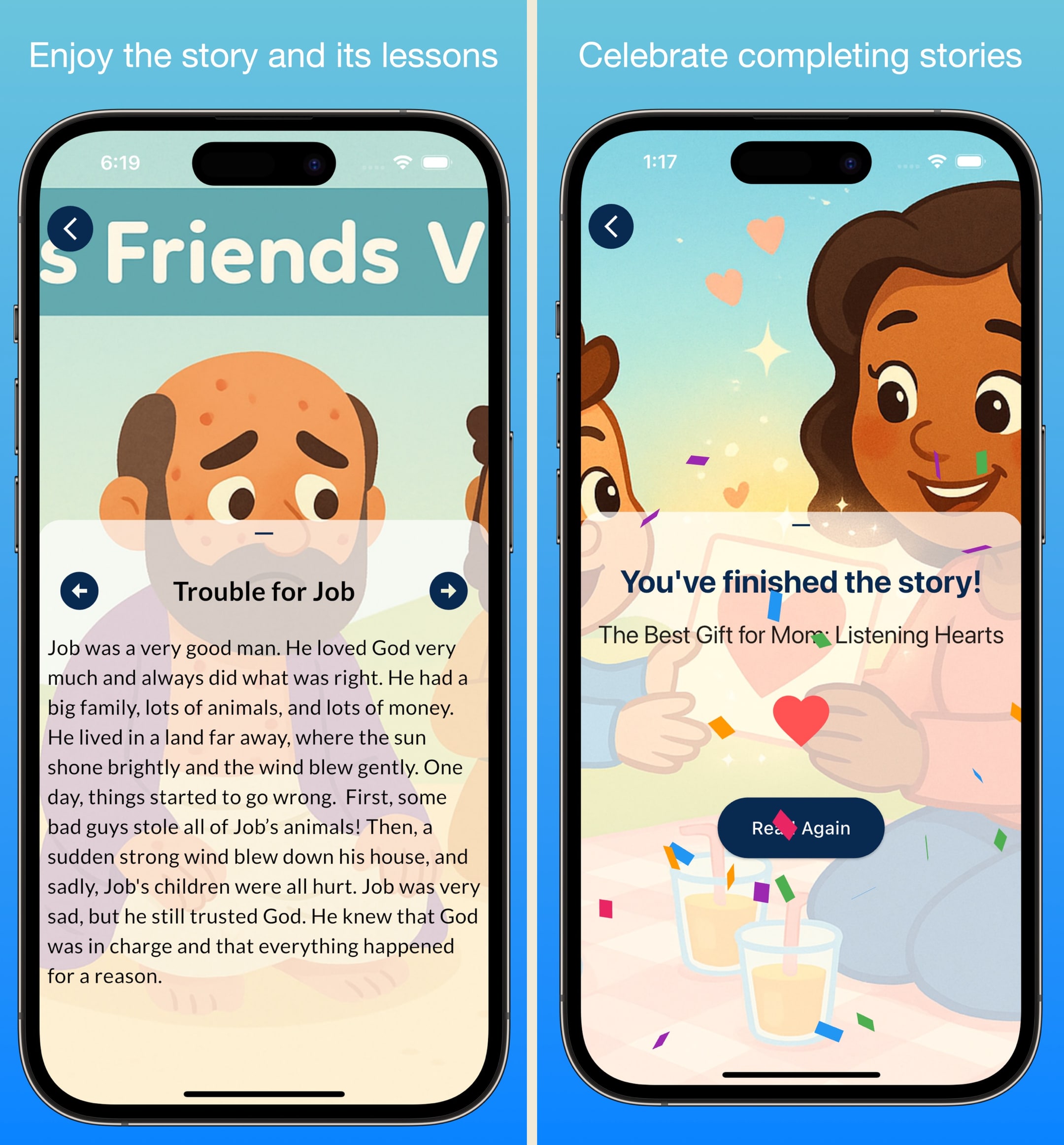
- Create-a-Story mode where kids craft narratives is genuinely novel in this category
- Yearly tier at $24.99 is the cheapest annual subscription reviewed
- Bible-themed coloring, quizzes, and memory games on the roadmap
- Stated focus on values — kindness, forgiveness, honesty, love — fits a character-formation use case
- Stated no-data-collection privacy stance
What to know
- Weekly subscription tier ($1.99/wk = $103/yr) is a predatory pricing pattern that should make parents cautious
- Solo developer with thin track record
- iOS-only with no Android plan
- No audio narration — purely text-based stories
- Many advertised features ('upcoming') are not actually live yet
Best for
Older kids on iPhone or iPad whose parents want to try the novel Create-a-Story authoring mode at the $24.99 annual price: a values-focused (kindness, forgiveness, honesty) set of text stories with quizzes and a planned coloring and memory-game roadmap.
Skip if
Weekly subscription pricing patterns make you uncomfortable ($1.99 a week works out to $103 a year), you want audio narration or animations, your kid cannot read on their own, or you are on Android.
Improved my kid’s Bible Reading
Grace has a truly remarkable way of presenting Bible stories. The narratives are captivating and easy for young minds to grasp, making the characters and events come alive. My kids, who are usually easily distracted, now eagerly gather around when it's Bible reading time.
— Fatouf · April 10, 2025
Verdict
Top pick: BibleBuddy Kids [biblebuddy-kids]. This is the only app we tested that bundles the four learning mechanics a parent on this page actually wants: a sequential 82-story arc with a quiz after every story (informal comprehension check), full KJV verses surfaced side-by-side with every retelling (so memory verses sit on the screen the kid is already reading), an AI tutor for follow-up questions the kid would otherwise ask a parent, and a real parent dashboard with weekly summary and time-in-app reporting. iOS-only is the dealbreaker for Android households and the gamification will rub some classical-method families the wrong way. For everyone else on iPhone or iPad, this is the strongest learning tool in the kids category by a wide margin.
Runner-up: Godly Kids [godly-kids]. The standout learning feature here is per-kid reading level inside a household, which no other app on this list ships. A 5 year old and an 8 year old in the same family can each have their own profile, their own progress, and their own difficulty calibration, all inside one $19.99 lifetime unlock. The daily sequence (story plus memory verse plus game plus worship plus prayer) is also genuinely curriculum-shaped rather than scattered. The catches are real: iOS-only, no scripture text view despite the learning framing, and the dual subscription-plus-credit-pack pricing structure is confusing for what is supposed to be a kids product. For families that fit the constraints, the per-kid reading level alone earns it the runner-up slot.
We would push back on the broader category framing here. Learning is the use case where the gap between marketing and product is widest. Almost every app claims it teaches kids the Bible. Almost none of them grade whether the kid learned anything. The apps highest in this ranking actually try to measure retention. The apps near the bottom serve up a story and hope the kid absorbed something. If your goal is genuine learning outcomes, the top two are the only honest picks. If your goal is exposure to Bible content with optional quizzes, the rest of the list will do.
What makes a kids Bible app actually a learning tool
Open any "best Bible apps for kids" roundup and the word "learning" gets thrown around as a halo, not as a design constraint. Almost every app in the kids Bible category claims it teaches kids the Bible. Almost none of them grade whether the kid learned anything. There is a structural reason for the gap: the kids Bible category was built for screen-time replacement, not knowledge transfer. A parent installs the app, hands the iPad to the kid, gets twenty quiet minutes, and assumes that because the audio mentioned Joseph and the coat, some learning happened. Whether the kid could re-tell the story tomorrow is not something the product was designed to measure¹.
The mismatch shows up in specific places that add up. Most kids Bible apps mark a story "complete" the moment audio finishes, with no recall check of any kind. Most memory-verse modes ship as a flashcard that nobody is grading: the verse appears, the kid taps next, the app moves on. Multi-kid households get one global difficulty setting (or no profiles at all), which means a 5 year old and a 9 year old are stuck on the same text. Caregiver-facing learning logs are rare enough that "shows you what your kid actually learned" is itself a marketing claim, not a baseline. Cognitive-science research on retention in young children is unambiguous: spaced retrieval (a quiz the next day, then the next week) drives long-term memory in a way passive exposure does not². Almost no Bible app for kids was built against that brief.
The apps that win for learning do a few quiet things on purpose: a real quiz or recall mechanic after every story, a memory-verse mode that records which verses are locked in versus merely seen, per-kid reading level so siblings can each have their own calibration, and a caregiver-facing summary so a parent can see in one place what was covered, what stuck, and what is still loose. The honest verdict from testing is that two apps in this list (BibleBuddy Kids and Godly Kids) were engineered as learning tools from the start, two more (SunScool, Superbook Kids Bible) bend to fit it, and the rest are story players with quizzes bolted on. We ranked accordingly. The same comprehension-checked, memory-verse-tracked, parent-visible learning shape is what our own Bible App for Kids is built around, because we ran into the same gap parents do and decided the cleanest fix was a product whose entire job is making sure the kid actually learned the story, not just that the kid heard it³.
How we evaluated the apps
Every app on this page was installed personally on a real iPad and a real Android phone where the platform supported it, then run through one week of structured-learning use: one story per day, the in-app quiz or recall mechanic after every story, a memory-verse check at the end of the week against the verses the app surfaced, and a parent-dashboard review at the end of the week to see what the app could actually tell us about retention. We watched what a learning routine actually looks like inside each app, not what the marketing copy claimed. The ranking comes from the four axes at the top of the page: comprehension and recall mechanics, memory-verse mode and tracking, reading-level adaptability across siblings, and parent visibility into what has been learned. Each axis is scored independently, then weighted toward the learning use case (comprehension mechanics and parent visibility matter more here than they do for bedtime). The full ranked list and per-app picks are in the verdict and ranked apps section above.
This page is AI-assisted writing, not AI-generated judgment. The notes came from real sessions in a real learning workflow, the calls about which app earns the top slot are ours, and the writing was sharpened with AI as a tool. We disclose this because most "best of" content lists in the kids Bible category never tell you who tested anything or whether anyone tested anything at all.
What we did NOT test
Eight apps from our wider spine of 16 are not on this page. We excluded each one for a learning-specific reason rather than a quality reason.
YouVersion's Bible App for Kids has the largest install base in the category and is genuinely useful for ages 3 to 7, but it ships zero comprehension checks, zero memory-verse tracking, and no parent-facing summary of what the kid saw. The product brief is interactive storytime, not learning measurement.
Pray.com Kids Bible delivers polished animated stories, guided prayers, and bedtime audio in a multi-profile parent-controlled wrapper. It does not ship per-story quizzes, a memory-verse mode, or a learning log. The brief is family devotion, not knowledge transfer.
Minno is Christian Netflix, not a Bible app. It serves video (VeggieTales, Adventures in Odyssey, Owlegories, 5 Minute Family Devotionals) and does that well, but there is no scripture, no quiz, and no recall mechanic. It is a streaming service that happens to be Christian.
Bible Stories For Kids! ships short audio Bible stories on a monthly subscription with no quizzes, no memory-verse mode, and no scripture text. It is a story player, not a learning tool. The same audio-first design that makes it strong for bedtime makes it weak for measurement.
Bible for Kids: Bedtime Stories is purpose-built for the lights-off routine: sleep timer, audio with the screen black, offline playback. It ships no quizzes, no memory-verse tracking, and no caregiver dashboard, because it is engineered against the bedtime brief, not the learning one.
Bible Kids (BCC Media) is a free ad-free animated video app from a small developer. The video library is decent but there is no scripture text, no comprehension check, and no parent view of progress.
Theo: Prayer and Meditation is a 9-minute audio routine pairing a Bible story with prayer and meditation, with Catholic and non-denominational filters. It is the strongest bedtime-prayer product we tested. It also ships no quizzes, no memory-verse mode, no scripture-text view, and no parent dashboard.
Bible Stories for the Young is a free semi-animated video app with an audio-only mode, growing toward a 365-story library. It has no quiz layer, no memory-verse tracking, and no caregiver-facing summary. Genuinely good as a free passive story player; not a learning tool.
We also did not test paper-based Bible curricula (Apologia, Veritas Press, Sonlight, BJU Press) because this page is a guide to apps. Spanish-only or regional-only apps unavailable on US storefronts as of were skipped, and apps pulled from the App Store or Google Play in the last twelve months were excluded. If a major learning-relevant Bible app launches between our quarterly re-reviews, we will fold it in at the next refresh. The date at the bottom of this page is the last hands-on session.
Tinykiwi. Coming soon.
The audio Bible app for kids.
Tinykiwi is an audio Bible app for kids that turns Bible learning into family time at bedtime, in the car, or before church.
Sources
- https://apps.apple.com/us/app/bible-app-for-kids/id668692393. YouVersion's Bible App for Kids on the App Store, accessed 2026-05-13. Stated audience and design framing centered on interactive animated storytime for ages 2 to 7, not on measurable knowledge transfer or learning outcomes.
- https://www.apa.org/education-career/k12/learning-memory. American Psychological Association overview of how children learn and retain information, accessed 2026-05-13. Spaced retrieval (low-stakes quizzes, repeated practice, retrieval practice over time) drives long-term memory in young learners more reliably than passive exposure.
- https://biblebuddykids.com/. BibleBuddy Kids product page, accessed 2026-05-13. Product description ships a sequential 82-story arc with quizzes after every story, full KJV verses side-by-side with the kid retelling, and a parent dashboard with weekly summary and time-in-app reporting, exemplifying the comprehension-checked / scripture-grounded / parent-visible shape the learning use case requires.