
Bible stories for kids
The David and Goliath Story for Kids
The story of David and Goliath is in 1 Samuel 17: a young shepherd, who would one day be King David, meets the giant Philistine champion Goliath with a sling and a stone. Here it is for kids and children, to read aloud, hear narrated or see in the picture storybook, with the King James words beside every scene.
The storybook opens full screen, one page at a time. The whole story is also below, with the Bible text beside it.
Where it is in the Bible
- Bible passages
- 1 Samuel 17. David is first chosen as the next king in 1 Samuel 16.
- Who is in it
- David, his father Jesse, his brother Eliab, King Saul and Goliath of Gath
- Where it happens
- The valley of Elah, between the camps of Israel and the Philistines
- When
- In the days of King Saul, after Samuel anointed David (1 Samuel 16:13)
- Key verse
- “And all this assembly shall know that the LORD saveth not with sword and spear: for the battle is the LORD'S, and he will give you into our hands.” (1 Samuel 17:47, KJV)
The story
This story is true. It is in the Bible, in the first book of Samuel.
Have you ever felt too small for something big? In this story, a whole army is afraid of one giant. Then a young shepherd says something about the battle that nobody else is saying. Listen for it.
Scene 1 of 5
A giant in the valley
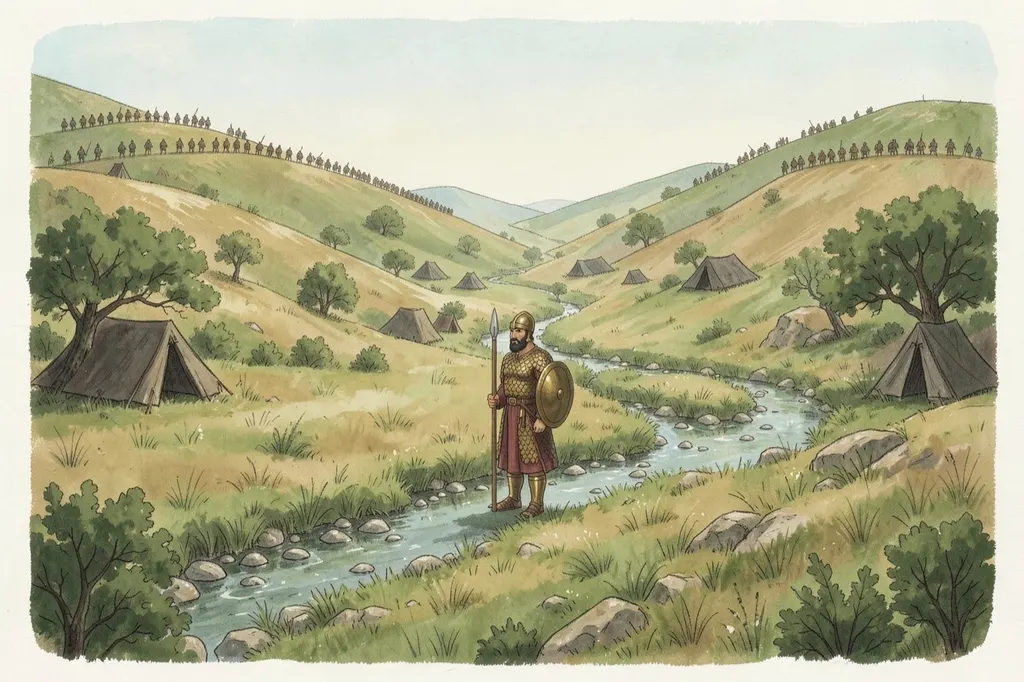
Long ago, the people of Israel had a king named Saul. And they had enemies called the Philistines.
One day, the two armies came to fight. The Philistines stood on a mountain on one side. Israel stood on a mountain on the other side. And between them was a valley, the valley of Elah.
Then a champion came out of the Philistine camp. A champion is one soldier who fights for everyone. His name was Goliath, and he was a giant, nearly ten feet tall. He wore a helmet of brass and a heavy coat of mail, made of small pieces of metal.
Goliath shouted across to Israel. He told them to choose one man to come down and fight him. If their man won, the Philistines would serve Israel. If Goliath won, Israel would serve the Philistines.
“I defy the armies of Israel this day; give me a man, that we may fight together.”
To defy means to dare someone, and to mock them. When King Saul and all Israel heard it, they were dismayed, and greatly afraid.
Scene 2 of 5
Ten loaves for the brothers
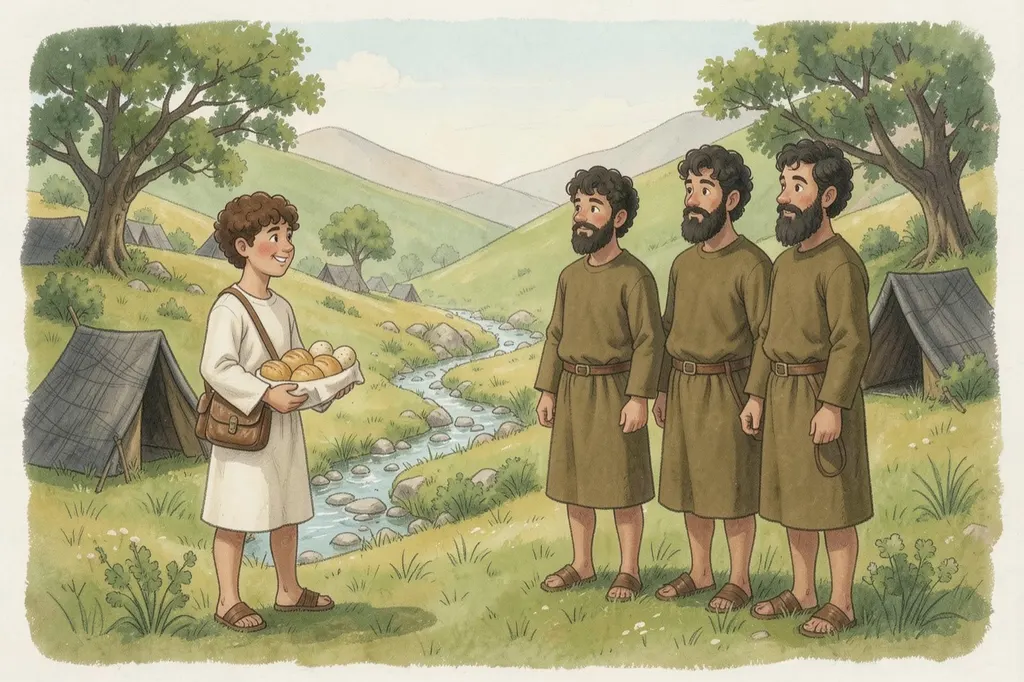
In Bethlehem lived a man named Jesse, who had eight sons. The youngest was David. His three oldest brothers had gone to fight in King Saul's army. David went back and forth from King Saul, to look after his father's sheep at home.
For forty days, morning and evening, Goliath came out and shouted his dare.
One day, Jesse sent David to the camp with roasted grain and ten loaves for his brothers, and ten cheeses for their captain.
David got up early, left the sheep with a keeper, and ran into the camp to find his brothers. As he talked with them, out came Goliath, shouting the same words. All the men of Israel ran from Goliath, sore afraid.
But David asked the men around him who this Philistine was,
“that he should defy the armies of the living God?”
David's oldest brother, Eliab, heard him, and was angry. He asked who was minding David's few sheep, and said David had come to watch the battle. David asked what he had done wrong, and turned to ask someone else.
Scene 3 of 5
The lion and the bear
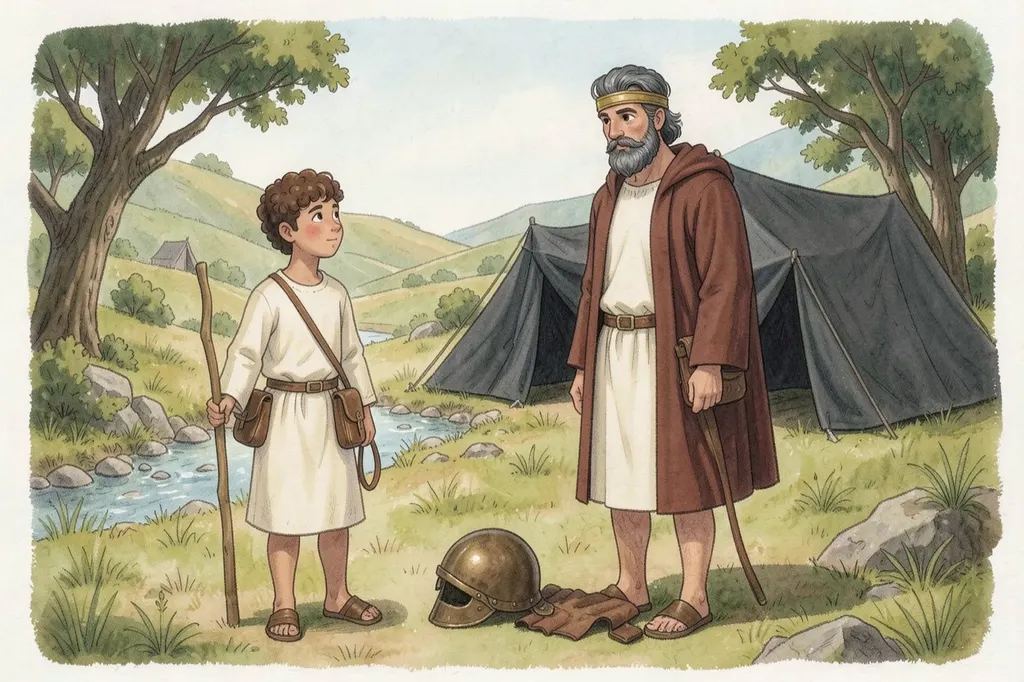
King Saul heard what David said, and sent for him. David told the king that nobody should lose heart. David would go and fight the giant.
Saul said David was only a youth, and Goliath had been a soldier since his youth.
Then David told how a lion came, and a bear, and took a lamb from his father's flock. David went after it and saved the lamb from its mouth. He had killed both the lion and the bear.
“The LORD that delivered me out of the paw of the lion, and out of the paw of the bear, he will deliver me out of the hand of this Philistine.”
So Saul told David to go, and wished that the Lord would be with him. Saul dressed David in his own armour. But David had not tested it, so he took it off.
David took his staff. He chose five smooth stones from the brook, and put them in his shepherd's bag. In his hand was his sling, a strap for throwing stones. And David went toward the giant.
Scene 4 of 5
In the name of the Lord
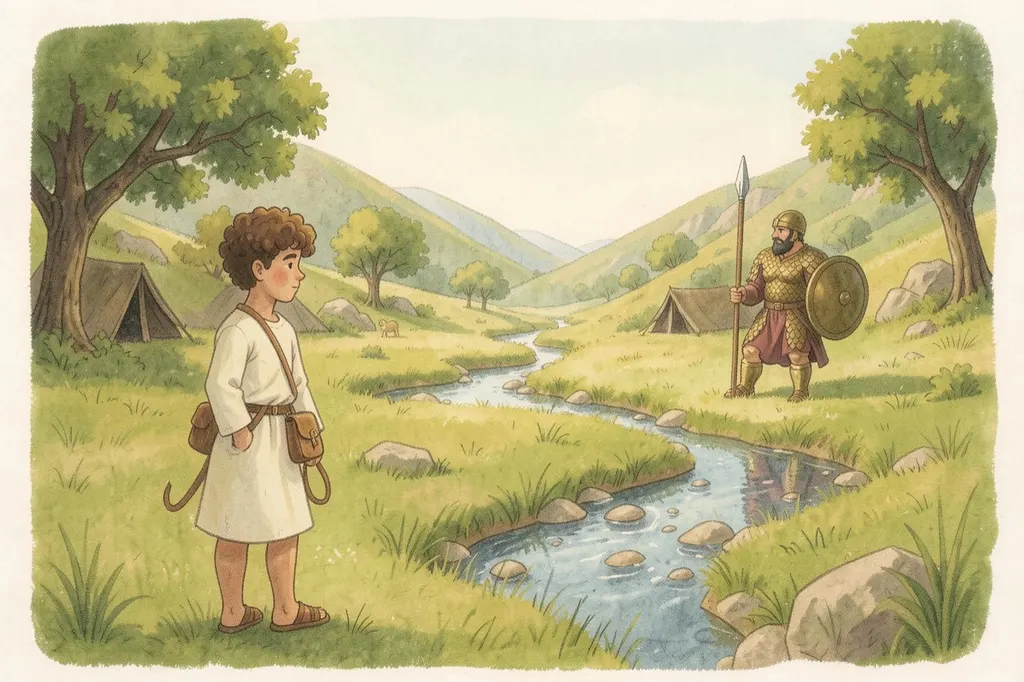
Goliath came nearer and nearer, with a man carrying his shield in front of him.
When Goliath saw David, he disdained him. That means he thought David was nothing at all. David was only a youth, with rosy cheeks and a fair face. Goliath asked if David took him for a dog, coming at him with sticks. Then he cursed David by his own gods, and said terrible things.
And David answered him:
“Thou comest to me with a sword, and with a spear, and with a shield: but I come to thee in the name of the LORD of hosts”
Hosts means armies. David said the Lord would give Goliath into his hand that very day, so all the earth would know there is a God in Israel. And everyone there would know that the Lord does not save with sword and spear.
Now listen. Here is what David said next:
“for the battle is the LORD’S, and he will give you into our hands.”
Scene 5 of 5
One smooth stone
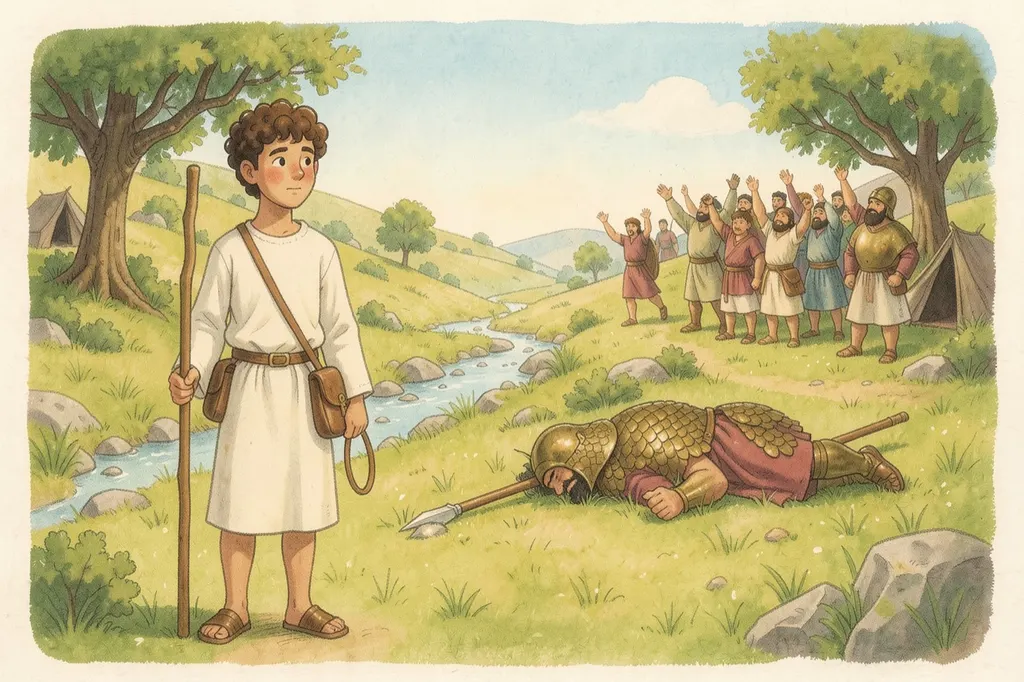
Goliath came forward to fight. David did not run away. He hurried, and ran toward the Philistine army, to meet the giant.
David put his hand in his bag and took out one of the smooth stones from the brook. He swung his sling, and the stone flew. It struck Goliath in the forehead, and the giant fell on his face to the ground.
“So David prevailed over the Philistine with a sling and with a stone”
Prevailed means won. Goliath was dead. And there was no sword in David's hand.
Do you remember what David said, in the valley? The battle is the Lord's.
Can you say it too? The battle is the Lord's.
Goliath had a sword, and a spear, and a shield. David had a sling, and a stone, and the name of the Lord.
One shepherd. One smooth stone.
The battle is the Lord's.
How to explain David and Goliath to a child
Keep God at the centre. David is brave, but the story's own point is what David says in 1 Samuel 17:47: "the battle is the LORD's". David trusts the Lord because the Lord already kept him safe from a lion and a bear (1 Samuel 17:37). So instead of telling your child to be brave like David, ask who David was trusting, and let the giant fall without lingering on it.
What this story shows about God
For grown-ups. The story itself never states a lesson, so here it is, with the verses behind it.
The battle is the Lord's
David did not say he was stronger than Goliath. He said the Lord saves, not sword and spear, and that the battle belonged to the Lord.
1 Samuel 17:47God had helped before
David trusted God with the giant because God had already kept him safe from a lion and a bear.
1 Samuel 17:37God is the living God
Goliath dared the army of Israel, but David saw it differently: these were the armies of the living God.
1 Samuel 17:26; 1 Samuel 17:36Questions to ask after
Pick the ones that fit your child. There are no wrong answers.
Ages 3 to 5
- What did David take out of the brook?
- Which two wild animals did David face when he looked after the sheep?
- Who did David say the battle belonged to?
Ages 6 to 9
- Everyone in the army was afraid. Why do you think David was not?
- David took off King Saul's armour. Why do you think he went with his sling instead?
- David remembered how God helped him with the lion and the bear. When has God helped you before?
Ages 10 to 12
- Goliath looked at David and saw nothing much. What did David see when he looked at Goliath?
- David said the Lord does not save with sword and spear. What do you think he meant?
- Eliab thought David had only come to watch. Why do you think David's own brother got so angry?
If your child asks
Honest answers to the hard questions, with the verses behind them.
Was David a little boy when he fought Goliath?
The Bible doesn't give David's age in the David and Goliath story. King Saul calls him "but a youth" (1 Samuel 17:33), which some modern Bibles put as "just a boy". He was old enough to guard sheep from a lion and a bear, and to try on Saul's armour (1 Samuel 17:34-39). Many pictures show a small child, but those details suggest he was older.
1 Samuel 17:33
How tall was Goliath?
In the David and Goliath story, 1 Samuel 17:4 says Goliath's height "was six cubits and a span". A cubit is about the length of a grown-up's forearm, so that is nearly ten feet. A few very old copies of 1 Samuel say four cubits and a span, which is still nearly seven feet: a giant next to a young shepherd either way.
1 Samuel 17:4
Did David kill Goliath?
For grown-ups: yes. In the David and Goliath story, David's stone knocks Goliath to the ground, and 1 Samuel 17:50 says David "slew him". Verse 51 adds that David then cut off Goliath's head with Goliath's own sword. Our telling says plainly that Goliath was dead and leaves out the rest. With a young child you could say: Goliath was fighting against God's people, and he died in the battle that day.
1 Samuel 17:49-51
Why did David pick five stones if he only needed one?
The Bible doesn't say. In the David and Goliath story, 1 Samuel 17:40 tells us only that David "chose him five smooth stones out of the brook", and 1 Samuel 17:49 that he took one stone from his bag. People have guessed at reasons, but they are guesses. What the story does tell us is that one was enough.
1 Samuel 17:40
What we added and left out
Every quoted line in this story is the King James Bible, word for word.
What we added
- Plain explanations of old words, in the next breath: champion, coat of mail, defy, disdained, Lord of hosts, sling, prevailed.
- We call Goliath a giant. 1 Samuel 17 never uses that word: it calls him a champion and "the Philistine", and gives his height (1 Samuel 17:4).
- Goliath's height in feet (nearly ten feet tall). The Bible gives it in cubits: "six cubits and a span" (1 Samuel 17:4).
- The narrator's words to your child: a question at the start, "Now listen" before David's answer, and two questions at the end. The "listen for it" frame is ours too. The line to listen for is David's own: "the battle is the LORD's" (1 Samuel 17:47).
- Roasted grain for "parched corn" (1 Samuel 17:17), and rosy cheeks for "ruddy" (1 Samuel 17:42).
- In the last scene, "one of the smooth stones from the brook" joins 1 Samuel 17:40 (five smooth stones out of the brook) and 17:49 (he took thence a stone).
What we left out
- Samuel anointing David as the next king (1 Samuel 16:1-13), and David playing the harp for Saul (1 Samuel 16:14-23).
- The weight of Goliath's armour, the bronze guards on his legs, and his huge spear (1 Samuel 17:5-7).
- The reward the king promised: riches, his daughter, and freedom for the family (1 Samuel 17:25).
- Goliath's threat to feed David to the birds and beasts, and David's answer in the same words (1 Samuel 17:44-46).
- David cutting off Goliath's head with Goliath's own sword (1 Samuel 17:51), the Philistines running away and the battle that followed, and David taking the head to Jerusalem (1 Samuel 17:52-54).
- Saul asking whose son David was (1 Samuel 17:55-58).
Not in the Bible, so not in our story
The Bible doesn't give David's age or call him a little boy: Saul calls him "but a youth" and puts his own armour on him (1 Samuel 17:33-38). It doesn't say why David chose five stones, or that the stone was big. It says he took one stone from his bag (1 Samuel 17:49). No one laughs at David in 1 Samuel 17; Goliath disdains him and curses him (1 Samuel 17:42-43).
Words from the story
Old Bible words your child might ask about.
- Philistines
- A people who lived by the sea, next to Israel, and often fought against it.
- Champion
- One soldier chosen to fight for a whole army.
- Cubit
- An old way to measure, about the length of a grown-up's arm from the elbow to the fingertips.
- Coat of mail
- Armour made of many small pieces of metal joined together.
- Defy
- To dare someone to fight, and to mock them.
- Sling
- A strap with a pouch in the middle, swung round to throw a stone far and fast.
- Scrip
- An old word for a shepherd's bag.
- Disdained
- Looked down on someone, as if they were nothing.
- Lord of hosts
- A name for God that means the Lord of armies.
- Prevailed
- Won.
Sources and how we made this story
References
- 1 Samuel 17:1-11: King James Version and Berean Standard Bible
- 1 Samuel 17:12-30: King James Version and Berean Standard Bible
- 1 Samuel 17:31-40: King James Version and Berean Standard Bible
- 1 Samuel 17:41-47: King James Version and Berean Standard Bible
- 1 Samuel 17:48-50: King James Version and Berean Standard Bible
- King James Version (1769 Oxford text), public domain. Berean Standard Bible, public domain since 2023 (berean.bible).
- Background: Goliath on Wikipedia.
How we made this story
- The retelling. Written by Tinykiwi with AI assistance, following how we tell these stories, then checked line by line against the Bible text. Every quoted line is the King James Version, word for word. What we explained, added and left out is listed above.
- The pictures and narration. The illustrations are AI-generated and chosen by hand. The narration is an AI voice recorded ahead of time, and every recording is checked word for word against the text.
- These stories are part of Tinykiwi, an audio Bible App for Kids we are building. For apps you can use today, see our guide to the best Bible story apps for kids.
More Bible stories for kids
Coming soon: Samson, Pentecost, Gideon, The Baptism of Jesus.
Tinykiwi. Coming soon.
The audio Bible app for kids.
Tinykiwi is an audio Bible app for kids that turns Bible learning into family time at bedtime, in the car, or before church.