
Bible stories for kids
The Ten Commandments for Kids
The Ten Commandments are the ten rules God gave his people at Mount Sinai and wrote on two tables of stone (Exodus 20). Here is the whole story for kids, with all 10 commandments in words children understand. Read it aloud, listen to it narrated, or open the picture storybook, with the Bible's own words beside it.
The storybook opens full screen, one page at a time. The whole story is also below, with the Bible text beside it.
Where it is in the Bible
- Bible passages
- Exodus 19, 20, 24, 32 and 34. The commandments themselves are Exodus 20:1-17, and again in Deuteronomy 5.
- Who is in it
- Moses, his brother Aaron, and the children of Israel
- Where it happens
- Mount Sinai, in the wilderness of Sinai
- When
- In the third month after God brought Israel out of Egypt (Exodus 19:1)
- Key verse
- “Thou shalt have no other gods before me.” (Exodus 20:3, KJV)
The 10 Commandments in words kids understand
From Exodus 20:1-17, each in plain words with the King James line beside it. Churches number them in slightly different ways; this is the order most Protestant churches use.
- Love God first. Have no other gods but God.KJV: “Thou shalt have no other gods before me.”
- Don't worship idols. Don't make statues or pictures to bow down to and worship.KJV: “Thou shalt not make unto thee any graven image”
- Treat God's name with respect. Don't use God's name in a careless or empty way.KJV: “Thou shalt not take the name of the LORD thy God in vain”
- Keep the Sabbath day special. Work for six days, and rest on the seventh, a day kept special for God.KJV: “Remember the sabbath day, to keep it holy.”
- Honour your father and mother. Listen to them, respect them and care for them.KJV: “Honour thy father and thy mother”
- Don't kill. Every person's life belongs to God.KJV: “Thou shalt not kill.”
- Keep your marriage promise. A husband and wife stay faithful to each other.KJV: “Thou shalt not commit adultery.”
- Don't steal. Don't take what belongs to someone else.KJV: “Thou shalt not steal.”
- Don't lie about others. Tell the truth about other people.KJV: “Thou shalt not bear false witness against thy neighbour.”
- Don't covet. Don't long for things that belong to someone else, wishing they were yours.KJV: “Thou shalt not covet thy neighbour’s house”
The story
This story is true. It is in the Bible, in the book of Exodus.
Have you ever made a big promise? In this story, a whole crowd of people make a promise to God, all together, in one big voice. Listen for what they say.
Scene 1 of 6
Carried on eagles' wings
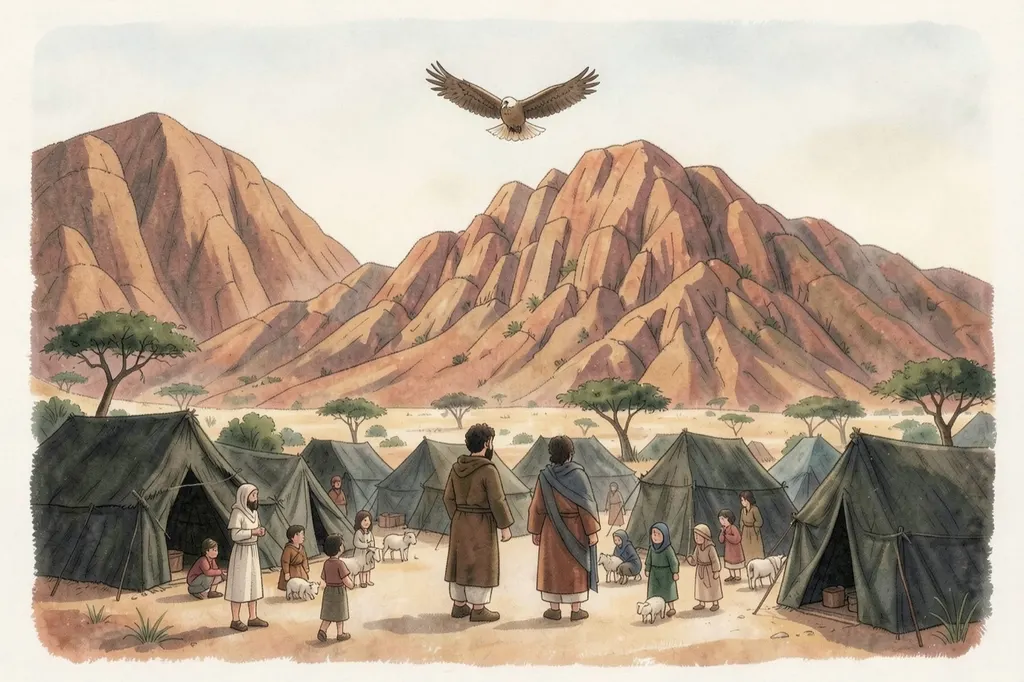
God's people, the children of Israel, had been slaves in Egypt. Then God set them free, and brought them out into the wide, dry desert.
After three months, they came to a great mountain called Mount Sinai. They put up their tents at the bottom of the mountain.
Their leader, Moses, climbed up to meet God. And God gave Moses a message for the people:
“how I bare you on eagles’ wings, and brought you unto myself.”
Bare means carried. God had carried his people, the way an eagle carries its young. If they would listen to his voice, God said, they would be his own special treasure.
Moses came down and told the people everything God had said. And all the people answered together:
“All that the LORD hath spoken we will do.”
Scene 2 of 6
The mountain of smoke and fire
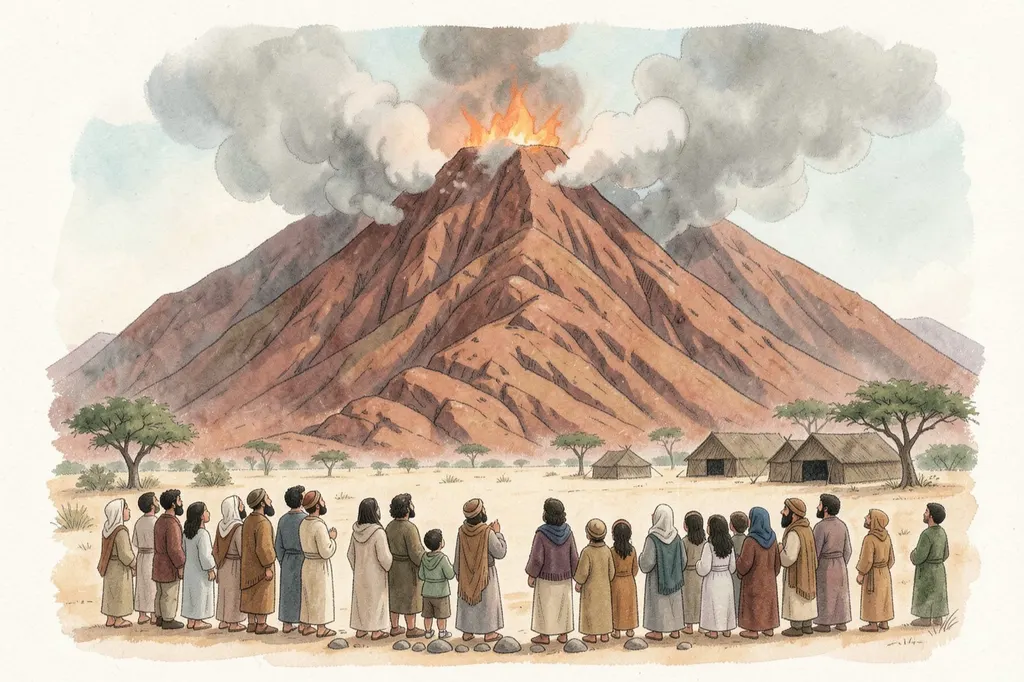
God told Moses that in three days, he would come down onto the mountain, where all the people could see.
So the people got ready. They washed their clothes. Moses marked a line all the way around the mountain, and the people stayed back behind it.
On the third day, in the morning, there was thunder and lightning. A thick cloud sat on the mountain. A trumpet sounded, very loud, and the people in the camp trembled.
Moses brought the people out of the camp to meet with God.
The whole mountain was covered in smoke, because the Lord had come down on it in fire. The smoke rose up like smoke from a great oven. The trumpet grew louder and louder.
Then God called Moses to the very top of the mountain. And Moses went up.
Scene 3 of 6
God speaks ten words
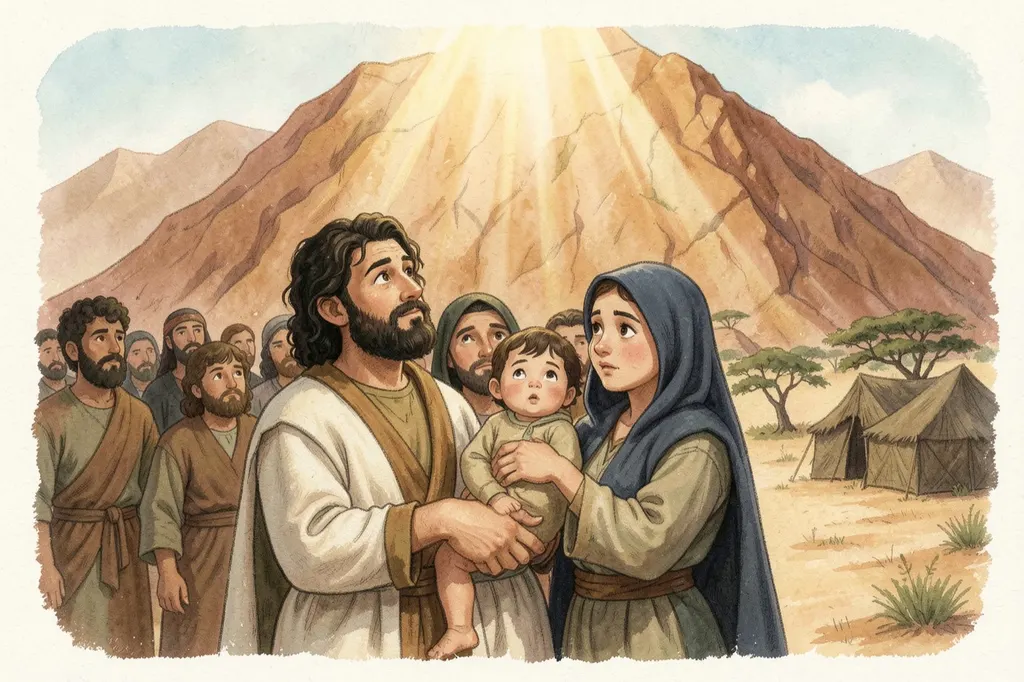
Then God spoke, and all the people heard. First he told them who he was: the Lord their God, who had brought them out of Egypt.
Then God gave ten commandments. A commandment is something God tells us to do.
“Thou shalt have no other gods before me.”
Do not make idols, statues to kneel down to and worship. Do not use God's name in a careless or empty way. Remember the Sabbath day. Work for six days, and rest on the seventh, a day kept special for God.
“Honour thy father and thy mother”
Do not kill. Husbands and wives, keep your promise to each other. Do not steal. Do not tell lies about other people. And do not covet. To covet is to want something that belongs to someone else, so much that you wish it were yours.
Ten commandments. And God had spoken every one.
Scene 4 of 6
Come up to me
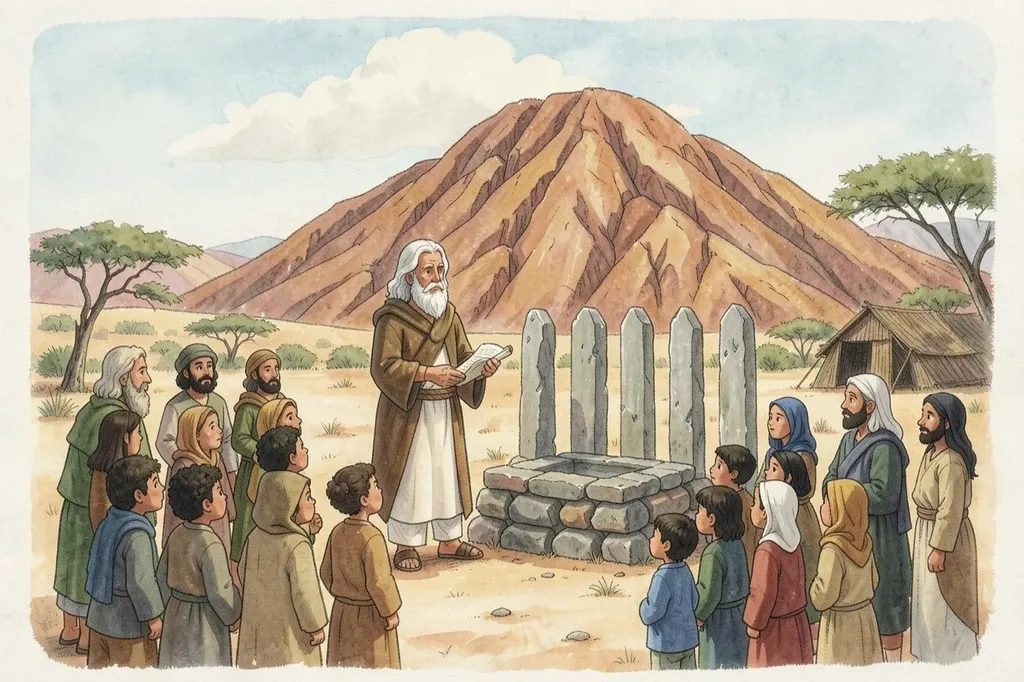
Moses wrote down all the words of the Lord. Early in the morning, he built an altar at the bottom of the mountain, and set up twelve tall stones, one for each tribe of Israel.
Then Moses took the book and spoke God's words out loud to all the people. And once more, the people promised:
“All that the LORD hath said will we do, and be obedient.”
Then God called Moses to come up the mountain. God would give him tables of stone, with the commandments written on them. Tables of stone are flat stones for writing on.
So Moses went up the mountain, and a cloud covered it. From down below, the glory of the Lord looked like fire on the mountaintop.
Moses went right into the cloud. And he stayed on the mountain for forty days and forty nights.
Scene 5 of 6
The golden calf
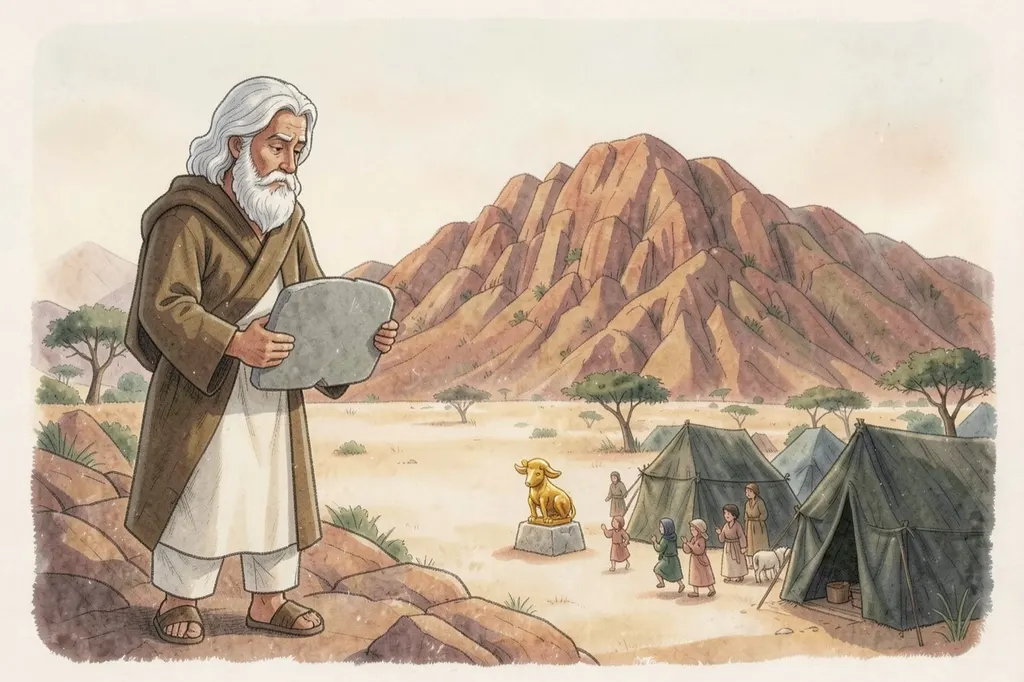
Down in the camp, the people waited and waited. Where had Moses gone?
The people went to Aaron, Moses' brother. They asked him to make them gods to go in front of them. So Aaron took their gold earrings, melted them, and shaped the gold into a calf. The people said the golden calf was the god that had brought them out of Egypt. The next day, they had a feast, and they danced.
Up on the mountain, God told Moses what the people had done. And Moses prayed for them.
Then Moses came down the mountain, with two tables of stone in his hands. They were written on both sides.
“the writing was the writing of God, graven upon the tables.”
When Moses came near the camp, he saw the golden calf, and the dancing. Moses was very angry. He threw down the stones, and they broke at the bottom of the mountain. Then he burned the golden calf in the fire.
Scene 6 of 6
Two new stones
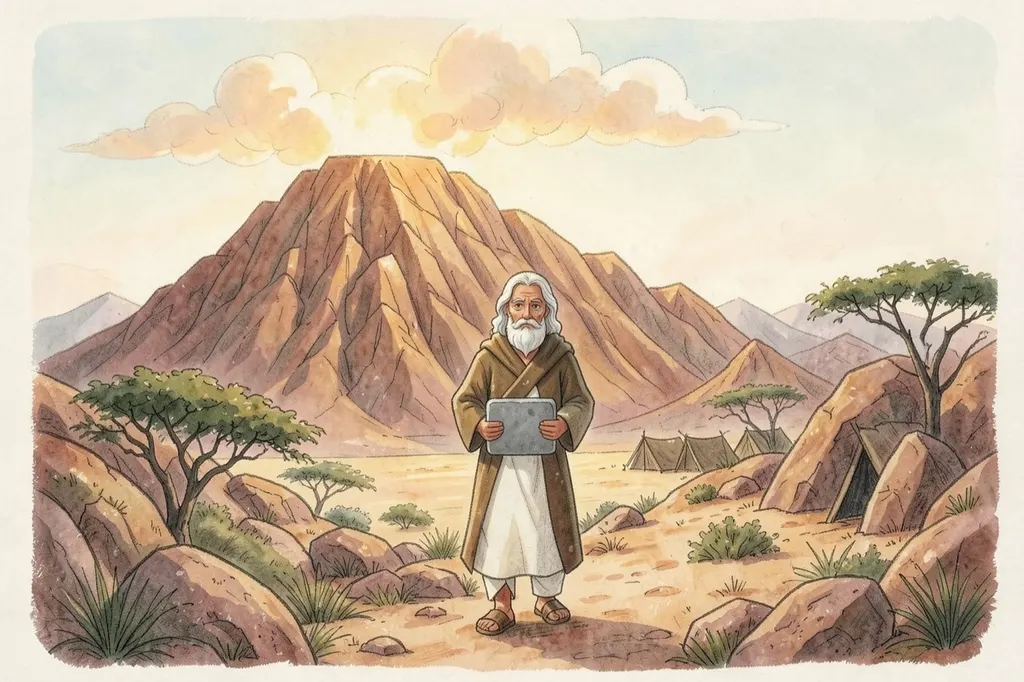
Then the Lord told Moses to cut two new stones, like the first ones. God would write the very same words on them again.
So Moses cut two new stones. Early in the morning, he climbed Mount Sinai all alone, carrying the stones in his hands.
The Lord came down in the cloud and stood with him there. Then the Lord passed by in front of Moses, and called out:
“The LORD, The LORD God, merciful and gracious, longsuffering, and abundant in goodness and truth”
Merciful means God is kind when we do wrong. Longsuffering means he is very, very patient.
Moses bent down low and worshipped. Then he asked God to go with the people and forgive them.
Do you remember what the people said, all together? All that the Lord hath spoken we will do.
Can you say it too? All that the Lord hath spoken we will do.
They said it at the bottom of the mountain. Then they forgot.
And God wrote his words again, on two new stones.
The Lord, the Lord God, merciful and gracious.
How to explain the Ten Commandments to a child
Start with the rescue. Before God gave a single commandment, he reminded his people that he had already set them free (Exodus 20:2). So the commandments are not how children earn God's love; they show how people God loves can live. The first ones are about loving God, and the rest are about treating other people well, the way Jesus summed them up (Matthew 22:37-40).
What this story shows about God
For grown-ups. The story itself never states a lesson, so here it is, with the verses behind it.
God rescues first
Before God gave a single commandment, he reminded his people that he had already set them free. The commandments were not how they earned his love. They were how a rescued people would live.
Exodus 20:2God speaks so we can know him
God came down and spoke to the people himself, and then wrote his words on stone so they would not be lost.
Exodus 20:1; Exodus 24:12God is merciful
When the people broke their promise, God gave his words again on two new stones, and named himself merciful and gracious, longsuffering, and abundant in goodness and truth.
Exodus 34:1-7Questions to ask after
Pick the ones that fit your child. There are no wrong answers.
Ages 3 to 5
- What did all the people promise, together?
- What did God write his words on?
- What did Moses carry up the mountain the second time?
Ages 6 to 9
- God told the people he had carried them like an eagle. What do you think that felt like?
- Which of the ten commandments do you think is the hardest to keep? Why?
- The people broke their promise, and God still wrote his words again. What does that tell you about God?
Ages 10 to 12
- God reminded the people he had set them free before he gave them a single commandment. Why do you think he did it in that order?
- The first commandments are about God and the rest are about other people. How are the two connected?
- Why do you think the people found it so hard to wait for Moses?
If your child asks
Honest answers to the hard questions, with the verses behind them.
Why are the Ten Commandments numbered differently in different churches?
The Bible calls them "the ten commandments" (Exodus 34:28) but doesn't put numbers on them. Jewish, Catholic and Lutheran, and most Protestant traditions group the verses of Exodus 20 in slightly different ways, so the numbers shift. The words themselves are the same in every list.
Exodus 34:28
How do I explain "adultery" to a child?
For little ones: adultery is when a husband or wife breaks their promise to love only each other. When people marry, they make that promise, and the seventh commandment says to keep it. Exodus 20:14 says it in four words: "Thou shalt not commit adultery."
Exodus 20:14
Why was Mount Sinai so scary in the Ten Commandments story?
God was showing his people how great and holy he is. In Exodus 20:20, Moses told the frightened people, "Fear not: for God is come to prove you", so that they would take God's words seriously and not do wrong. The line around the mountain kept the people safe (Exodus 19:12).
Exodus 20:18-21
Do Christians still have to keep the Ten Commandments?
Jesus said he did not come to destroy the law but to fulfil it (Matthew 5:17). When someone asked him for the greatest commandment, he said to love the Lord your God with all your heart, and to love your neighbour as yourself, and that all the law hangs on those two (Matthew 22:36-40). Churches explain how this applies to the Sabbath in different ways.
Matthew 5:17; Matthew 22:36-40
What happened to the people who made the golden calf?
For grown-ups: Exodus 32:25-35 tells that about three thousand men died that day, and that God sent a plague on the people. Our Ten Commandments story leaves this out. With a young child you could say: doing wrong hurt many people, Moses prayed for them, and God forgave them and went with them (Exodus 34:9-10).
Exodus 32:25-35; Exodus 34:9-10
What we added and left out
Every quoted line in this story is the King James Bible, word for word.
What we added
- Plain explanations of old words, in the next breath: bare, commandment, tables of stone, covet, merciful, longsuffering.
- The ten commandments in children's words inside the story. The Bible's own words for every one are in the scripture panel.
- We say the people grew tired of waiting. The Bible says "the people saw that Moses delayed to come down out of the mount" (Exodus 32:1).
What we left out
- The laws in Exodus 21 to 23 and the instructions for the tabernacle in Exodus 25 to 31.
- The sacrifices and the sprinkled blood of the covenant (Exodus 24:5-8), and the elders' meal on the mountain (Exodus 24:9-11).
- God's anger and Moses' long prayer for the people (Exodus 32:7-14), shortened to one sentence.
- Moses making the people drink water with the ground-up calf in it (Exodus 32:20), the punishment that followed (Exodus 32:25-35), and Moses' shining face (Exodus 34:29-35).
- Moses' second forty days on the mountain, when the new stones were written (Exodus 34:28).
Not in the Bible, so not in our story
The Bible doesn't say the stones had rounded tops, as many pictures show, or how big they were. It says there were two tables of stone, written on both sides by God (Exodus 32:15-16). It doesn't put numbers on the commandments either: it calls them "the ten commandments" (Exodus 34:28) and leaves the grouping to us.
Words from the story
Old Bible words your child might ask about.
- Commandment
- Something God tells us to do, or not to do.
- Bare
- An old word for carried.
- Tables of stone
- Flat, smooth pieces of stone, with words cut into them. Many people call them tablets.
- Sabbath
- The seventh day of the week, a day of rest kept special for God.
- Covet
- To want something that belongs to someone else, so much that you wish it were yours.
- Graven
- Cut or carved into something hard, like stone.
- Merciful
- Kind and forgiving to someone who has done wrong.
- Longsuffering
- Very, very patient.
Sources and how we made this story
References
- Exodus 19:1-8: King James Version and Berean Standard Bible
- Exodus 19:9-20: King James Version and Berean Standard Bible
- Exodus 20:1-17: King James Version and Berean Standard Bible
- Exodus 24:3-18: King James Version and Berean Standard Bible
- Exodus 32:1-20: King James Version and Berean Standard Bible
- Exodus 34:1-9: King James Version and Berean Standard Bible
- King James Version (1769 Oxford text), public domain. Berean Standard Bible, public domain since 2023 (berean.bible).
- Background: Ten Commandments on Wikipedia.
How we made this story
- The retelling. Written by Tinykiwi with AI assistance, following how we tell these stories, then checked line by line against the Bible text. Every quoted line is the King James Version, word for word. What we explained, added and left out is listed above.
- The pictures and narration. The illustrations are AI-generated and chosen by hand. The narration is an AI voice recorded ahead of time, and every recording is checked word for word against the text.
- These stories are part of Tinykiwi, an audio Bible App for Kids we are building. For apps you can use today, see our guide to the best Bible story apps for kids.
More Bible stories for kids
Coming soon: Noah's Ark, David and Goliath, Daniel in the Lions' Den, Jonah and the Whale, The Empty Tomb.
Tinykiwi. Coming soon.
The audio Bible app for kids.
Tinykiwi is an audio Bible app for kids that turns Bible learning into family time at bedtime, in the car, or before church.