
Bible stories for kids
Jonah and the Whale for Kids
Jonah and the whale, also called Jonah and the big fish, is the true story in the book of Jonah of a man who ran from God, was swallowed by a great fish, and was sent again to Nineveh. Here is the whole Jonah story for kids and children, all four chapters, to read aloud, hear narrated or see as a storybook, with the King James words beside every scene.
The storybook opens full screen, one page at a time. The whole story is also below, with the Bible text beside it.
Where it is in the Bible
- Bible passages
- Jonah 1 to 4, the whole book of Jonah. Jesus speaks about Jonah in Matthew 12:39-41.
- Who is in it
- Jonah the son of Amittai, the sailors on the ship, and the king and people of Nineveh
- Where it happens
- The sea off Joppa, and the great city of Nineveh in Assyria
- When
- The book of Jonah gives no date. Jonah the son of Amittai was a prophet in the days of Jeroboam the son of Joash, king of Israel (2 Kings 14:23-25)
- Key verse
- “Now the LORD had prepared a great fish to swallow up Jonah. And Jonah was in the belly of the fish three days and three nights.” (Jonah 1:17, KJV)
The story
This story is true. It is in the Bible, in the book of Jonah.
Have you ever wanted to run the other way? In this story, God sends Jonah to a big city. Three times, God calls that city by the same name. Listen for it.
Scene 1 of 6
Jonah runs the other way
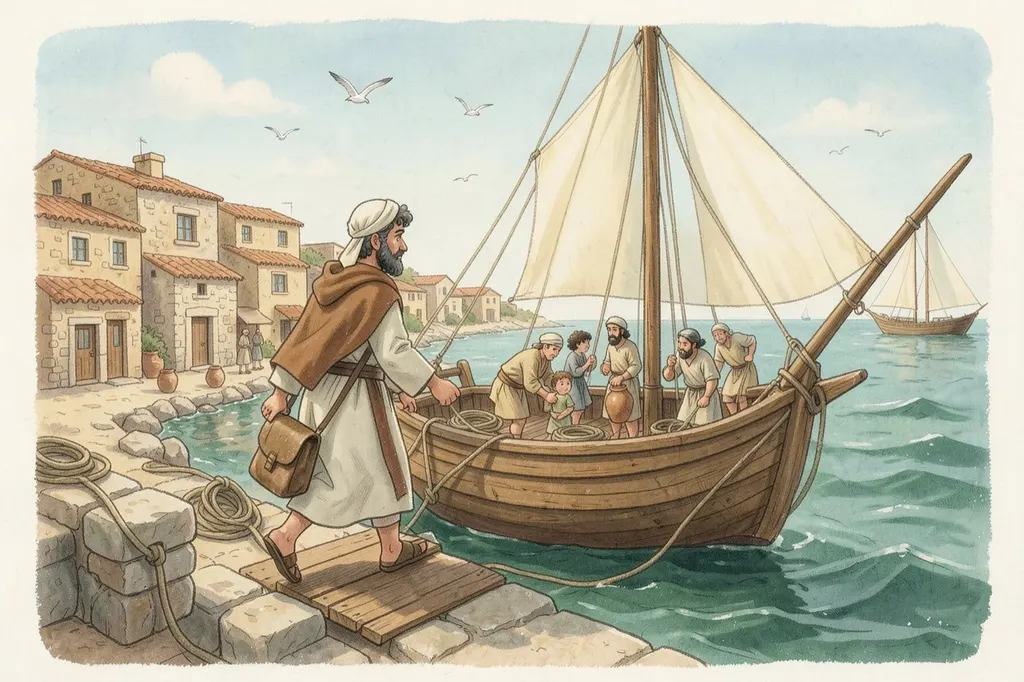
Long ago, there lived a man named Jonah. Jonah was a prophet, someone who brings God's message to other people.
One day, the word of the Lord came to Jonah:
“Arise, go to Nineveh, that great city, and cry against it; for their wickedness is come up before me.”
Wickedness means doing wrong. God had seen the wrong that the people of Nineveh were doing.
But Jonah did not go. He ran the other way, down to the sea at Joppa. There he found a ship, sailing far away to Tarshish.
Jonah paid his fare and went down into the ship. He was running away from the presence of the Lord, trying to get away from God.
Scene 2 of 6
The great storm
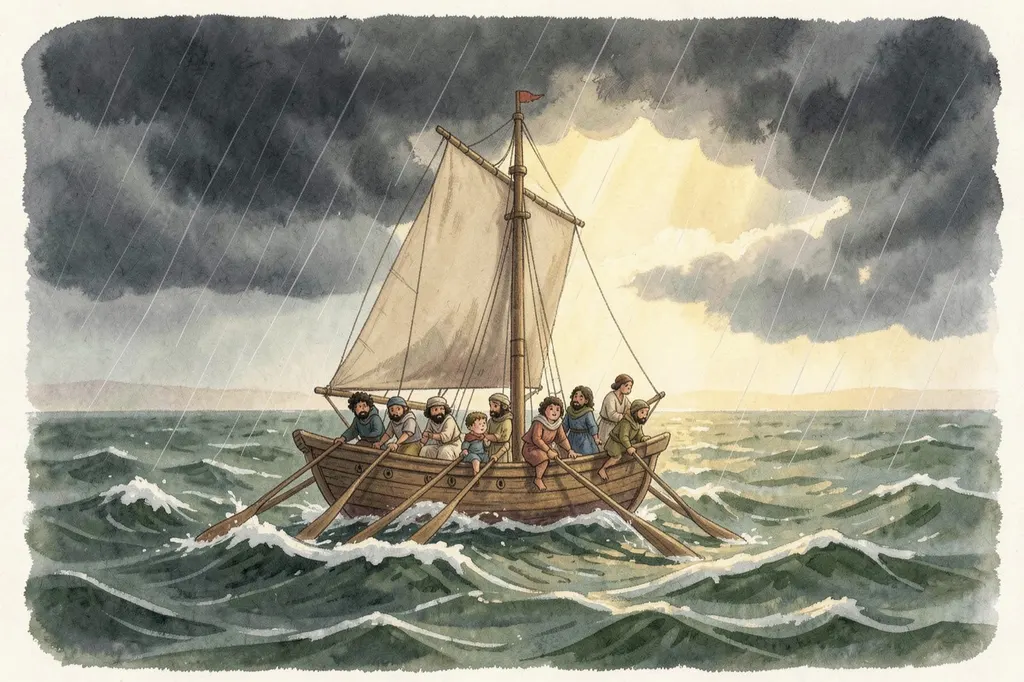
But the Lord sent a great storm. The ship was about to break apart.
The sailors were afraid, and each cried out to his own god. They threw the cargo overboard.
And Jonah? He was down inside the ship, fast asleep. The captain woke him, and told him to call on his God.
The sailors cast lots, a bit like drawing straws, to find whose fault this was. The lot fell on Jonah.
Jonah told them he worshipped the Lord, who made the sea and the dry land. And he said he was running away from God.
The sea grew wilder. Jonah told them to throw him into the sea, and then it would be calm.
The sailors rowed hard for land, but they could not. So they prayed to the Lord. Then they threw Jonah into the sea. And the sea was calm.
But God was taking care of Jonah.
“Now the LORD had prepared a great fish to swallow up Jonah. And Jonah was in the belly of the fish three days and three nights.”
Scene 3 of 6
Inside the great fish
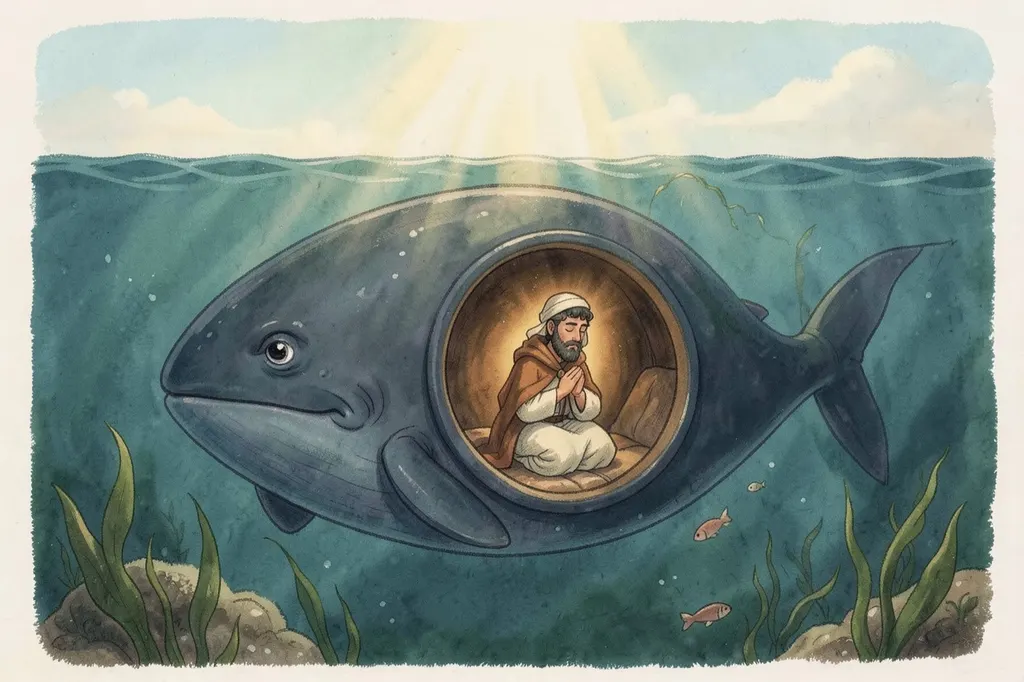
Inside the great fish, Jonah prayed to the Lord his God.
He told God how he had gone down, down, into the deep sea. The waves had gone over him. Seaweed had wrapped around his head.
But Jonah remembered the Lord, and called to him. And God heard him.
Jonah thanked God, and said:
“Salvation is of the LORD.”
Salvation means being saved. Jonah knew that it was God who had saved him.
Then the Lord spoke to the fish.
And the fish spat Jonah out, right onto the dry land.
Scene 4 of 6
A second time
Then the word of the Lord came to Jonah a second time:
“Arise, go unto Nineveh, that great city, and preach unto it the preaching that I bid thee.”
And this time, Jonah went.
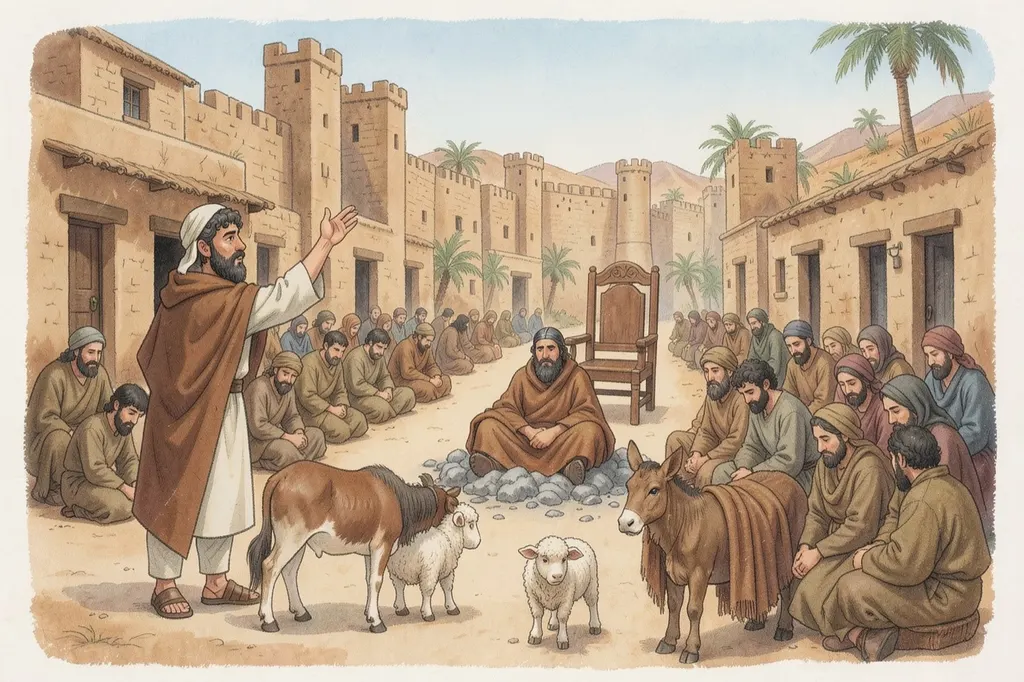
Nineveh was so big, it took three days to walk through it. Jonah walked in for a whole day, and called out God's message: in forty days, Nineveh would be overthrown. Overthrown means knocked down.
And the people of Nineveh believed God. Everyone, from the greatest to the least, stopped eating and put on sackcloth. Sackcloth is rough cloth that people wore when they were very sorry.
Even the king left his throne, put on sackcloth, and sat in the ashes. He told everyone, people and animals too, to eat and drink nothing. They must call out to God, and turn from their wrong and cruel ways.
God saw that they turned from their evil way. And God did not destroy the city.
Scene 5 of 6
Jonah is angry
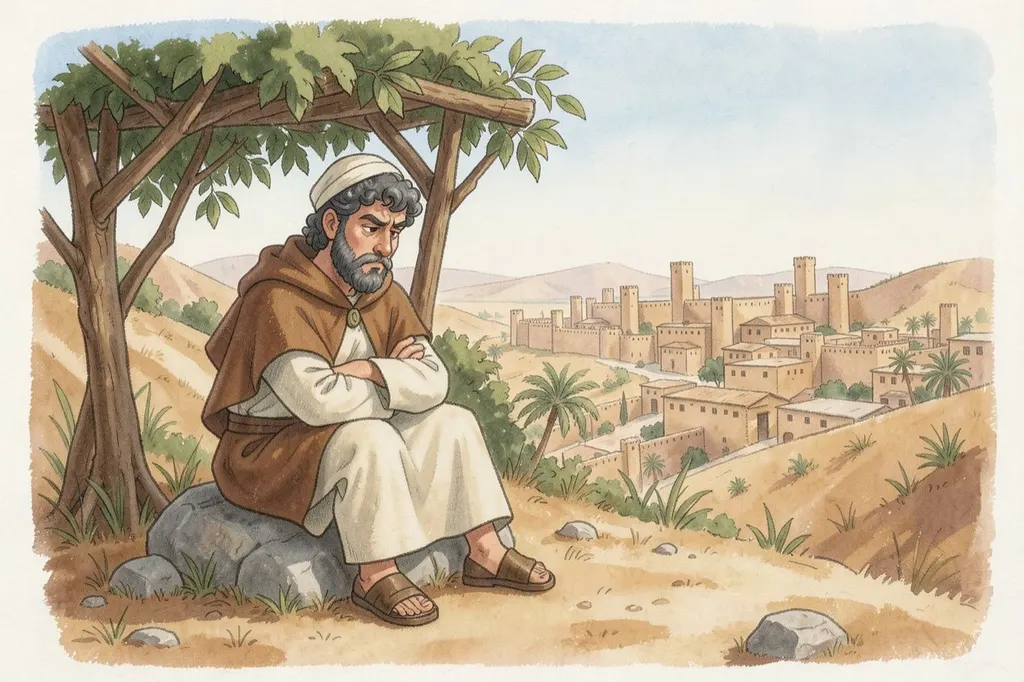
But Jonah was very angry.
He prayed, and told God that this was why he had run away to Tarshish. He had known it all along:
“for I knew that thou art a gracious God, and merciful, slow to anger, and of great kindness”
Gracious and merciful mean kind and forgiving, even to people who have done wrong.
Jonah was so upset that he told God he would rather die. And the Lord asked Jonah:
“Doest thou well to be angry?”
That means: is it right for you to be so angry?
Then Jonah went out to the east side of the city. He made himself a booth, a little shelter, and sat in its shade, to see what would happen.
Scene 6 of 6
The gourd
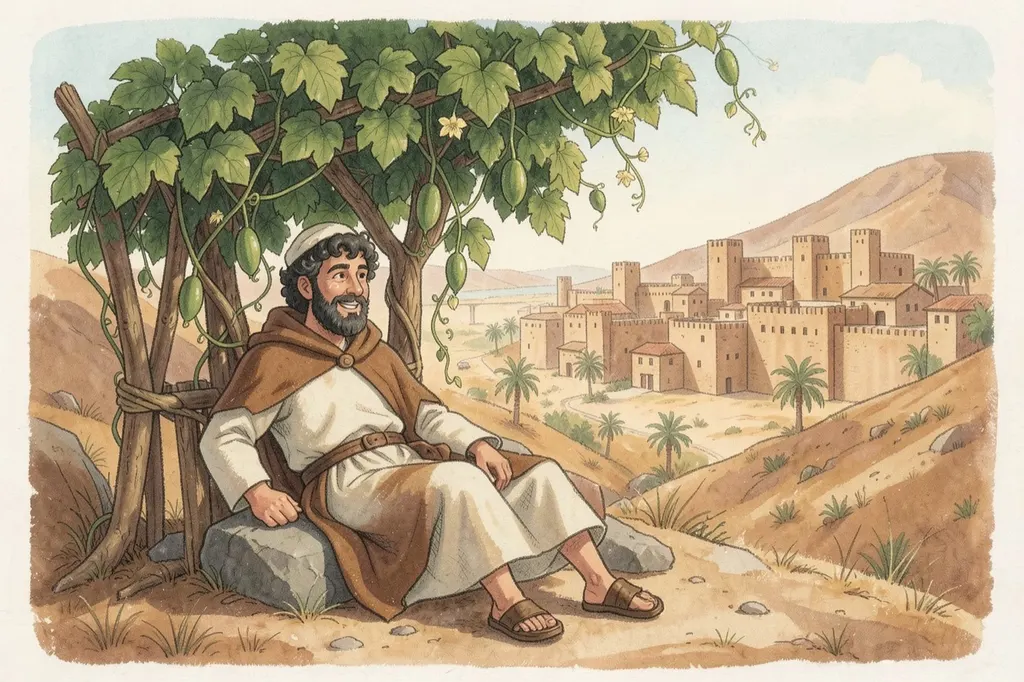
Then the Lord God made a plant grow up over Jonah, to shade his head. The Bible calls it a gourd. And Jonah was very glad of it.
But early the next morning, God sent a worm, and the gourd dried up.
When the sun came up, God sent a burning hot blast from the east. The sun beat down on Jonah's head, until he felt faint. And Jonah was angry about his plant.
Then the Lord spoke to Jonah. Jonah felt sorry for the gourd, God said, though he had not made it grow. It came up in a night, and it was gone in a night.
And God said:
“And should not I spare Nineveh, that great city, wherein are more than sixscore thousand persons that cannot discern between their right hand and their left hand; and also much cattle?”
Sixscore thousand is a hundred and twenty thousand people. Much cattle means lots of animals.
And that is where the book of Jonah ends, with God's question.
Do you remember what God called Nineveh? Nineveh, that great city.
Can you say it too? Nineveh, that great city.
Jonah ran away, and God called him a second time.
The people of Nineveh were sorry, and God spared them.
A gracious God, and merciful, slow to anger, and of great kindness.
How to tell Jonah and the whale to a young child
Keep God at the centre, not the fish. God sent the storm, prepared the great fish (Jonah 1:17) and sent Jonah a second time (Jonah 3:1-2). Then tell chapter 4, which many retellings skip: Jonah is angry that God spared Nineveh, and the book ends on God's question about a city full of people "and also much cattle" (Jonah 4:11). Let your child wonder about it.
What this story shows about God
For grown-ups. The story itself never states a lesson, so here it is, with the verses behind it.
God gives second chances
After Jonah ran away, the word of the Lord came to him a second time, with the same city and the same call.
Jonah 3:1-2God is gracious and merciful
When the people of Nineveh turned from their evil way, God spared the city. Jonah himself said it: God is gracious, and merciful, slow to anger, and of great kindness.
Jonah 3:10; Jonah 4:2God cares for whole cities, and their animals too
The book of Jonah ends with God's question: should he not spare Nineveh, with its sixscore thousand people, and also much cattle?
Jonah 4:11Questions to ask after
Pick the ones that fit your child. There are no wrong answers.
Ages 3 to 5
- What swallowed Jonah?
- Where did God tell Jonah to go?
- How do you think Jonah felt inside the great fish?
Ages 6 to 9
- Jonah ran the other way when God asked him to go. Why do you think he ran?
- God gave Jonah a second chance. When have you been given a second chance?
- Jonah was sad about his plant, but angry that God was kind to Nineveh. Why do you think he felt that way?
Ages 10 to 12
- Jonah was glad when God saved him, but angry when God saved Nineveh. What does that tell you about Jonah?
- The book of Jonah ends with God's question, and we never hear Jonah's answer. Why do you think it ends that way?
- God cared about the people of Nineveh, and even their animals. Who are the people you find it hard to want good things for?
If your child asks
Honest answers to the hard questions, with the verses behind them.
Was it a whale or a big fish that swallowed Jonah?
The book of Jonah says "a great fish" (Jonah 1:17). When Jesus spoke about Jonah, the King James Version of Matthew 12:40 says "the whale's belly", which is why so many people call it Jonah and the whale. The Greek word there means a huge sea creature. The Bible doesn't say what kind of fish it was.
Jonah 1:17; Matthew 12:40
How could Jonah stay alive inside a fish for three days?
The Bible doesn't explain how. In the Jonah and the whale story, Jonah 1:17 says the Lord "had prepared a great fish to swallow up Jonah", and Jonah 2:10 says the Lord spoke to the fish and it put Jonah out on dry land. It was something only God could do. Jesus called it "the sign of the prophet Jonas": as Jonah was three days and three nights in the fish, Jesus would be three days and three nights in the heart of the earth (Matthew 12:39-40).
Jonah 1:17; Jonah 2:10; Matthew 12:39-40
Why did Jonah run away from God?
In the Jonah story, Jonah tells us himself. He ran to Tarshish because he knew God is "a gracious God, and merciful, slow to anger, and of great kindness" (Jonah 4:2), and he had said so back home: God would spare Nineveh. When God did, Jonah was very angry (Jonah 4:1). The book gives no other reason. Nineveh was a great city of Assyria, the nation that later carried Jonah's people, Israel, away (2 Kings 17:6).
Jonah 4:1-2; 2 Kings 17:6
Why did the sailors throw Jonah into the sea?
In Jonah and the whale, it was Jonah's own idea. He told the sailors, "Take me up, and cast me forth into the sea; so shall the sea be calm unto you" (Jonah 1:12). The sailors rowed hard for land instead, and prayed to the Lord before they did it (Jonah 1:13-14). The sea grew calm, and the great fish God had prepared was ready for Jonah (Jonah 1:15-17).
Jonah 1:12-17
Why did Jonah say he wanted to die?
In the Jonah story, Jonah was so angry that God spared Nineveh that he asked God to take his life (Jonah 4:3), and he said it again when his gourd dried up (Jonah 4:8). God didn't leave him. He asked, "Doest thou well to be angry?" (Jonah 4:4) and kept talking with him. With a young child you could say: Jonah was very, very upset, and God stayed with him.
Jonah 4:3-4; Jonah 4:8-9
What we added and left out
Every quoted line in this story is the King James Bible, word for word.
What we added
- Plain explanations of old words, in the next breath: prophet, wickedness, the presence of the Lord, casting lots, salvation, overthrown, sackcloth, gracious and merciful, booth, gourd, sixscore thousand, much cattle.
- We call Jonah a prophet. The book of Jonah doesn't use the word, but 2 Kings 14:25 calls him "Jonah, the son of Amittai, the prophet".
- We say the great storm. The King James says the Lord "sent out a great wind into the sea, and there was a mighty tempest" (Jonah 1:4).
- We say Jonah told the sailors he worshipped the Lord, as the Berean Standard Bible does. The King James says "I fear the LORD" (Jonah 1:9), and a child can hear fear as being scared.
- We say the fish spat Jonah out. The King James says it "vomited out Jonah upon the dry land" (Jonah 2:10).
- We say God sent a burning hot blast from the east. The King James says "a vehement east wind" (Jonah 4:8).
- We say Nineveh took three days to walk through. The King James says "an exceeding great city of three days' journey" (Jonah 3:3), which may mean the time to cross it or the time to visit all of it.
- "But God was taking care of Jonah" is our sentence, leading into Jonah 1:17, which says the Lord "had prepared a great fish".
- The "listen for it" frame and the questions from the narrator to your child. "Nineveh, that great city" is God's own name for it, three times: Jonah 1:2, 3:2 and 4:11.
What we left out
- The sailors' questions to Jonah about his work and his country, his answer "I am an Hebrew", their fear and "Why hast thou done this?", and their question about what to do with him (Jonah 1:8-11). Also their sacrifice and vows to the Lord once the sea was calm (Jonah 1:16).
- Most of Jonah's prayer from inside the fish (Jonah 2:2-8), shortened to a few of its own pictures: the deep, the waves, the weeds wrapped about his head.
- The king's nobles joining in his decree, and the hope "Who can tell if God will turn and repent" (Jonah 3:7-9).
- That God "repented of the evil" he had said he would do (Jonah 3:10), and the end of Jonah's words in Jonah 4:2, "and repentest thee of the evil". We say God did not destroy the city.
- Jonah saying a second time that he would rather die, when the gourd dried up (Jonah 4:8), and God's question about the gourd with Jonah's answer, "I do well to be angry, even unto death" (Jonah 4:9). See "If your child asks" above.
- Jesus' words about Jonah and Nineveh (Matthew 12:39-41), which are in "If your child asks" above.
Not in the Bible, so not in our story
The book of Jonah never says a whale swallowed Jonah. It says "a great fish" (Jonah 1:17). The word whale is in the King James Version of Matthew 12:40, where Jesus says Jonas was three days and three nights "in the whale's belly", which is why so many people, and our title, say whale; the Greek word there means a huge sea creature. The Bible doesn't say what kind of fish it was, what it was like inside, or what the gourd looked like.
Words from the story
Old Bible words your child might ask about.
- Prophet
- Someone God gives a message to, to tell to other people.
- Nineveh
- A very big city in Assyria, far to the east of Jonah's home in Israel.
- Tarshish
- A faraway place across the sea, where Jonah's ship was going.
- Presence of the Lord
- Being near God. Jonah was trying to get away from God.
- Tempest
- A great storm.
- Cast lots
- To choose by chance, a bit like drawing straws.
- Salvation
- Being saved, rescued from danger.
- Overthrown
- Knocked down and destroyed.
- Sackcloth
- Rough, scratchy cloth that people wore to show they were very sorry.
- Gracious
- Kind and generous, even when someone doesn't deserve it.
- Merciful
- Kind and forgiving to someone who has done wrong.
- Booth
- A small shelter, often made of branches.
- Gourd
- A big leafy plant that God made grow up over Jonah for shade.
- Sixscore
- Six times twenty. Sixscore thousand is a hundred and twenty thousand.
- Cannot discern between their right hand and their left hand
- Cannot tell their right hand from their left. Some think God means the little children of Nineveh; others think he means people who did not know right from wrong.
- Cattle
- Cows, sheep and other farm animals.
Sources and how we made this story
References
- Jonah 1:1-3: King James Version and Berean Standard Bible
- Jonah 1:4-17: King James Version and Berean Standard Bible
- Jonah 2:1-10: King James Version and Berean Standard Bible
- Jonah 3:1-10: King James Version and Berean Standard Bible
- Jonah 4:1-5: King James Version and Berean Standard Bible
- Jonah 4:6-11: King James Version and Berean Standard Bible
- King James Version (1769 Oxford text), public domain. Berean Standard Bible, public domain since 2023 (berean.bible).
- Background: Jonah on Wikipedia.
How we made this story
- The retelling. Written by Tinykiwi with AI assistance, following how we tell these stories, then checked line by line against the Bible text. Every quoted line is the King James Version, word for word. What we explained, added and left out is listed above.
- The pictures and narration. The illustrations are AI-generated and chosen by hand. The narration is an AI voice recorded ahead of time, and every recording is checked word for word against the text.
- These stories are part of Tinykiwi, an audio Bible App for Kids we are building. For apps you can use today, see our guide to the best Bible story apps for kids.
More Bible stories for kids
- The Story of Esther
- Daniel and the Lions' Den
- The Christmas Story
- The Good Samaritan
- The Palm Sunday Story
Coming soon: Samson, Pentecost, Gideon, The Baptism of Jesus.
Tinykiwi. Coming soon.
The audio Bible app for kids.
Tinykiwi is an audio Bible app for kids that turns Bible learning into family time at bedtime, in the car, or before church.